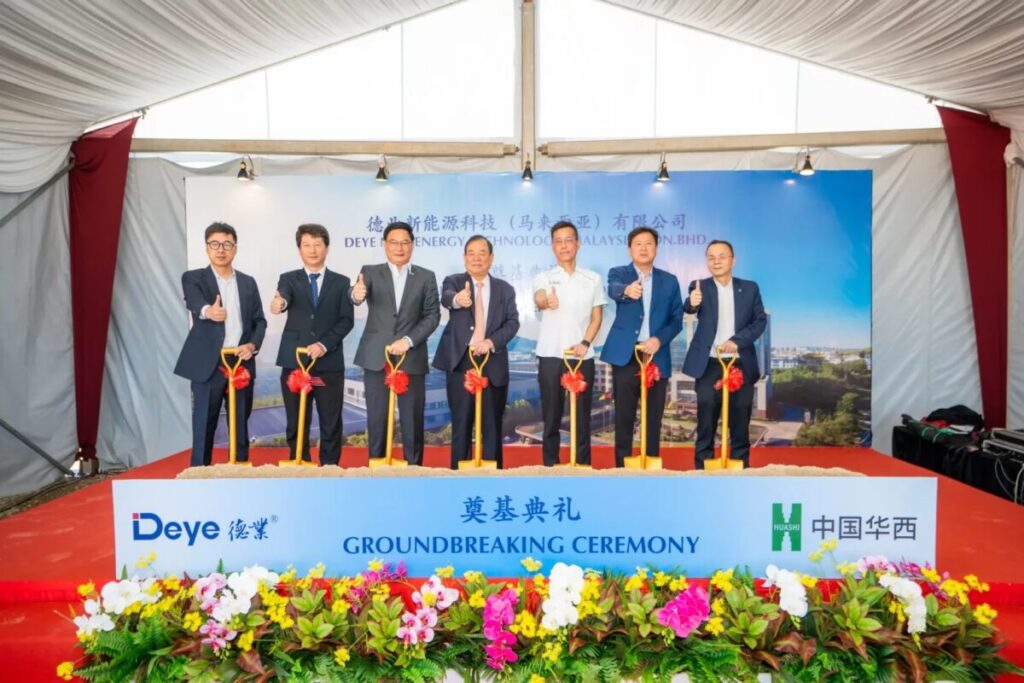
Chinese listed energy storage companies Deye, EVE Energy and Ganfeng Lithium are among those to recently release Q3 2026 financial results, with all three reporting robust growth.
Of the three, Ganfeng Lithium currently lists its main A-Shares on the Shenzhen Stock Exchange (SZSE) and H-Shares on the Hong Kong Stock Exchange (HKEX). EVE Energy also lists its A-Shares on SZSE but is pursuing listing on HKEX, while Deye lists its A-Shares on the Shanghai Stock Exchange (SSE).
Deye
Technology and manufacturing company Ningbo Deye Technology (Deye), which produces battery energy storage systems (BESS), solar inverters, smart energy and electric vehicle (EV) charging and HVAC solutions, released its earnings forecast for the first three quarters of 2026.
The company projects a net profit of RMB 4.22 billion (US$630 million) to RMB 4.32 billion, a year-on-year increase of 79.81%–84.07%. Adjusted net profit excluding non-recurring items is expected to reach RMB 3.95 billion to RMB 4.06 billion, up 73.33%–78.16% from the same period last year.
Try Premium for just $1
- Full premium access for the first month at only $1
- Converts to an annual rate after 30 days unless cancelled
- Cancel anytime during the trial period
Premium Benefits
- Expert industry analysis and interviews
- Digital access to PV Tech Power journal
- Exclusive event discounts
Or get the full Premium subscription right away
Or continue reading this article for free
Deye attributed this profit surge to global efforts to bolster energy security and supportive storage policies, which have fueled sustained demand in overseas markets. In response, the company has actively diversified its use cases and refined its residential and commercial & industrial (C&I) product lines. This strategy has driven a sharp year-on-year rise in sales, boosting overall revenue.
EVE Energy
EVE Energy released its earnings forecast for the first nine months of 2026 last week (15 October). The company expects net profit of RMB 5.068 billion to RMB 5.350 billion, an 80%–90% year-on-year increase. Adjusted net profit excluding non-recurring items is projected at RMB 3.875 billion to RMB 4.262 billion, up 100%–120% from a year earlier.
EVE Energy attributed the strong performance to two factors. First, continued product upgrades, service enhancements and process optimisation helped it capture market growth, driving revenue up by roughly 60% year-on-year.
Second, its emphasis on forward-looking technology has supported a more diversified business portfolio and a global manufacturing footprint. The ramp-up of new capacity and the launch of new products have laid the groundwork for scaled growth and higher profitability.
In September, EVE Energy announced a framework battery supply agreement with North American energy storage system integrator Fluence Energy. The deal covers up to 206GWh of battery supply, roughly 1.7 times EVE Energy’s total power and storage battery shipments in 2025, which stood at 121.2GWh. It also surpasses in scale the previous 200GWh cell framework procurement agreement between HyperStrong and CATL.
Ganfeng Lithium
Lithium metals producer and battery manufacturer Ganfeng Lithium also reported strong results as it released its Q3 2026 financial report on the same day as EVE Energy last week.
According to the announcement, for the first nine months of the year, the company recorded revenue of RMB 36.159 billion, up 147.24% year-on-year. Net profit attributable to shareholders of the parent company reached RMB 5.012 billion, a 19,540.5% increase from a year earlier. Adjusted net profit excluding non-recurring items stood at RMB 4.636 billion, up 592.14% year-on-year.
In Q3 alone, revenue came in at RMB 13.062 billion, up 109.03% year-on-year. Net profit attributable to shareholders of the parent company was RMB 755 million, a 35.62% year-on-year increase. Adjusted net profit excluding non-recurring items for the quarter totalled RMB 788 million, up 2,803.44% year-on-year. The stronger adjusted result indicates a meaningful recovery in profitability from core operations.
Ganfeng Lithium attributed the revenue growth to higher selling prices for lithium products and increased lithium battery shipments during the period. Recovering lithium prices helped expand gross margins, while stronger battery sales reinforced its second growth curve.
As noted during the company’s H1 2026 earnings call, its lithium battery operations were running at near-full capacity in the first half of the year.
The company said it will continue to expand storage battery capacity and upgrade its product lineup in response to market conditions. In Xinyu city, its power and storage cell capacity has reached 40GWh per year, with storage pack system capacity at 18GWh per year.
Its Nanchang facility has added 10GWh per year of new storage battery capacity. Ganfeng’s 588Ah large-format in-house cell line in Nanchang city has entered trial commissioning and pilot production, with formal capacity ramp-up scheduled for Q3 2026. Development of the 648Ah large-format cell line is also being accelerated.