
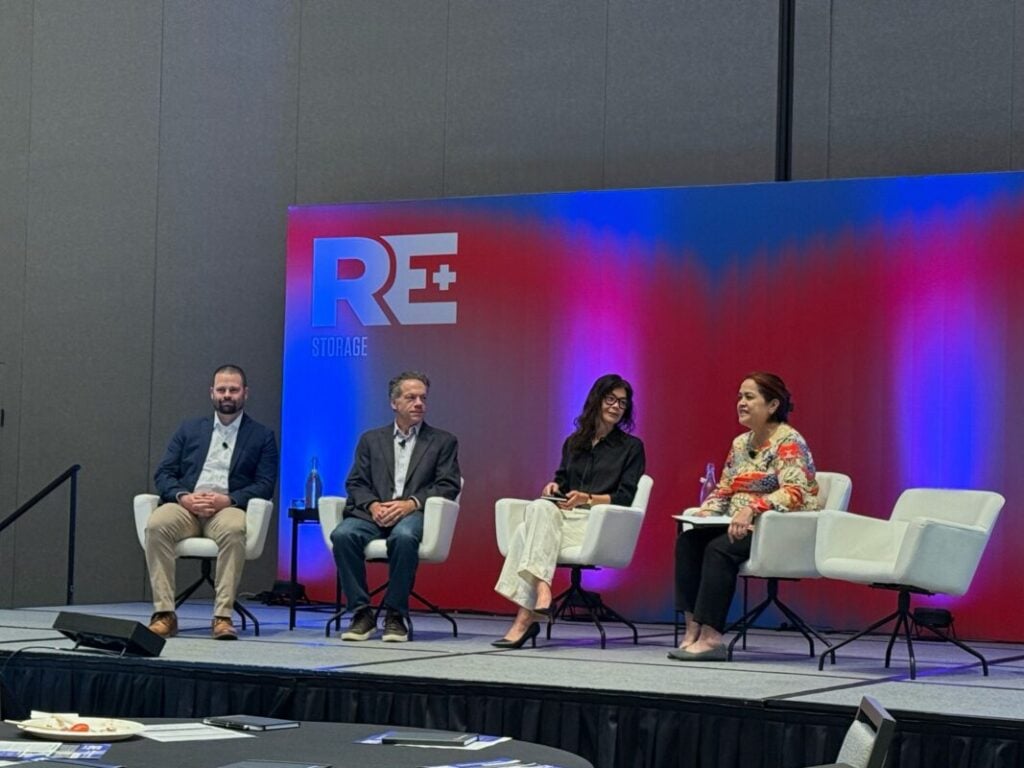
Scott Murtishaw, executive director at the California Energy Storage Alliance, discusses local opposition, safety misconceptions, and why the state’s fleet of containerised BESS projects have proven safe.
The California Energy Storage Alliance (CESA) has played a role in shaping energy storage policy since 2009, predating the emergence of a commercial battery energy storage system (BESS) industry.
Initially focused on establishing regulatory frameworks and procurement obligations in California, CESA’s advocacy led to 2011 legislation that created the state’s first large-scale storage mandate and expanded incentives for residential, commercial, and industrial systems—policy foundations that helped catalyse the global energy storage market.
Murtishaw was previously the policy director at the Independent Energy Producers Association (IEPA). He was named executive director at CESA in October 2023.
Try Premium for just $1
- Full premium access for the first month at only $1
- Converts to an annual rate after 30 days unless cancelled
- Cancel anytime during the trial period
Premium Benefits
- Expert industry analysis and interviews
- Digital access to PV Tech Power journal
- Exclusive event discounts
Or get the full Premium subscription right away
Or continue reading this article for free
Energy-Storage.news: What do you see as the biggest barriers to energy storage adoption in California today?
Scott Murtishaw: The biggest obstacle to energy storage by far in California at this point is local opposition and misunderstandings of the true safety implications of energy storage.
California, as an early adopter, has largely figured out and implemented the big-picture policies that need to be in place for energy storage to serve a meaningful portion of the energy supply portfolio in the electricity sector.
We’ve learnt how to integrate energy storage into our wholesale market. We now model energy storage more accurately for long-term planning. The California Public Utilities Commission’s (CPUC’s) rules and decisions have led to the procurement and growth of energy storage from less than 1,000MW total in the state before 2020 to 21,000MW currently.
In that sense, the energy storage industry is succeeding wildly in California. The growth has been phenomenal. The problem now is that in the wake of two of the largest energy storage fires in the world occurring in California (IPP LS Power’s Gateway facility and Vistra Energy’s Moss Landing facility), there is much more fear of still a relatively new technology, and a lack of understanding that the technology and the way we develop the systems has changed substantially just in the past five to six years.
The long and short of it: safety, safety, safety.
What are the best ways to communicate safety to residents where these projects are being built?
The industry needs to do a better job of communicating to the general public in easy-to-understand terms why energy storage is essential to reliable electric power. With growth in demand being driven in other states by data centres, and in California more by electrification policies and EV adoption, we have to keep pace with that growth in demand.
We need energy storage regardless of policies around renewable energy or clean energy targets. Energy storage is what’s keeping the lights on in California and many other jurisdictions, and playing a larger role in doing so. That helps the public understand that the technology is needed—there’s no question that it’s needed.
The secondary issue we then have to deal with is that you face local opposition where members of the public will declare that they support renewable energy and energy storage broadly—they just don’t want it built near their neighbourhoods and their schools.
After we explain the value of energy storage in integrating renewables and providing reliability, we need to communicate the real safety track record. California, as an early adopter, had two competing models of energy storage development: take dozens or even hundreds of cabinets or racks of energy storage and put those into a building, versus produce a standardised product—something like a shipping container-type product—and then lay several of those containerised energy storage systems in a field spaced apart.
Out of the over 300 front-of-the-meter (FTM) projects that California has, only 11 were built with that indoor building-based design configuration, and that’s where the largest fires have occurred because the systems that were created to detect and minimise the risk of the spread of fires from one cabinet to another didn’t work as those developers thought they would.
On the other hand, among containerised projects—where there are over 1,000 utility-scale projects in the world, virtually all of which use the containerised configuration—I’ve only been able to find four cases in the world across these tens or hundreds of thousands of energy storage containers where fire spread from more than one container to a second container, and none where there has been spread to a third or more containers.
The configuration itself prevents the propagation or spread of those fires. When you’re talking about a fire that consists of one of these containers, it will burn itself out in a few hours. It doesn’t require fire departments to do anything except monitor and ensure that there is no further propagation. They will burn themselves out within a few hours with no meaningful public health or environmental impact.
The modern way of building BESS using containerised products is inherently safe because it prevents propagation of fires beyond a relatively small amount of the energy storage facility.
How do you combat misinformation, particularly when it comes from influential sources?
CESA has been working with several of our members and American Clean Power (ACP) as a partner to conduct polling, do message testing, and design better materials that can explain to the public and to representatives what we know about the incidents that have occurred to date.
We want to help them better understand the advances in the technology and project design, and show them all of the information we’ve gathered from the incidents in California and elsewhere about the air quality measurements that were taken in real time, and the soil and water impacts.
We need to get that in front of people before the misinformation overwhelms us. We need to do a better job of being proactive, developing easy-to-understand materials, and we’re learning that we need to work with partners to help us amplify that message.
In the past year, we’ve seen organisations like the Sierra Club, labour unions, and some other non-profits like Greenlight America helping us to dispel misinformation and combat disinformation. I think we’re beginning to see impacts in California. It’s an uphill battle at this point.
As one example, I was communicating with supervisors from Solano County here in California, and there were supervisors making public comments that agricultural fields within miles of Moss Landing were so contaminated that they couldn’t produce food anymore.
I then walked those supervisors through two studies—one by the University of California and one by the Santa Cruz Department of Public Health—that were available on Monterey County’s website. They showed that beyond a very thin level of surface contamination, the agricultural soils were not affected at all.
In other words, there was no difference between the soils below a very small surface layer in terms of the trace amounts of lithium or cobalt or other metals of concern, and those fields are perfectly productive and operational today.
But for some reason, those supervisors had been led to believe that they were so contaminated they couldn’t be used, and that was not the case at all.
Can you speak to the importance of co-locating storage with solar generation?
Ten years ago, the state agencies and the California Independent System Operator (CAISO) were very alarmed about the reliance on the ability of gas-fired power plants to ramp up very quickly.
They were showing these graphs of what came to be known across the world as the duck curve—how did other types of power plants, mostly fossil-fired power plants, have to respond to the influx of solar, and then the relatively sudden departure of solar energy from the grid in the evening hours?
Covering that gap from a lot of solar being exported into the electrical grid and then the disappearance of that solar around sunset was a major operational concern for the system operator.
If you look at those graphs today, storage has almost obliterated the duck curve. It is not a problem because solar has this twofold advantage: unlike building additional gas-fired power plants, storage absorbs all of that solar energy during the day so that it’s not a problem to be managed and a power source that has to be curtailed—it’s stored and then it’s used in those evening peaks.
One way that we know storage is providing that reliability benefit is that in 2020, we had two brief rolling blackouts in the summer. We went from less than 1,000MW to over 3,500MW of storage by 2022, but we had a very prolonged heatwave in 2022—no blackouts, but 11 calls for consumers to conserve through what’s called the Flex Alert programme. There were multiple instances where the state asked people to turn down their energy usage to prevent blackouts.
Since 2022, we’ve gone from about 4,000MW to 21,000MW of storage. There hasn’t been a single one of these Flex Alerts. You couldn’t have a clearer demonstration of the reliability benefits of storage.
Scott Murtishaw will be speaking on revenue and growth across ERCOT and CAISO as well as several other topics at the 2026 Battery Asset Management and Solar & Storage Finance Summits in Garden Grove, California.
Battery Asset Management Summit USA 2026 will be held 15-16 September in Garden Grove, California, hosted by Energy-Storage.news publisher Solar Media (part of the Informa Group). The agenda emphasises addressing the roles of AI, cybersecurity, and second-life applications, broken down into two tracks: Technical Asset Management and Commercial Asset Management. This year, the conference is also co-located with Solar & Storage Finance Summit USA.
Energy-Storage.news readers can grab a 20% discount on their tickets with the code: ESN20 at checkout. Visit the official site for more details.
This article has been updated to accurately reflect the date Scott Murtishaw was named executive director at CESA.
