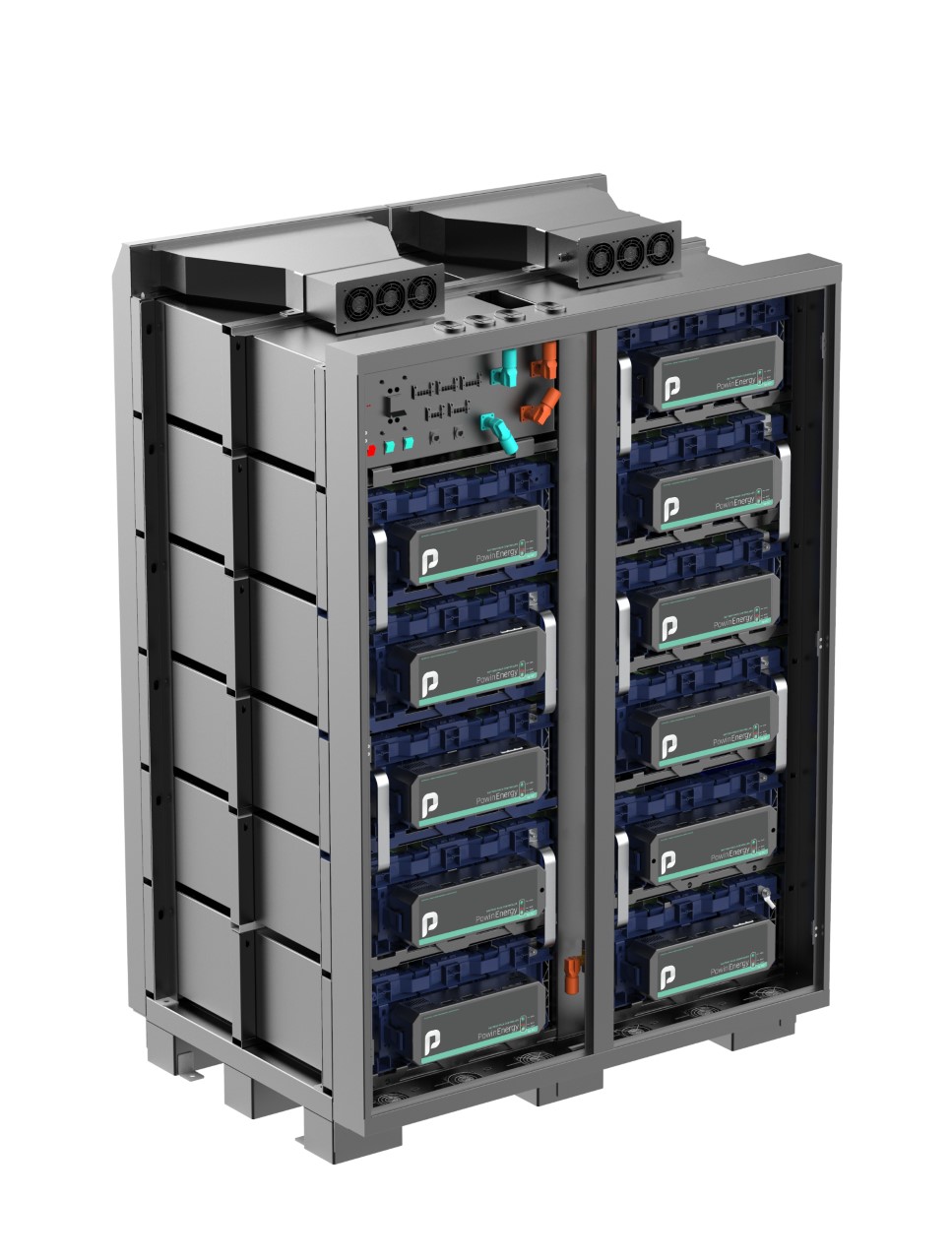
Oregon, USA-headquartered Powin Energy has launched a set of three battery storage system products using CATL’s large form factor lithium-ion cells, including a system solution capable of 4+ hour duration and backed by a 20-year warranty.
The new products, branded Stack 225, Stack 230 and Stack 230P are system manufacturer Powin’s first to utilise Contemporary Amperex Technology Limited – to give China-headquartered CATL its full monicker – battery cells combined with Powin’s battery management and controls software, StackOS.
Powin said in a release that the three products perform a wide variety of applications for the main industry segments of front-of-meter, behind-the-meter and micro- or off-grid energy storage:
- Stack 225 – comes with a 10-year, one full cycle per day warranty and is suitable for 2-hour duration energy storage applications
- Stack230 – comes with a 20-year, one full cycle per day warranty, and has been “specifically designed for solar PV-plus-storage applications which typically require 3+ hour system durations,” and the longer warranty period brings the expected battery system lifetime into closer alignment with the solar module’s “typical life cycles”.
- Stack 230P – is designed for short duration, higher power applications such as frequency regulation and other grid-balancing ancillary services
Powin Energy supplies complete energy storage systems to utility-scale developers including US leaders such as Key Capture Energy, and has also in the past couple of years begun delivering projects for customers in other regions including Europe and Australia.
Try Premium for just $1
- Full premium access for the first month at only $1
- Converts to an annual rate after 30 days unless cancelled
- Cancel anytime during the trial period
Premium Benefits
- Expert industry analysis and interviews
- Digital access to PV Tech Power journal
- Exclusive event discounts
Or get the full Premium subscription right away
Or continue reading this article for free
The company has a 1.85GW master supply agreement in place with CATL, spanning 2019 to 2022, which Powin Energy VP Danny Lu told Energy-Storage.news helps lock in pricing and available capacity, as well as offering a strong level of quality assurance.
“They’ve done a lot of work to hone in the technical R&D of the battery chemistry to allow a warranty for 20 years which we’ve seen so far, it’s the first of its kind in the industry,” Danny Lu said.
CATL is one of the world’s biggest battery cell vendors, delivering 21.31GWh of cells in 2018 alone, and recently becoming one of Tesla’s partners for its manufacturing in China. While CATL delivers to a wide range of customers including the electric mobility sector for the likes of BMW, Daimler Benz and Volkswagen, it is also one of the few large vendors in the world to manufacture large volumes of lithium iron phosphate (LFP) battery cells, which Lu said was also part of the reasoning behind the Chinese company’s selection as supplier.
“For a variety of reasons, LFP has been trending upwards over the past couple of years. I think, the original reasoning on why we selected LFP instead of NMC was really because of the safety characteristics and properties of LFP,” Danny Lu said.
The Powin Energy VP added that “nickel manganese cobalt (NMC) and the [other] cobalt chemistries”, commonly used in electric vehicles (EVs), are “not really designed to perform 100% to 0% discharges because when electric vehicles are operating in the field, you typically don’t continuously in one drive go 100% state-of-charge (SOC) to 0%. So I think a lot of those continuous use cases aren’t actually as good a fit for NMC as they are for LFP”.
“I think the 20-year CATL LFP battery is a prime example of the small innovations within even just LFP. I think that this is just the start of building a battery that’s directly designed for the energy storage market and the different use cases of the energy storage market. Even CATL, a lot of the battery cells that we’ve been sold in previous years have all been for electric buses or even big commercial EVs that use LFP, but I think this 280 amp-hour cell they’ve released is the first iteration of a solely designed for energy storage cell.”
Lu confirmed to Energy-Storage.news yesterday that the Stack 230 product can perform use cases with 4+ hours duration, with a 20-year performance guarantee. Powin said it already has contracted orders for over 600MWh for the three new system products for delivery this year and in 2021, having to date already installed or delivered more than 250MWh of battery storage projects.