The upcoming German capacity market must be designed in such a way that enables battery energy storage systems (BESS) to generate revenue, or risk excluding BESS from the mechanism entirely.
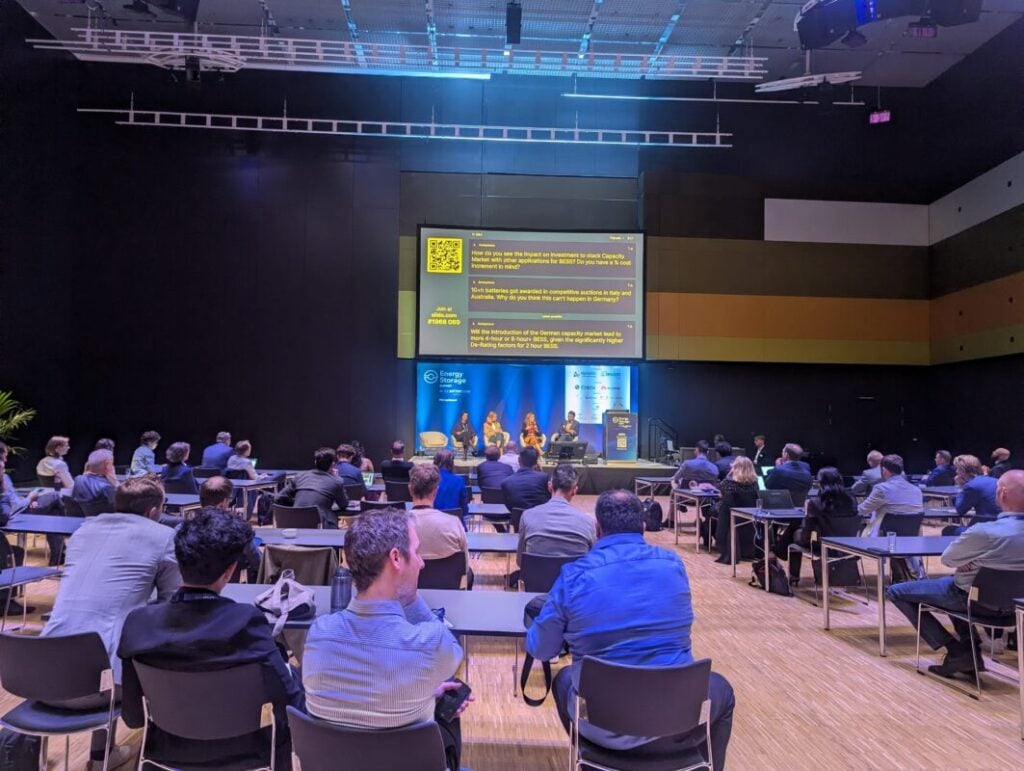
This was an opinion expressed by speakers on a panel held during the first day of the Energy Storage Summit at the Battery Show Europe, hosted by Energy-Storage.news publisher Solar Media and co-located with parent company Informa’s The Battery Show Europe, this week in Stuttgart, Germany.
Elisabeth Giesemann, senior policy associate at Fluence, said that the design of capacity market mechanisms is “critical” to the successful integration of BESS into the programme.
“I think, generally capacity markets can be an opportunity to secure financing,” said Giesemann, referring to the upcoming CM programme for Germany, the details of which have yet to be released. “However, the design of these markets is critical, and we see [in] is the German law, which we saw in a draft… there are a couple of things where we think the design of this is not technology neutral.”
Try Premium for just $1
- Full premium access for the first month at only $1
- Converts to an annual rate after 30 days unless cancelled
- Cancel anytime during the trial period
Premium Benefits
- Expert industry analysis and interviews
- Digital access to PV Tech Power journal
- Exclusive event discounts
Or get the full Premium subscription right away
Or continue reading this article for free
“Capacity markets can tend towards specific technologies because of the complexities of the battery storage systems,” added Sonja Risteska, head of the battery storage Europe platform at SolarPower Europe, who said that technology-neutral auctions can disadvantage BESS in particular.
“For example, one of the issues is the de-rating actor, which we’ve seen in existing capacity markets, [and can] go against the business case for battery storage,” Riteska said.
“Battery storage does struggle to capture the revenues from capacity markets, especially because of how they’re designed. This is not the fault of having a capacity market itself, but [raises questions about] what kind of provisions do you have to have it in it to support battery storage?”
Learning from the example of Poland
The panellists also made frequent reference to Poland as an example of a capacity market programme that has not effectively integrated BESS and its requirements into its design; in December 2025, Poland awarded contracts to just 685MW of batteries, down from 2.5GW in 2024.
“In the Polish market the de-rating factor for batteries was very high, and [there was a] perspective that batteries could, compared to other technologies, earn quite well in this market, which led to a lot of BESS being deployed, and then the polish policymaker went a bit backwards, because they needed a longer capacity supply,” explained Nina Schmüser, regulatory affairs manager at Grenergy, who added that the capacity market could have been designed in a way to facilitate more awards to BESS.
“This law draft could have been designed in a way to give a little bit more security for future investments in such an emerging and fossil free technology, like BESS,” she said. “We are facing this period where we’re removing a lot of reliable sources from our energy market—such as coal in Poland—and we need to replace this somehow.”
Ultimately, the introduction of new financial mechanisms like capacity markets grants an opportunity to design an energy mix that is more digital and modern, according to Giesemann.
“If you want to have a capacity market and security of supply in the future, you should not model it on an energy system of the past,” she explained. “We have new technologies—batteries can play an important role for many reasons in our energy system—so the design should orient itself on what is actually technologically possible, and what can make a digitalised and modernised energy system.”