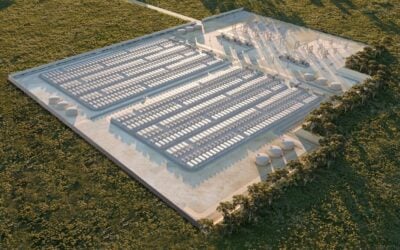
The Canadian Province of Prince Edward Island’s PEI Energy Corporation (PEIEC) has issued a request for expressions of interest (REOI) for a 10-50MW battery energy storage system (BESS).
PEIEC aims to install and operate a BESS capable of integrating into the PEI electric grid. The goal is to deliver capacity and additional services at the lowest possible net cost. Through this REOI, PEIEC seeks to identify a solution for deploying 10 to 50MW, 4-hour duration BESS, potentially across multiple locations, with an option to extend the duration to 8-hour.
After this REOI process, PEIEC says it plans to collaborate with the federal government to obtain funding for the project’s procurement and implementation. The success of PEIEC in securing an effective solution will then depend on the amount of federal funding received.
The REOI was issued on 23 March, the deadline for questions is 14 April, the deadline for addenda is 17 April, and the submission deadline is 23 April at 14:00 Atlantic Time.
Try Premium for just $1
- Full premium access for the first month at only $1
- Converts to an annual rate after 30 days unless cancelled
- Cancel anytime during the trial period
Premium Benefits
- Expert industry analysis and interviews
- Digital access to PV Tech Power journal
- Exclusive event discounts
Or get the full Premium subscription right away
Or continue reading this article for free
According to the REOI, submissions must include a detailed outline of project steps and timelines required to achieve full operational status, providing a clear roadmap from initiation through commissioning.
Second, respondents must clearly demonstrate their capability to develop, design, and build the project as submitted, showcasing relevant experience, technical expertise, and organisational capacity. Third, proposals must clearly demonstrate a social and economic benefit plan that includes an equity, diversity, and inclusion plan or, alternatively, evidence of signing on to a public commitment for equity, diversity, and inclusion.
Fourth, respondents must clearly demonstrate all financial aspects of the project by providing detailed costing of the activities included in the execution and implementation phases, to help ensure transparency and feasibility of the proposed budget.
Fifth, submissions should indicate the expected life of the equipment included in the project, along with related warranty information, to establish long-term value and reliability.
Sixth, respondents must submit the requested BESS information to PEIEC and attach any other relevant supporting documentation that strengthens the proposal. Finally, all submissions must be submitted via the designated platform to be considered for evaluation.
Prince Edward Island and Canada
Even a 10MW project would almost double Prince Edward Island’s current installed BESS capacity. According to the Canada Energy Regulator, PEI has around 11.8MW of BESS in service.
The maritime province, off New Brunswick and Nova Scotia, in the Gulf of St Lawrence on the north-eastern seaboard, is Canada’s smallest province, with a population of around 182,000 as of the beginning of 2026, according to official statistics.
In 2023, the island’s distributed solar PV generation capacity was 39.7MW. PEI ranks second in Canada for per-capita biomass use for space heating, with a total biomass boiler capacity of 23MW across community, light industrial, institutional, commercial, and agricultural sectors.
The city of Summerside does have a planned solar-plus-storage project under development. It pairs 21.6MW of solar with a 10MW/20MWh BESS.
Ontario and Alberta, the main wholesale electricity market regions in Canada, top the country in installed energy storage capacity. Ontario accounts for over two-thirds of the grid-connected storage, while Alberta holds more than a quarter.
In March, Quebec-based IPP Boralex and Six Nations of the Grand River Development Corporation (SNGRDC) have commissioned the 300MW/1,200MWh Hagersville Battery Energy Storage Park in Haldimand County, Ontario. Boralex claimed it as the largest operating BESS in the country.
The Battery Asset Management Summit Canada will be held 23-24 June, in Toronto, Ontario. It features keynote speeches and panel discussions on topics like AI, fire safety, and alternative battery chemstries. ESN Premium subscribers can get an exclusive discount on ticket prices. For complete information, visit the Battery Asset Management Summit Canada website.