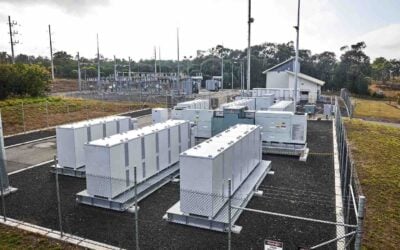
Imperial Irrigation District has already updated a number of substations to accomodate more renewables. Image: IID facebook page.
A community-owned utility company in California is preparing to install a large-scale battery system that could enable the addition of around 50MW of solar generation capacity to the local grid.
On New Year’s Eve, local news outlet The Desert Sun wrote an editorial piece supporting the aims of the project, which has contributed to the utility, Imperial Irrigation District (IID), needing to raise its consumer electricity rates for the first time in 20 years. The project will involve the installation of a 20MW/33MVA batter-based energy storage system with 92kV interconnection. IID serves around 145,000 customers in areas including Imperial Valley and San Diego and the latest plan, approved by the utility’s board in late November, was originally put together in response to a serious blackout three years ago. As a result of that blackout, a settlement was made between IID and the Federal Energy Regulatory Commission (FERC) for the utility to install 33MW of energy storage for supplying uninterrupted power to its customers.
As well as serving as backup, the battery energy storage system (BESS), which will cost around US$68 million in total to install, will smooth imbalances resulting from the addition of variable solar PV resources to the grid. At present, fossil fuels are used to smooth out these imbalances, with units kept on a “spinning reserve”. The US$68 million outlay, which includes US$6 million for contingencies, will be spread across four years from 2014 to 2017, with the project expected to come online during the final quarter of 2016.
Avista receives one of four containerised energy storage units on 30 December. Image: Avista facebook page.
Under the terms of IID’s settlement with FERC, the utility will risk incurring a US$9 million penalty if the project is not completed by the last day of that year. However, the procurement is not related to AB2514, an often-talked about driver for energy storage in California, which has put the state among the world’s leading regions for energy storage deployment. AB2514 is a state-wide mandate for California’s three biggest investor-owned utilities, Southern California Edison, Pacific Gas & Electric and San Diego Gas & Electric to put 1.35GW of storage on the grid by 2020.
Try Premium for just $1
- Full premium access for the first month at only $1
- Converts to an annual rate after 30 days unless cancelled
- Cancel anytime during the trial period
Premium Benefits
- Expert industry analysis and interviews
- Digital access to PV Tech Power journal
- Exclusive event discounts
Or get the full Premium subscription right away
Or continue reading this article for free
According to a report in The Desert Sun, the IID battery will help the grid accommodate power from two large-scale solar projects, one, Midway III, which has 30MW capacity and the other, SunPeak 2, which has a generation capacity of 20MW. IID is now expecting to receive bids from companies interested in building and installing the battery system.
In other recent large-scale energy storage news from the US, another utility, Avista Corporation, has in the past few days taken delivery of some containerised energy storage units which will be used for research into integrating renewable energy sources. On 30 December, four battery storage units were put in place on campus at Schweitzer Engineering Laboratories in Pullman, Washington.
The Avista Energy Storage Project, as it will be known, received a US$3.2 million grant from Washington Governor Jay Inslee and the Washington State Department of Commerce this summer. In a July press release announcing the funding, Avista touted the ability of batteries to respond within 15 milliseconds to signals to ramp up or take down generation capacity, compared to the 10 to 15 minutes typically expected of gas turbines.