Chinese EV giant BYD has launched what an executive claimed is the ‘world’s first high-performance’ sodium-ion BESS product, using its proprietary form factor Long Blade Battery cell.
Posting on business networking site LinkedIn, BYD Energy Storage’s UK and Ireland head Kai Wang announced the launch of the company’s ‘MC Cube-SIB ESS’ product.
He said it uses the company’s Long Blade Battery, has a ‘CTS super integrated design’, and is the world’s first high-performance sodium-ion battery energy storage system (BESS). He claimed it has ultra high energy density, exceptional safety standards and flexible module design.
The BESS has an energy storage capacity of 2.3MWh and a nominal voltage of 1200V, with a voltage range from 800V-1400V.
Try Premium for just $1
- Full premium access for the first month at only $1
- Converts to an annual rate after 30 days unless cancelled
- Cancel anytime during the trial period
Premium Benefits
- Expert industry analysis and interviews
- Digital access to PV Tech Power journal
- Exclusive event discounts
Or get the full Premium subscription right away
Or continue reading this article for free
Energy-Storage.news has asked BYD’s press team for more information and will update this article or follow up in due course.
In response to questions left as comments on his post, Wang said, of the advantages of sodium-ion: “The first advantage is its natural abundance, which theoretically results in lower manufacturing costs compared to lithium-ion batteries. Furthermore, sodium-ion batteries offer a higher charge/discharge rate, a broader operating temperature range, a longer cycle life, and improved safety.”
Natural abundance of sodium and better fire safety features are the two main reasons many are pinning their hopes on sodium-ion as an alternative to lithium-ion, with the latter’s supply chain shocks of 2021 and 2022 and relatively rare but high-profile fire incidents causing major challenges for the energy storage industry to-date.
Most agree that, thanks to its cheaper materials, sodium-ion cells should also be cheaper than lithium-ion once manufacturing scales up.
Sodium-ion cells are however much less energy dense, as illustrated by BYD’s new product only packing 2.3MWh per 20-foot container, much less than the 5MWh and more than is now standard in the lithium-ion BESS space. That is less of an issue in the BESS segment than for EVs, however, though there are EVs in China being sold with sodium-ion batteries too.
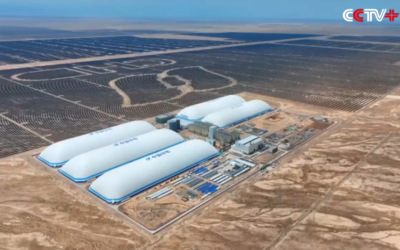
Chinese companies are investing a lot into the sodium-ion technology space, and the world’s largest BESS system using sodium-ion technology is there, a 100MW/200MWh system, half of which came online in summer. One of the technology providers on that project was China-based company called HiNa Battery.
In January, BYD began construction of 30GWh sodium-ion battery plant in Xuzhou City, China. BYD is the largest EV company in the world by sales, and has also expanded into lithium-ion battery cells and BESS production over the years, growing to be one of the largest in that space too.
The US is also making a push into sodium-ion technology. The US Department of Energy (DOE) last week (21 November) awarded US$50 million to establish the ‘Low-cost Earth-abundant Na-ion Storage (LENS) Consortium’, which aims to develop high-energy, long-lasting sodium-ion battery technology.
The consortium will be led by Argonne National Laboratory, and will also involve Brookhaven National Laboratory, Lawrence Berkeley National Laboratory, Pacific Northwest National Laboratory, Sandia National Laboratories and SLAC National Accelerator Laboratory.
US-based sodium-ion BESS startup Peak Energy recently raised US$55 million in a Series A led by TDK Ventures, following which the TDK partner who led the deal spoke to Energy-Storage.news about the sodium-ion BESS space (Premium access article).