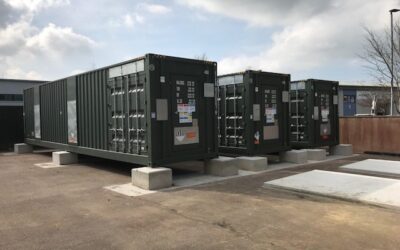
Food wholesaler Philip Dennis Foodservice has installed energy storage units totalling over 4MW at one of its UK offices in an effort to generate revenue from grid services, rather than making savings from behind-the-meter activity.
Virtual Power Plant (VPP) operator Next Kraftwerke and electric vehicle (EV) aggregator and smart charging platform provider Jedlix has launched a trial to test if EV batteries can be used to provide automatic frequency reserve.
Scotland’s first utility-scale battery storage facility has been officially opened today, having begun delivering sub-second balancing services to National Grid at the end of June under a bespoke agreement secured before the hotly contested Enhanced Frequency Response (EFR) auction of 2016.
Leclanché has been selected by a new UK electric vehicle (EV) charging network to support the roll-out of hundreds of EV chargers by limiting their impact on the grid with energy storage units.
Andres Cortes and Ben Kaun of the Electric Power Research Institute discuss some of their recent work looking into the issues of the attributes and operations of co-locating energy storage with renewables
California’s Governor Jerry Brown has passed the state’s 2045 zero-carbon electricity target into law, offering a major boost to the energy storage sector in the process.
Up to 140MW of capacity will be procured under the first ever tender for Ireland’s new frequency response and balancing programme, with projects to go live by September 2021.
Over 370MW of energy storage projects, along with 1.25GW of solar, have been successfully moved into the ‘first batch’ of projects to be processed under a new connections procedure, brought in to tackle the surging levels of smaller projects aiming to connect.
Power outages pose great risks for corporate bottom lines and many have already suffered the economic brunt of unforeseen weather and grid events in 2018. Battery energy storage can be a versatile actor in networks, bringing resiliency as well as energy efficiency and economic benefits, writes Lisa Laughner, CEO of Go Electric.
Energy storage and other flexibility providers with units as small as 1MW will soon be able to access ‘Great Britain’s core flexibility market’ under reforms being proposed by transmission system operator, National Grid.