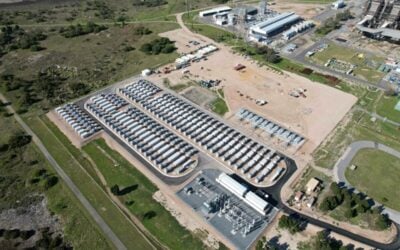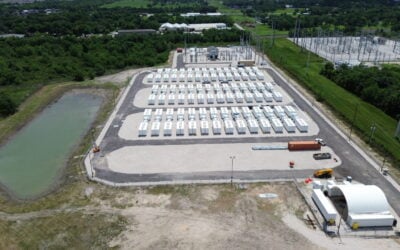
Australian AI-driven energy management company OptiGrid has partnered with Hepburn Energy to optimise a battery energy storage system (BESS) at the 4.1MW Hepburn Wind Project in Victoria.
This marks a major step in preventing exposure to negative power prices at Australia’s first community-owned wind power plant. It first started generating power in 2011.
The Hepburn Wind Project frequently encounters negative power prices due to fluctuations in the wholesale market, which often forces the plant to suspend operations, the companies said.
To mitigate this issue, OptiGrid will deploy its OptiBidder platform to manage the operation of a new 5MWh BESS being integrated at the site.
Try Premium for just $1
- Full premium access for the first month at only $1
- Converts to an annual rate after 30 days unless cancelled
- Cancel anytime during the trial period
Premium Benefits
- Expert industry analysis and interviews
- Digital access to PV Tech Power journal
- Exclusive event discounts
Or get the full Premium subscription right away
Or continue reading this article for free
This platform leverages AI and machine learning to optimise energy market bidding for batteries, as well as related solar PV and wind plants.
OptiGrid’s journey in AI-driven BESS optimisation
Hepburn Energy’s general manager, Taryn Lane, emphasised the importance of selecting OptiGrid’s platform to maximise the value of the co-located BESS.
“We selected OptiGrid because the data clearly shows its strong performance in maximising the value of batteries. The fact that it’s backed by major, well-informed investors gave us extra confidence,” Lane said.
OptiGrid officially entered the market in 2024, emerging from research at the University of Adelaide into advanced AI and optimisation models for energy price forecasting and battery trading.
Since its launch, the company has gained support from prominent investors, including IP Group, the Clean Energy Finance Corporation (CEFC), Hostplus, the University of Adelaide, the University of New South Wales (UNSW), and EnergyLab.
Negative pricing and its impact on BESS operations
Negative pricing has become a significant challenge for renewable energy projects in Australia. Tim Buckley, founder and director of the think tank Climate Energy Finance, awarded the country the title of having “world-leading negative pricing in wholesale markets.”
At the Energy Storage Summit Australia 2025, he noted that negative pricing occurred for 24% and 26% of the previous year in Victoria and South Australia, respectively, approximately four times higher than in European power markets.
Data from the Australian Energy Market Operator (AEMO) revealed that during the fourth quarter of 2024, negative price events occurred in 23.1% of instances across the National Electricity Market (NEM).
Negative pricing typically arises when solar PV generation peaks, creating a surplus of energy during the middle of the day. This forces project owners, like those at the Hepburn Wind Project, to pay consumers to take their energy, often leading to operational shutdowns.
AI and machine learning: Unlocking BESS potential in Australia
Sahand Karimi, CEO of OptiGrid, explained that the rise in variable renewable energy generation and the transition to five-minute markets in the NEM have increased energy price volatility.
This makes it challenging for BESS operators to achieve optimal returns.
The introduction of the Five-Minute Settlement (5MS) in 2021 replaced the 30-minute wholesale electricity spot market settlement period, which had been in place since 1998. This change was described as “massive” for batteries, enabling faster and more precise market responses.
Karimi emphasised the role of AI and machine learning in overcoming these challenges.
“Using AI and machine learning to intelligently manage energy market bidding will make it easier for new batteries to get funding, accelerating the transition to 100% renewable energy,” he said.
Karimi will present a case study on the deployment of the 5MWh BESS at Hepburn at Solar Media’s upcoming Battery Asset Management Summit Australia 2025, which will be held from 26-27 August in Sydney. You can get 20% off your ticket using the code ESN20 at checkout.