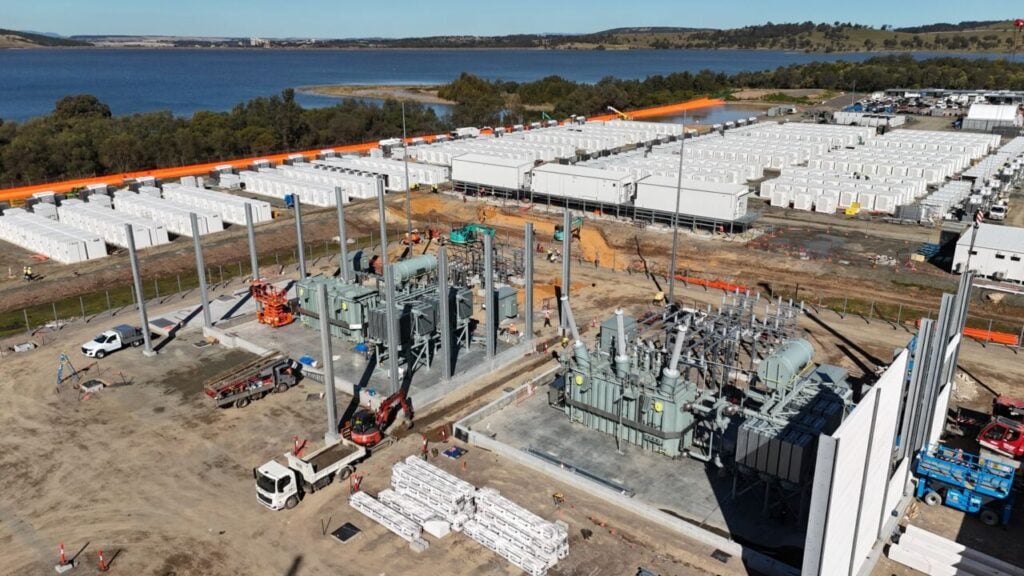
AGL Energy has advanced two separate grid-scale battery storage projects in New South Wales, one now before Australia’s federal environmental regulator and the other still in early planning.
The company has submitted its 350MW/1,450MWh Kangaroo Valley battery energy storage system (BESS) for assessment under the Environment Protection and Biodiversity Conservation (EPBC) Act, self-assessing the project as a “likely controlled action” due to impacts on threatened species habitat and a critically endangered vegetation community near Shoalhaven.
Separately, AGL is in the early stages of investigating a 500MW/4,000MWh, 8-hour-duration battery storage system near Bathurst, which would extend the company’s growing portfolio of flexible storage assets built around its retiring thermal generation sites.
Kangaroo Valley Battery self-assessed as a controlled action
AGL has lodged the Kangaroo Valley BESS to the EPBC Act, proposing a 4-hour duration battery storage system on a 51.76-hectare site approximately 4km west of Kangaroo Valley in the Shoalhaven local government area.
Try Premium for just $1
- Full premium access for the first month at only $1
- Converts to an annual rate after 30 days unless cancelled
- Cancel anytime during the trial period
Premium Benefits
- Expert industry analysis and interviews
- Digital access to PV Tech Power journal
- Exclusive event discounts
Or get the full Premium subscription right away
Or continue reading this article for free
The project would connect via a 1.2km underground 330kV transmission line to Transgrid’s existing Kangaroo Valley Switching Station, with construction expected to take approximately 18 months and the battery designed to operate for up to 20 years.
Unlike many recent battery storage referrals in Australia, AGL has self-assessed the Kangaroo Valley project as a likely controlled action under the EPBC Act, meaning ministerial approval will be required before construction can proceed.
The referral identifies likely significant impacts on five matters of national environmental significance. This includes the critically endangered River-flat eucalypt forest ecological community and habitat for the Gang-gang Cockatoo, Glossy Black-Cockatoo, Grey-headed Flying-fox and Large-eared Pied Bat.
The project’s direct disturbance footprint of 41.11 hectares would clear 14.35 hectares of native vegetation, including 1.42 hectares of the River-flat eucalypt forest community and 0.13 hectares of Illawarra and south coast lowland forest and woodland, both of which are listed as critically endangered.
AGL said the site was selected in part because roughly 56% of the disturbance footprint comprises previously cleared agricultural land, and that the project design was refined iteratively to site infrastructure north of an existing transmission easement, avoiding a larger, higher-value patch of native vegetation to the south that connects to the Kangaroo River.
The referral notes AGL’s extensive prior history with the EPBC process, listing 20 previous referrals for AGL projects, including battery systems at Liddell, Tomago, Beresfield and Awaba, as well as gas and coal infrastructure dating back to 2000.
As reported by Energy-Storage.news, AGL separately submitted its 50MW/100MWh Awaba BESS on the NSW Central Coast for EPBC assessment in June 2026, a project already holding state development consent and designed to connect directly into Ausgrid’s distribution network at Toronto.
However, the volume of projects moving through the EPBC process has drawn scrutiny over implementation speed. The Clean Energy Investor Group published a report in July 2026 calling on the federal government to prioritise faster, more consistent decisions under the reformed Act, representing developers and investors with more than 16GW of installed capacity and a project pipeline exceeding 46GW nationally.
The group found that the National Environmental Standards, an offsets calculator, and a formal definition of “net gain” were still under development as of mid-2026, despite most assessment powers having already been delegated to the newly established National Environmental Protection Agency.
Bathurst Battery to add 8-hour duration storage to AGL’s flexible asset portfolio
Separately, AGL is in the early stages of investigating a grid-scale BESS in Eglinton, approximately 6km northwest of Bathurst town centre.
The Bathurst BESS would connect to an existing 330kV transmission line traversing the site and, at 500MW with 4,000MWh of storage, would provide 8-hours of discharge duration, with 5,400MWh of installed capacity built in to support performance over the asset’s operating life.
AGL’s project documentation describes a construction period of around 24 months, with works expected to begin in late 2028 and operations targeted for 2030, delivering up to 200 jobs during construction.
The project is classified as a State Significant Development under the NSW Environmental Planning and Assessment Act, with AGL currently preparing a scoping report to request the Secretary’s Environmental Assessment Requirements prior to an Environmental Impact Statement.
AGL said it uses lithium iron phosphate (LFP) batteries across its current project pipeline, housed in fire-resistant, custom-designed steel containers with individual thermal management systems, and plans for a 20-year operating life before decommissioning and site rehabilitation.
Bathurst Battery would extend AGL’s storage portfolio, built around repurposing sites tied to its retiring thermal generation fleet. AGL began commissioning its 500MW/1,000MWh Liddell BESS in March 2026, built on the site of the former Liddell coal-fired power station and equipped with grid-forming inverter technology.
Never miss an Australian energy storage story. Sign up for our Australia newsletter and get the latest project announcements, policy updates and market analysis delivered directly to you.