
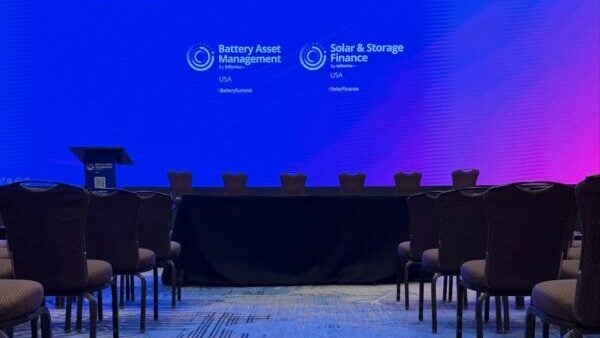
Energy-Storage.news Premium speaks with David Miller, CCO of optimiser Gridmatic, at the 2026 US Battery Asset Management Summit in Garden Grove, California.
Over the past three years, the revenue mix for battery energy storage systems (BESS) in the US has changed, David Miller says, nowhere more so than in the Electric Reliability Council of Texas (ERCOT) and California Independent System Operator (CAISO) markets. It’s no coincidence that ERCOT and CAISO are the country’s two biggest markets for BESS.
“I would say three years ago, the revenue streams across markets in the US, were dominated by ancillary services for batteries, and that has changed pretty significantly both in ERCOT and CAISO, where the energy revenues are the largest, primarily because there’s been enough batteries to provide the ancillary service need, so the prices of ancillary service have saturated from that participation,” he says.
Miller continues, “In ERCOT, you could make pretty good revenue just bidding the same product every hour, every day, and you could even bid it at just zero price and say, ‘I’ll just take whatever the market clears.’ That wasn’t the ideal strategy, but it wasn’t bad. Whereas if you did that today, you’d be one of the worst battery operators in the market.”
Try Premium for just $1
- Full premium access for the first month at only $1
- Converts to an annual rate after 30 days unless cancelled
- Cancel anytime during the trial period
Premium Benefits
- Expert industry analysis and interviews
- Digital access to PV Tech Power journal
- Exclusive event discounts
Or get the full Premium subscription right away
Or continue reading this article for free
Forecast quality is key to maximising returns
The shift towards energy revenues has made bid optimisation significantly more challenging, Miller explains. When ancillary service revenues dominated, operators could employ relatively simple strategies. Now, with energy arbitrage becoming the primary revenue source, accurate price forecasting has become critical.
“Even in California, where we think of battery resources bidding into the duck curve—charge in the middle of the day, discharge in the evening—it is somewhat challenging to predict when the actual peak periods will occur and which hours to use,” Miller says.
He notes that many batteries are discharging too early during evening peaks, particularly in ERCOT, where “the peak ends up moving later, when the battery state of charge (SoC) has been empty.”
Miller emphasises that forecast quality is the most important factor in maximising battery value. “Our view is it really comes down to forecast quality. The optimisation—you can only learn the market rules so well. They are what they are. But forecast error is still extraordinarily high, and it’s a really hard problem to get forecasts right.”
The challenge is particularly acute because batteries can participate in both day-ahead and real-time markets, and predicting the differences between these markets is “a very, very challenging problem,” he adds.
AI offers significant advantages for forecasting
Gridmatic has been using fully AI-based models for wholesale battery operations since 2023, and Miller is a strong advocate for the technology’s benefits in forecasting.
“We’re big believers in the benefits of AI for forecasting,” he says, contrasting AI approaches with traditional power flow forecasts that simulate grid conditions. “Those models are just so sensitive that if you get any little thing off, they can really get funky results. Whereas an AI-based model can correct itself.”
AI-based approaches also excel at producing probability distributions rather than single-point forecasts, allowing operators to better quantify risk, Miller explains.
However, he cautions against over-reliance on AI without proper controls. “They’re often extremely helpful, and then sometimes they get things really wrong. If you’re going to use an AI-based approach, you need to have the right checks in place, the right alerting, the right risk management frameworks to understand and continue to monitor how that forecaster works.”
Miller notes that whilst Gridmatic’s tools are not based on large language models, there is an analogy, “The risk is not so much that AI itself is going to be a problem for modelling, but more that the misapplication of AI could lead to problems.”
Cybersecurity and automation present evolving challenges
On the cybersecurity front, Miller explains that market operations require companies like Gridmatic to operate as qualified scheduling entities with secured connections to ISOs, isolated from the outside world.
“That market participant relationship is one of the key cybersecurity requirements that we are obligated to meet,” he says.
The challenge lies in maintaining security standards whilst adding automation to processes. “The original tools were not fit for purpose,” Miller explains. “These systems were originally specified for a few hundred-MW and GW-scale plants. We still have those, but we have more and more distributed resources making up more of the mix.”
With smaller, more numerous facilities that aren’t operated by on-site personnel, “automation becomes a requirement because you just can’t have an individual person at each of the sites to take manual actions.”
Co-location with load represents industry shift
Miller identifies the rise of storage co-located with load—particularly data centres—as an important emerging trend that is adding complexity to battery operations.
“It feels like a shift that’s happening in the industry, where the primary attributes that we’ve been looking at for BESS over the past few years have been wholesale market revenue generation, and that continues to be important, but increasingly we’re seeing things that are more like mandates or reliability requirements that take on a bigger role,” he says.
In ERCOT, for example, large loads are subject to a “kill switch” requiring them to shut off within 30 minutes under the Batch Zero process. Many facilities are installing BESS primarily to manage that risk and deal with issues like voltage ride-through or frequency ride-through.
“You’re installing these large batteries—they may be larger than is needed for that reliability use case. They also can participate in the grid. How do these use cases interact? What are the requirements, the constraints, the priorities across them?” Miller asks.
“It’s a use case we always said batteries could do—provide reliability—but now we’re actually seeing customers for whom that’s the primary use case, which wasn’t as much the case previously, at least in grid-type BESS.”
ESN previously spoke with Miller in July about Gridmatic’s CAISO Storage Report, which examined 30 BESS projects operating in the CAISO market and found notable performance differences stemming primarily from bidding strategies rather than location or equipment factors.
