
Energy-Storage.news Premium speaks with David Miller, CCO of Gridmatic, about the company’s latest report from CAISO.
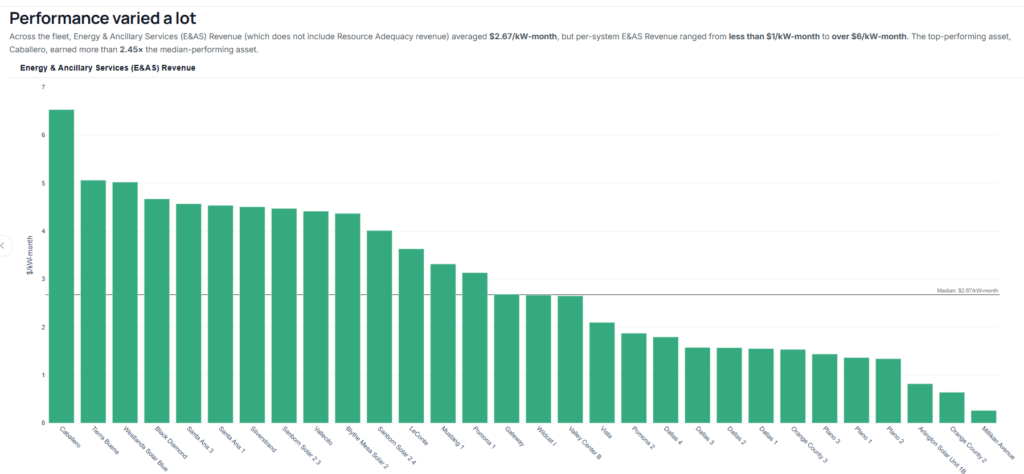
An analysis of California’s grid-scale battery storage market has found significant variations in how battery energy storage systems (BESS) are operated, with underperforming assets collectively missing out on approximately US$98 million in potential revenue.
Released on 24 June, California Independent System Operator (CAISO) Storage Report report from Gridmatic, a California-based company specialising in AI-powered grid forecasting and battery optimisation, examined 30 BESS projects operating in the CAISO market and found notable performance differences that stem primarily from bidding strategies rather than location or equipment factors.
The analysis revealed considerable disparity in revenue generation, with some batteries earning less than US$1-per-kW-per-month while top performers exceeded US$6-per-kW-per-month. The median performance was approximately US$2-per-kW-per-month.
Try Premium for just $1
- Full premium access for the first month at only $1
- Converts to an annual rate after 30 days unless cancelled
- Cancel anytime during the trial period
Premium Benefits
- Expert industry analysis and interviews
- Digital access to PV Tech Power journal
- Exclusive event discounts
Or get the full Premium subscription right away
Or continue reading this article for free
“We thought CAISO, it’s not the same level of volatility (as ERCOT). It has this daily duck curve that batteries can charge and discharge,” explains Miller, who authored the report. “We thought, well, maybe it’s just an easier market for batteries to make money in, and there’s kind of less going on here.”
However, the data showed otherwise.
“The big takeaway was the variation in dollar earned per-kW figures,” Miller says. “It’s just a very dispersed performance.”
Static bidding strategies
The analysis found that many battery operators use static bidding strategies that remain unchanged for extended periods, rather than adapting to market conditions.
“There are a lot of batteries that are doing essentially a ‘set it and forget it’ strategy, where in some of these markets, the battery operator is just saying, ‘Okay, I’m going to bid my battery at this price, at this quantity, every hour of the day for an extended period of time,’” Miller notes.
“Our view is that really leaves a lot of money on the table and shows that the market is probably less sophisticated in terms of its operations than what we had anticipated.”
This approach can be particularly limiting during high-price events. “You might say, ‘I just want to do the duck curve. I want to charge during the day and discharge in the evening,’ and that’s a reasonable strategy. But, the value of that duck curve might be I’m charging at US$0 and discharging at US$50. Well, on a high price day, you’re actually charging at US$100 and discharging at US$500. If you had a static bid curve, you miss all of that.”
Three factors differentiate performance
Gridmatic’s analysis identified three primary strategies that distinguished higher-performing batteries.
The first was static bidding. Many operators maintained the same bid prices and quantities for extended periods, failing to adjust for changing market conditions or high-price events.
Next was limited market participation. Some batteries focused only on day-ahead energy markets, missing opportunities in real-time markets and ancillary services.
Third, similar to limited market participation, but concerning what is being sold rather than when, was single-product focus. Lower performers often concentrated on one revenue stream rather than co-optimising across energy and ancillary service markets.
Location also influenced performance, with batteries in Southern California’s SP zone benefiting from stronger duck curve effects due to higher solar penetration, while batteries in Northern California’s NP zone found more opportunities in ancillary services markets.
Developing the analysis required Gridmatic to work around data limitations in CAISO that don’t exist in other markets like ERCOT.
“CAISO didn’t have the same level of disclosure of information that ERCOT has in terms of what individual resources are doing,” Miller explains.
The team developed a “shadow clearing engine”—a tool that estimates market awards based on publicly available bid data and market clearing prices.
“The shadow clearing engine is essentially running the CAISO market logic for how the batteries get dispatched based on their bids and based on the market clearing prices that were available at that time in the marketplace,” Miller says.
The methodology was validated by cross-referencing results with available Federal Energy Regulatory Commission (FERC) data and comparing predictions against Gridmatic’s own operated asset.
Utility contract structures
The findings are particularly relevant given recent changes in California battery storage contracts. Utilities including PG&E and Southern California Edison, along with Community Choice Aggregators, have increasingly adopted “resource adequacy plus financial settlement” contracts.
Under these arrangements, utilities pay for resource adequacy (RA) capacity and a fixed amount to battery owners, but the owners must provide a financial settlement based on the “top-bottom” (TB) value—the difference between peak and off-peak energy prices.
“The battery owner is on the hook for a variable amount. It’s like a financial swap where the battery owner pays a variable amount, which is the TB value, and the utility pays a fixed amount,” Miller says.
“If (operators) are making 100% of that amount, they’re net neutral. If they’re making more than that, they’re making money on top of their contract with the utility. But, if they’re making less than that, it means this long-term contract with the utility has this obligation where they’re not actually getting all that revenue.”
Gridmatic’s analysis found that its operated battery, the 100MW/400MWh Caballero BESS in San Luis Obispo County, from Fengate Asset Management and Alpha Omega Power (AOP), achieved 141% of its TB value—the highest ratio in the study—while many batteries fell below 100%.
Future analysis
Gridmatic, which has been operating battery storage in CAISO since 2024 and in ERCOT since 2023, is considering expanding the methodology to other markets, though data availability varies by region.
The company previously published similar reports for the ERCOT market in Texas, where greater data transparency simplified the analysis. The successful application of the shadow clearing methodology in CAISO suggests similar analyses may be feasible in other markets with limited resource-level disclosure.
Battery Asset Management Summit USA 2026 will be held 15-16 September in Garden Grove, California, hosted by Energy-Storage.news publisher Solar Media (part of the Informa Group). The agenda emphasises addressing the roles of AI, cybersecurity, and second-life applications, broken down into two tracks: Technical Asset Management and Commercial Asset Management. This year, the conference is also co-located with Solar & Storage Finance Summit USA. Visit the official site for more details.
