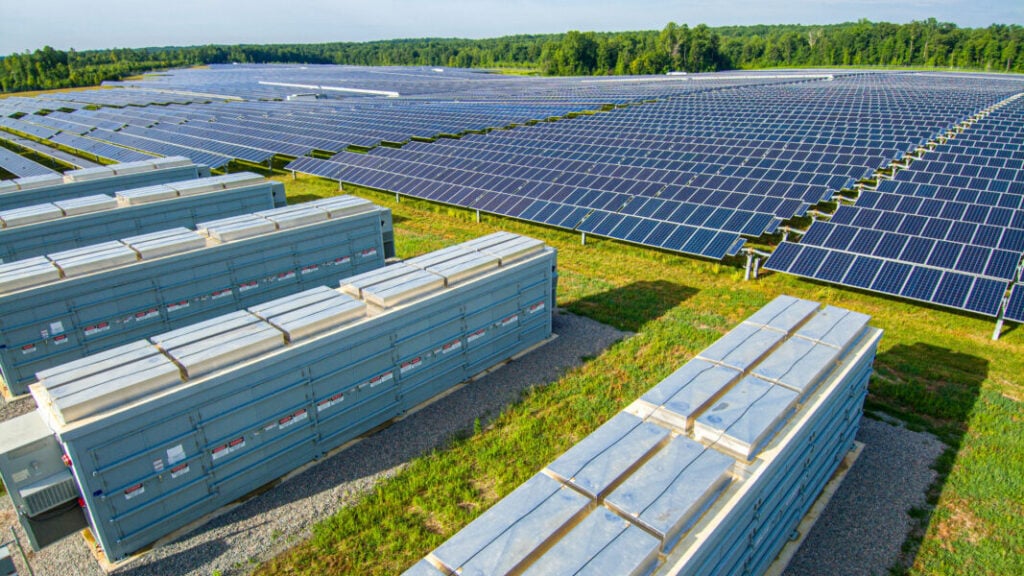
US utility Dominion Energy plans to build 3.5GW of battery energy storage systems (BESS) over the next 20 years, according to its recently filed integrated resource plan (IRP).
On 15 October, Dominion filed a full comprehensive IRP with the North Carolina Utilities Commission (NCUC) and an interim update with the Virginia State Corporation Commission (SCC).
The 2026 IRP addresses three converging pressures: rising and shifting demand, evolving policy, and tightening capacity markets within PJM.
As the utility noted in its IRP, demand in Dominion Energy’s delivery zone continues to grow, with peaks shifting to winter mornings and summer evenings when weather-dependent resources produce less.
Try Premium for just $1
- Full premium access for the first month at only $1
- Converts to an annual rate after 30 days unless cancelled
- Cancel anytime during the trial period
Premium Benefits
- Expert industry analysis and interviews
- Digital access to PV Tech Power journal
- Exclusive event discounts
Or get the full Premium subscription right away
Or continue reading this article for free
Meanwhile, new generation and transmission projects face longer timelines, interconnection constraints, supply-chain pressures, and siting challenges.
The IRP also reflects Virginia’s expanded storage mandate. In February, the Virginia General Assembly passed legislation to promote new energy storage investments by Dominion and Appalachian Power, the state’s primary utilities.
In April, Virginia Governor Abigail Spanberger signed the legislation into law. It requires Dominion to add 16,000MW of short-duration BESS capacity and 3,480MW of long-duration energy storage (LDES) capacity by 2045.
PJM conditions add further pressure. Dominion relies on PJM’s capacity market for resource adequacy, and the 2028/2029 Base Residual Auction cleared at the price cap, with committed capacity over 6,800MW below PJM’s requirement and reserve margin at just 14.4% against a 20% target — the second straight auction to clear short, reflecting load growth, generation retirements, resource delays, and updated ELCC accreditation standards.
The IRP stated, “Notably, the LDES targets do not become effective unless and until the SCC determines such technology is technically viable and that the construction, acquisition, or procurement targets are reasonably achievable.”
Dominion showed that its 2025 capacity resource mix was 39.7% natural gas, with renewables including solar, wind, hyrdo, and biomass at 11.3%, below Nuclear and coal. Renewable purchases were 6.5%, and separately, energy storage was 0.1%.
Dominion has petitioned for SCC approval of new company-owned and power purchase agreement (PPA) resources totalling 712MW of BESS capacity and nearly 5,000MW of solar in its annual Renewable Portfolio Standard (RPS) Development Plan proceeding. The utility currently has over 170MW of approved company-owned BESS projects and has approximately 50MW in operation. 459MW of BESS has also been approved under PPAs.
Dominion received approval from SCC to pilot three non-lithium-ion (Li-ion) projects, two of which are LDES projects. At the Darbytown Power Station in Virginia, two electrochemical systems will be tested, a zinc-hybrid battery from zinc battery storage player Eos Energy and an iron-air battery capable of discharging for up to 100 hours from US startup Form Energy.
Dominion’s preferred plan prioritises solar, wind, and BESS petitioned by 2035 and built by 2039, with remaining capacity selected on a least-cost basis.
For BESS, only the portion not requiring additional commission review (petitioned by 2030) is included upfront, with the rest selected on a least-cost basis — totalling 3.5GW. The plan also builds over 21GW of solar, exceeding Virginia Clean Economy Act (VCEA) requirements, plus three small modular reactor (SMR) sets starting in 2042 and 3.4GW of additional offshore wind.
To “preserve existing generation” and meet future reliability needs, the plan requires invoking the VCEA’s reliability exception and adding 8.9GW of gas-fired capacity.