Envision Energy has signed a 660MWh battery energy storage system (BESS) supply agreement with SOLA Group and construction company WBHO for the Naos-1 project in South Africa’s Free State.
The deal has been described as the largest privately contracted hybrid renewable energy initiative to have reached financial close in the country.
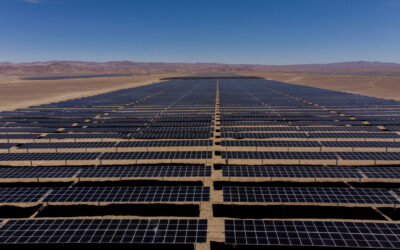
The project, located near Viljoenskroon, combines 300MW of solar PV generation with 660MWh of battery storage to deliver dispatchable renewable energy to corporate electricity customers.
Rather than selling power directly to the national utility at a fixed connection point, Naos-1 is designed for wheeling: electricity generated at the site is transmitted across Eskom’s national grid to multiple offtakers located elsewhere in South Africa, allowing large businesses to source renewable energy without needing to be physically adjacent to the generation site.
Try Premium for just $1
- Full premium access for the first month at only $1
- Converts to an annual rate after 30 days unless cancelled
- Cancel anytime during the trial period
Premium Benefits
- Expert industry analysis and interviews
- Digital access to PV Tech Power journal
- Exclusive event discounts
Or get the full Premium subscription right away
Or continue reading this article for free
Envision will provide design, manufacturing, operation and maintenance support across the project’s lifecycle, with a 25-year Long-Term Service Agreement (LTSA) between Envision and SOLA Group underpinning the operational phase.
The company says its AI-driven energy management system will be integrated with the battery storage hardware to optimise dispatch and performance over the contract period.
John Lee, general manager of Asia and Africa Markets at Envision Energy, said the project illustrates how storage-integrated renewable energy solutions can deliver dispatchability at scale.
“Naos-1 demonstrates how integrated renewable energy and storage solutions can redefine the future energy systems, delivering not only clean power, but also reliability, flexibility, and economic value at scale,” Lee said.
A private market developing alongside public procurement
The Naos-1 deal sits within South Africa’s expanding private power market, which has grown substantially since the government relaxed licensing requirements allowing embedded generation projects to sell electricity directly to commercial and industrial customers without going through Eskom.
The wheeling mechanism Naos-1 uses takes that model further, enabling a utility-scale project in one location to serve offtakers distributed across the national grid under long-term bilateral agreements.
South Africa’s government-led battery storage programme has been running in parallel, with three bid windows of the Battery Energy Storage Independent Power Producer Procurement Programme (BESIPPPP) having procured a combined 1,744MW and 6,976MWh of grid-scale storage to date, as analysis of the government’s 11GWh procurement programme has shown.
Winning projects supply capacity and ancillary services to the National Transmission Company South Africa under 15-year power purchase agreements.
Naos-1 operates entirely outside that framework, illustrating that battery-integrated renewable energy generation is now attracting private capital at scale without government procurement underwriting.
The scale of private sector battery storage projects reaching financial close in South Africa has also grown considerably.
The 153MW/612MWh Red Sands BESS, developed by Globeleq and African Rainbow Energy and selected through the first BESIPPPP bid window, reached financial close in mid-2025 at a project cost of approximately ZAR 5.4 billion, backed by Absa and Standard Bank and with Sungrow as the BESS technology provider.
At 660MWh, the Naos-1 storage component marginally exceeds Red Sands in storage capacity, though the projects differ in structure: Red Sands supplies the transmission system operator under a government-backed PPA, while Naos-1 delivers directly to private corporate customers through a wheeling arrangement.
Envision’s African and global expansion
Envision describes the Naos-1 agreement as a milestone in its expansion into Africa.
The company, headquartered in Shanghai, China, positions itself as a vertically integrated renewable energy technology provider covering wind turbines, battery storage and an AI-driven energy management platform.
Outside Africa, Envision has been exploring a 300MW hybrid wind and BESS project in Nova Scotia, Canada, where the company has been in discussions with the province about a long-term supply arrangement combining offshore-adjacent wind generation with battery storage for grid firming.
The Naos-1 supply agreement extends Envision’s footprint into a market where Chinese manufacturers have been increasingly active across both the government and private procurement channels.
The Red Sands project selected China Energy Engineering Corporation as its EPC contractor, while the BESIPPPP third window saw Chinese manufacturers feature prominently among technology providers for the successful bidders.
SOLA Group is a South African renewable energy developer with a portfolio spanning commercial and industrial, utility-scale and embedded generation projects.
WBHO is one of South Africa’s largest construction and engineering groups, with experience in delivering infrastructure and renewable energy projects across the continent.