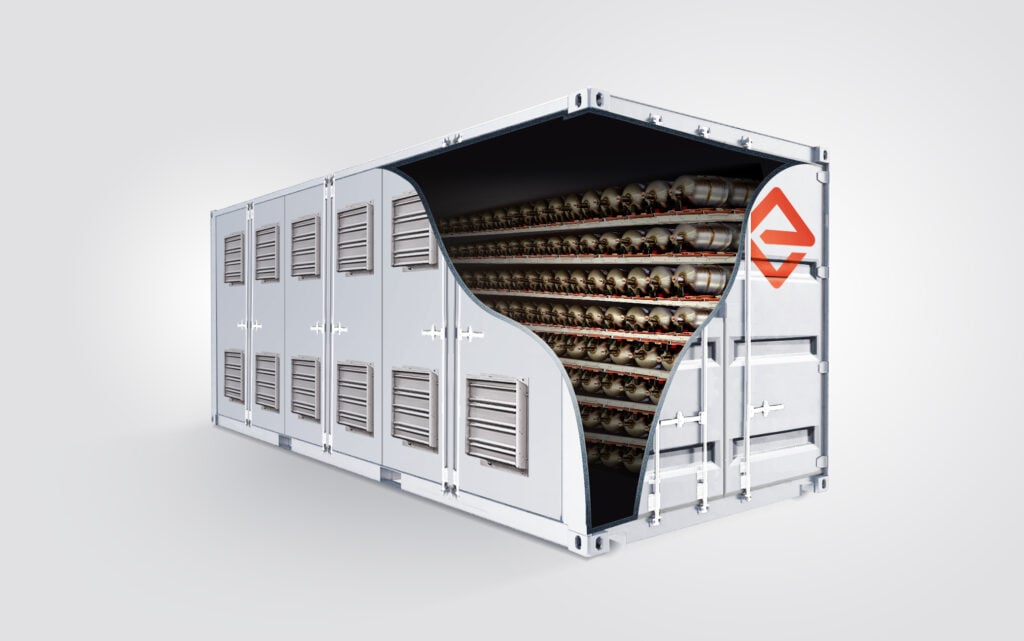
Nickel-hydrogen battery company EnerVenue has announced a pilot battery energy storage system (BESS) project in Jintan, Changzhou, China.
The project will be owned and operated by Hong Kong’s first public utility and one of China’s largest energy suppliers, The Hong Kong and China Gas Company Limited (Towngas).
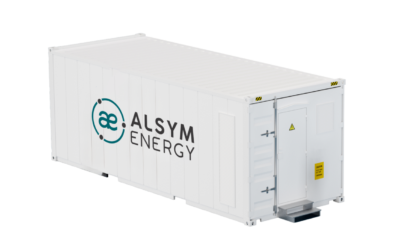
EnerVenue’s nickel-hydrogen energy storage vessel (ESV), a roughly two-meter-long steel tank wrapped in composite material, and assembled into energy racks and containerised for deployment, will be utilised at the Towngas facility, which integrates on-site renewable energy generation with electric bus charging stations.
The pilot operates a customised version of EnerVenue’s modular Energy Rack solution. Energy Rack uses outdoor-rated housing to house 50 aqueous metal cells (AMCs), delivering a total storage capacity of 150kWh, with an inverter and battery management system (BMS).
Try Premium for just $1
- Full premium access for the first month at only $1
- Converts to an annual rate after 30 days unless cancelled
- Cancel anytime during the trial period
Premium Benefits
- Expert industry analysis and interviews
- Digital access to PV Tech Power journal
- Exclusive event discounts
Or get the full Premium subscription right away
Or continue reading this article for free
Towngas claims the pilot will be joined by more commercial demonstration systems with other partners worldwide in the coming months.
In parallel, EnerVenue claims its recently announced US$300 million funding round will enable the rapid scale-up of the company’s manufacturing operations in Changzhou, China, where the company’s fourth-generation AMC technology and Energy Racks are made. Construction of a new 250MWh high volume production line is due to begin later this year.
This is also not the first time EnerVenue and Towngas have worked together. In 2021, EnerVenue signed a distribution agreement with Towngas, which saw the utility deploying the energy storage technology in its own projects and distributing them to customers.
EnerVenue claims its ESVs can exceed 30,000 cycles and operate up to three full cycles daily without interruption, delivering approximately 4 to 6 times higher throughput than standard lithium-ion (Li-ion) batteries.
In May 2023, EnerVenue’s metal-hydrogen battery received UL1973 certification and passed UL9540A testing. UL1973 is a safety standard for batteries in stationary applications, light electric rail (LER), and vehicle auxiliary power systems. It establishes construction requirements and evaluates fire resistance, mechanical design, thermal management, and electrical safety.
UL9540A certification assesses thermal runaway fire risk in battery systems. When thermal runaway is possible, the system undergoes testing at progressively longer intervals to evaluate associated risks.
In 2024, the company raised US$308 million in venture capital, placing it among Mercom Capital’s top five VC deals for the first half of the year.
Following EnerVenue’s latest financing announcement from this April, newly appointed CEO Henning Rath spoke with Energy-Storage.news about the company’s goals for the year.
EnerVenue is taking a pragmatic approach to global manufacturing that acknowledges current geopolitical tensions rather than avoiding them. The company’s first high-volume production line is also being built in China, with 250MWh of capacity expected online by the end of Q3 2026, scaling to 1GWh in 2027.
For a company headquartered in Fremont, California, the choice to manufacture in China might seem counterintuitive given US-China trade tensions. However, Rath framed it as strategic realism in an interview with ESN Premium last month.
“America, especially Silicon Valley, is still an amazing place for driving innovation. In the same way, China is a very competitive place when it comes to infrastructure, manufacturing, and supply chain capabilities,” Rath noted.
He continued, “Never fight the universe. The geopolitics is what it is, and companies that adapt most flexibly to the situations will be the companies that thrive in the future.”