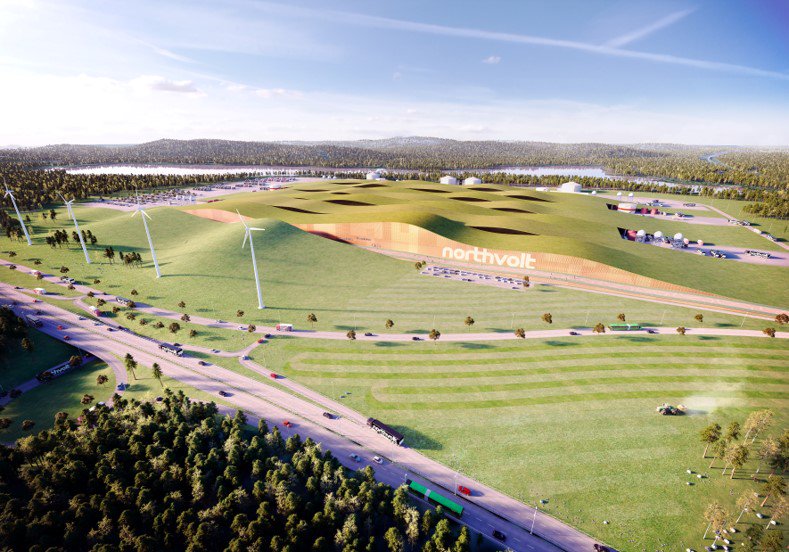
Swedish start-up Northvolt, which is run by two former Tesla Motors executives, plans to build a huge lithium-ion battery factory in the Nordic region, giving Tesla and Panasonic’s Nevada Gigafactory a close rival within Europe in terms of size.
The Stockholm-based company’s website reveals plans for what will be Europe’s largest battery factory, standing at more than 32GWh divided into four blocks of 8GWh capacity and needing more than €4 billion investment.
The site will require 500,000m2 of land – roughly equivalent to nine football pitches – but the firm is still looking for a suitable location with hopes for making a decision by the middle of the year. Northvolt claims the project will provide an opportunity to create an “industry cluster” for experts in energy storage and batteries.
The Nordic region has been chosen for its access to clean water and energy, stable grids and educated workforce. Perhaps more importantly, the area also holds some of the critical minerals needed for the battery technology.
Try Premium for just $1
- Full premium access for the first month at only $1
- Converts to an annual rate after 30 days unless cancelled
- Cancel anytime during the trial period
Premium Benefits
- Expert industry analysis and interviews
- Digital access to PV Tech Power journal
- Exclusive event discounts
Or get the full Premium subscription right away
Or continue reading this article for free
Northvolt was founded by CEO Peter Carlsson, COO Paolo Cerruti, Carl-Erik Lagercrantz and Harald Mix. Both Carlsson and Cerruti previously served more than four years at Tesla Motors in executive positions, with roles in the supply chain at various points.
With cost still a major barrier to wider energy storage uptake, Northvolt plans to benefit from economies of scale and believes that the world has room and potential demand for another 100 to 150 factories of a similar scale.
It stated: “Until now cost has been too high for widespread adoption. We are now able to bring costs down.”
The batteries produced will be used in electric vehicles (EVs), although Northvolt’s website touts the uses of energy stroage in white goods and for integrating renewables to the grid. The firm is currently offering supply options to customers requiring more than 250MWh per annum.
Northvolt has received external funding the Swedish Energy Agency (Energimyndigheten), Vinnova, Innoenergy, Vattenfall and Stena.
Sending out an optimistic message to industry, the company website stated: “There are strong indications that when the cost of lithium-ion batteries drops below US$100/kWh, a number of user-sectors will reach an inflection point where traditional technology is no longer cheaper.”
In other news, the largest battery ever developed within the Nordic countries was recently commissioned at Fortum’s Järvenpää power plant in Finland.