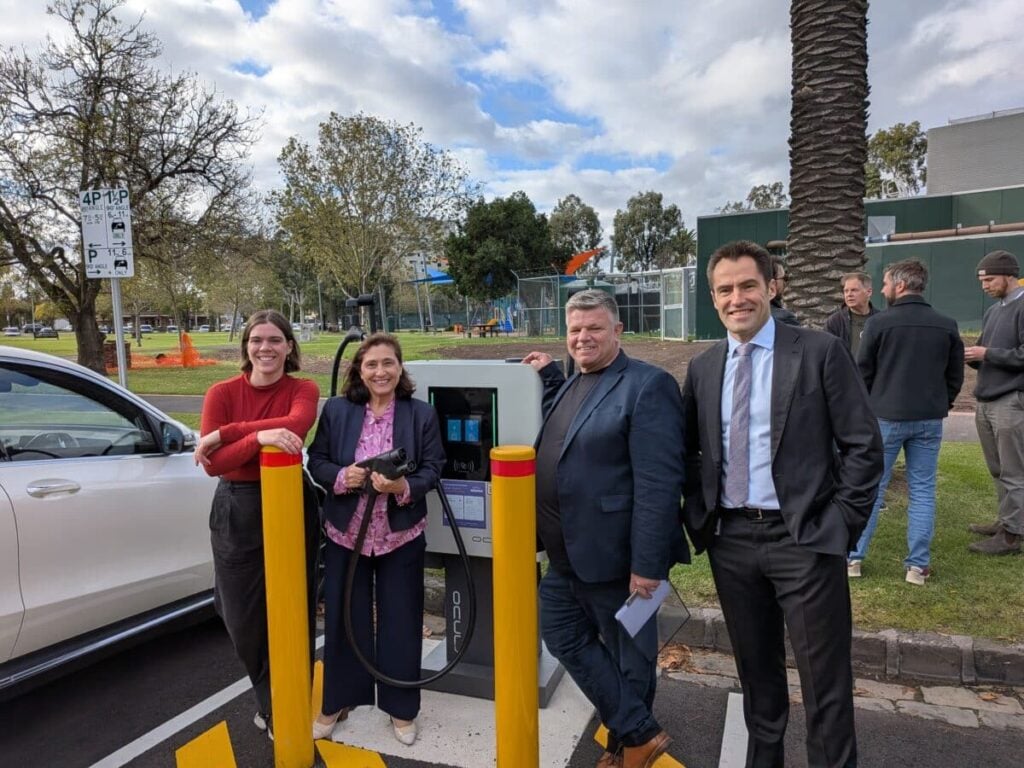
Yarra Energy Foundation (YEF), a not-for-profit organisation, has commissioned a community battery storage system and two wheelchair-accessible electric vehicle (EV) charging bays in Clifton Hill, an inner-city suburb of Melbourne, Australia.
This marks the first dedicated front-of-meter community battery storage system designed to integrate with public EV charging infrastructure in inner Melbourne.
The project, installed at Collingwood Leisure Centre on Turnbull Street, was funded through a AU$750,000 (US$536,000) grant from the Victoria government’s Neighbourhood Battery Initiative.
According to YEF, the installation aims to trial how battery storage and EVs can work together to reduce grid demand by incentivising charging during peak solar generation hours, typically between 10:00 and 16:00, when emissions and energy prices are traditionally at their lowest.
Try Premium for just $1
- Full premium access for the first month at only $1
- Converts to an annual rate after 30 days unless cancelled
- Cancel anytime during the trial period
Premium Benefits
- Expert industry analysis and interviews
- Digital access to PV Tech Power journal
- Exclusive event discounts
Or get the full Premium subscription right away
Or continue reading this article for free
The community battery will charge during daytime periods when residential areas generate surplus solar energy, then discharge during the evening peak demand from 17:00 to 21:00, offsetting predominantly fossil-fuel-generated electricity.
The project includes a dual 60kW DC charger serving two dedicated bays, designed in consultation with the City of Yarra’s Disability Advisory Committee and a community reference group of local residents.
The 60kW medium-fast charger can add approximately 150km of range per hour of charging, substantially faster than standard household AC chargers, which typically require four to 12 hours for a full charge. The facility is designed for “topping up” rather than full charging cycles.
Neighbourhood batteries and BESS adoption in Australia
Neighbourhood and community batteries have become a focal point for Australian policymakers, given their ability to harness the country’s extensive distributed rooftop solar PV generation capacity.
The technology has garnered significant attention from industry leaders and government agencies.
In July 2024, the Australian Renewable Energy Agency (ARENA) approved AU$143 million in funding through its Community Battery Funding Round 1 initiative to scale BESS technology.
This scheme will deploy 370 community batteries across Australia, benefiting all states and the Northern Territory. ARENA anticipates that the initiative will unlock around AU$359 million in investment in renewable energy infrastructure.
One of the awardees of ARENA’s initiative was YEF, which has installed several community BESS in Melbourne and its surrounding suburbs. Indeed, YEF can be considered an early adopter of community batteries, starting with its Fitzroy North BESS in Melbourne, installed in 2022.
Last year, YEF reported that its Fitzroy North community battery generated AU$8,423 in revenue (excluding GST) for the 2023-24 financial year.
The revenue primarily came from energy arbitrage (AU$8,158), with a smaller portion derived from Citipower’s bidirectional community battery trial tariff (AU$1,046). YEF explored these findings further in a guest blog on Energy-Storage.news in February 2025.
At the start of 2026, the Australian Energy Regulator (AER) confirmed that around 244 community battery storage systems were connected to the country’s distribution networks.
Parts of this article first appeared on EV Infrastructure News.