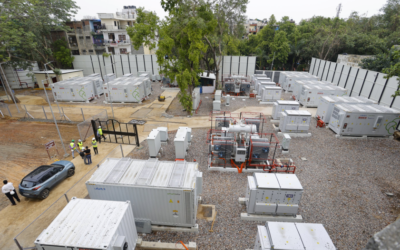
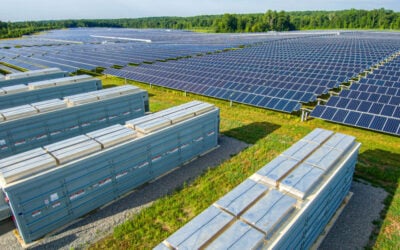
Cheaper battery-based storage solutions will be able to provide support during cloud cover, monsoons and overnight. Credit: Tom Kenning
Indian rooftop solar will reach an inflection point in 2020 when battery-based storage becomes affordable enough to drive the PV segment, according to a new report by global analysis firm Crisil Research.
Launching the new data while speaking at the India Rooftop Solar Congress 2017 in New Delhi, Pranav Master, associate director, Crisil, said India is expected to reach just 12-13GW of rooftop solar by 2022, up from 1.1GW at present. This would be well short of the government’s 40GW target, despite a huge leap in the next five years.
While Commercial and Industrial rooftop PV has strong growth at present the agricultural and residential segments have seen very slow growth and will continue this way for 3-4 years, until generational and operational issues are addressed.
Howover, the Crisil report said: “Faster-than-anticipated technological disruptions in terms of battery storage solutions at affordable prices, too, can provide some upside to adoption of rooftop solar.”
Try Premium for just $1
- Full premium access for the first month at only $1
- Converts to an annual rate after 30 days unless cancelled
- Cancel anytime during the trial period
Premium Benefits
- Expert industry analysis and interviews
- Digital access to PV Tech Power journal
- Exclusive event discounts
Or get the full Premium subscription right away
Or continue reading this article for free
This cheaper battery-based storage solutions will be able to provide support during cloud cover, monsoons and overnight.
The Crisil report said that taking the current capital cost of large-scale rooftop solar (>50kw capacity) projects as INR55-60/W (US$0.8-0.88) in India, the partial battery backup based systems could increase the system cost of a rooftop solar project by around 30-35%. However, with continuous innovation and rising scale of production, battery costs, which reduced to US$350/kWh in 2015 from US$1,000/kWh in FY2010, are expected to fall further.
The report added: “We expect the rooftop-based capacity additions to rise post FY2020, led by declining battery prices.”
But the rooftop sector still faces multiple challenges in the short-term. Annual rooftop installations are even expected to fall this financial year, from 740MW in 2015/16, to just 550MW in 2016/17. Installations will only start rising again the following year:
2017/18 – 900MW
2018/19 – 1.6GW
2019/20 – 2.2GW
2020/21 – 3GW
2021/22 – 3.7GW
Pranav Master said: “In 2016/17 we still believe that there are significant challenges. A lot of Distribution companies are in the process of ironing out administrative and procedural issues and hence we believe there is going to be some amount of slowing down. Pickup will happen say a year or two down the line.”
Gagan Vermani, founder and CEO of India-based rooftop solar specialist MYSUN, said that if the status quo is maintained then the 40GW target will not be achievable, while claiming that even 12GW would be a “Herculean task”. Instead the solar industry offer needs to be portrayed not just as an industrial product, but also as a consumer product. Indian consumers are highly curious about solar but they are not aware of the availability of rooftop solar. As a result, the industry needs to “shift mind-sets” to create more consumer demand. If demand is improved then 40GW is “highly achievable”.
Vermani added: “Today buying solar is a big hassle for a lot of consumers.”
However, affordable storage will part of this positive shift in mindsets.