
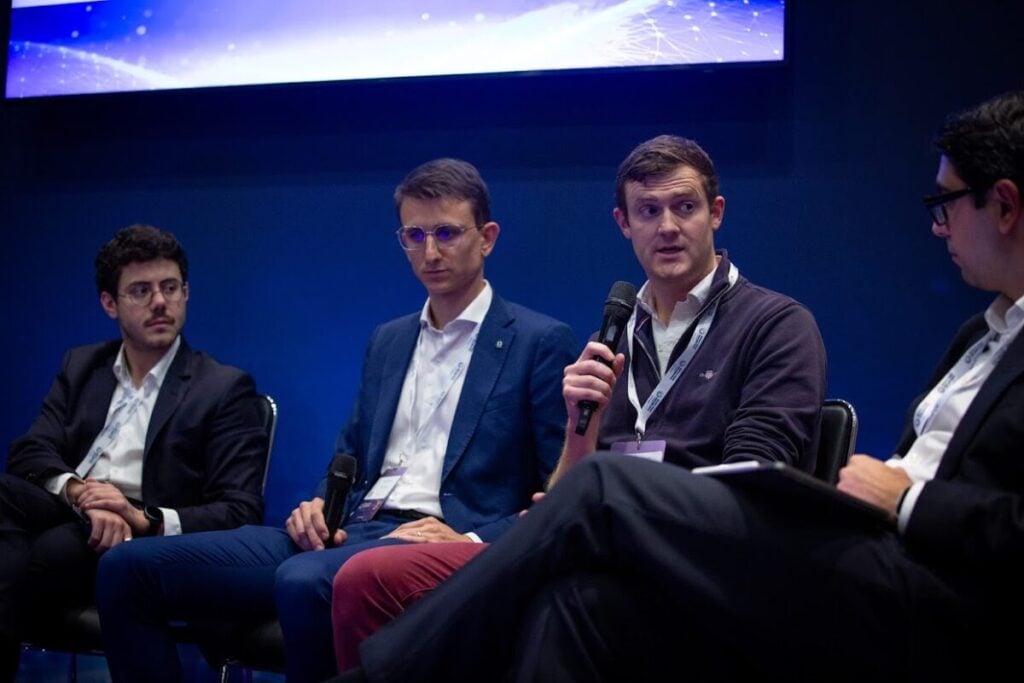
A panel at the Battery Asset Management Summit UK & Ireland 2026 last week discussed BESS capital expenditure (capex) trends and strategies to manage it.
Lithium-ion batteries and battery energy storage systems (BESS) prices had, until this year, been on a steady downward curve the past few years. Panellists from system integrator NHAO Energy, owner-operator Gore Street Capital and consultancy Timera Energy discussed the implications of this and the future outlook on ‘The CAPEX Shock: Lessons from the Last Price Cycle’ panel discussion. See our write-up below.
Capex trends
NHOA’s business development manager Paolo Rossetti started out by saying that batteries are just one part of overall capex and that balance-of-plant items do not have the same price trend. These include medium voltage transformers, inverters, and infrastructure and processes related to grid connection.
“If we look at the broader picture, batteries are just part of the price of the capex,” he said. “The other items are actually increasing, or at least it’s more difficult to find room for improvement in terms of price.”
Try Premium for just $1
- Full premium access for the first month at only $1
- Converts to an annual rate after 30 days unless cancelled
- Cancel anytime during the trial period
Premium Benefits
- Expert industry analysis and interviews
- Digital access to PV Tech Power journal
- Exclusive event discounts
Or get the full Premium subscription right away
Or continue reading this article for free
Gore Street’s project development manager Michael Darzi pointed to a significantly different picture from five years ago. Back then, lithium prices drove the bulk of project capex and DC block containers were 50-60% of a project’s capex, but that has fallen to roughly 38% of costs, even though lithium prices have doubled since November 2025.
“Five years ago, lithium prices generally determined the overall capex of your project, especially the DC block containers, which attributed 50 to 60% of your capex,” he said. “Things have shifted — even though lithium has doubled per kilogramme since November 2025, the proportion of your capex on the DC block has gone down to probably around 38%.”
He agreed that balance of plant items like high-voltage transformers, grid code compliance, early civil enabling works, and grid connection costs now carry more weight and can materially affect project economics, adding that grid connection costs “can be quite material and can put a damper on your project economics overall.”
Steven Coppack, power director at Timera Energy, said the decline in cell and pack costs is clearly shifting investment cases toward longer-duration storage, but also warned that balance-of-plant costs are not falling at the same pace.
He said this will put growing pressure on a limited pool of suppliers capable of installing equipment outside of the DC block: “As your cell impact costs decrease, you’re just going to be putting more and more pressure on a limited number of suppliers to actually install, deliver, and get these batteries on the ground.”
On managing price uncertainty from procurement to final investment decision
Darzi said his team sets an early budget based on anticipated market pricing, then manages the gap between that budget and final contract pricing through various mechanisms. This could be setting a longer validity period for the agreed price, or accepting some form of lithium indexation and building that into the contingency. But that indexation needs a cap and floor element.
Rossetti, giving the system integrator’s side of this equation, said the standard approach is to pass supplier risk through to clients but timed carefully as a project nears financial close.
“Our standard approach is to transfer the risk that we have from our battery supplier,” he said. “But we need to tackle this point with the right timing. We cannot tackle too much in advance, but when everything is close to the final investment decision into the closing then we will push for more visibility and certainty from the suppliers.”
“Four or five years ago lithium indexation was something newer, but now all clients are aware of it and accept it, though closer to the final investment decision we normally find a better way to manage things,” he said.
Darzi added that signing your toll and procurement agreements simultaneously is critical. This ensures that toll pricing reflects the capex figure actually being financed, rather than risking a mismatch if capex rises after contracts are repriced months later.
On managing the financing side more broadly, he said: “Running a competitive tender process keeps your suppliers and BOP contractors honest in terms of pricing.”
Full wrap contracts versus multi-contracting
Rossetti said the market trend is clearly moving toward split, multi-contract procurement, but cautioned that this introduces long-term service risk since availability shortfalls affect both revenue and future asset valuation or refinancing prospects.
For example, having lots of different suppliers rather than one EPC reduces the amount of liquidated damages you could expect as the project owner if, for example, a project doesn’t come online in time and revenues are missed.
Darzi gave an example of a project where the full wrap contract he evaluated cost around €25-26 million (US$28-29 million) for a full wrap versus around €23 million for multi-contracting.
“That three million difference will need to be absorbed somehow into your contingency, and you’ll need some additional buffer as well if prices are going to change once at contracting,” he said.
Looking ahead five years
Coppack said the historic most common regret on procurement is failing to build enough optionality into business plans, particularly around battery duration. As cell costs and capex have fallen, that has increased the viability of expanding a BESS site’s size and duration, but there might not be room if this wasn’t factored in.
“We’ve seen that there are so many legacy projects which, in hindsight, you would make a different decision on,” he said. “We’ve also seen warranties that are just not fit for purpose in a world where the ancillary markets are saturating.”
He also warned that the industry hasn’t yet identified what today’s equivalent blind spot might be: “What are we not thinking about now that we may come to regret in the future?”
Phrasing the question differently, moderator Mehdi Omrani from Antin Infrastructure Partners, asked Darzi what long-term risks are currently underpriced.
Darzi said augmentation and repowering risk remains underpriced, along with long-term compatibility between evolving battery technologies and control systems such as EMS and PPC controllers.
“Trying to factor in BOP costs initially — the initial civil works, the foundations — but also if there is a wider risk around compatibility between technologies and control systems is key,” he said.
Prices going forward
Omrani then asked a question from the audience on where battery prices are going in the medium-term.
Rossetti said the trend of declines for battery cells and prices is still there in the medium term, with potential bumps in the road due to legislation or lithium prices.
“But, as discussed before, it’s important to keep an eye on all the other items needed for the project. For inverters, we see a bit less price improvement. We are working on the technical side, and one avenue is increasing the size of the inverters to get a better price at the kilowatt-level.”
Coppack agreed that in the long-term cell prices will come down though not as fast as they did in the past few years but, as he said earlier on, those price falls drive inflationary pressure on services. “You know, if we come back in five years, this conversation might be entirely about inverters and construction crews rather than cells and packs.”
What you’d spend spare capex on
Omrani then asked the panellists what they would advise project owners should spend a spare 5% of capex on.
Rosetti said he’d focus on increasing the reliability and availability of a system by, for example, having a spare transformer or switchgear, or doing extra enabling works for augmentation to help future-proof the project.
“These allow us to have higher availability of the project, and this at the end brings more revenues to the client,” he said.
Darzi agreed and said this was particularly important for large-scale projects. Instead of having one larger transformer, having two or three smaller ones could have a positive impact: “All it takes is one outage or one part on that transformer to go bust, and then you are not operating at all for X amount of months. So building in that redundancy is quite important.”
Key lessons from the last capex cycle
Coppack reiterated the importance of building optionality into site selection, equipment choice, and supplier selection to keep projects adaptable to market and technology shifts.
Rossetti said the battery supplier landscape has changed substantially in five years, with new entrants continuing to emerge and apply downward pricing pressure on both battery and balance-of-plant costs. “Five years ago, different names were building projects, or were mainly delivering batteries,” he said. “Now there are different players, and also newcomers every year.”
“So don’t go for the cheapest price,” Omrani suggested as one interpretation from that.
Darzi summarised his advice simply: don’t budget for the lowest capex. “Ensure that whoever is procuring your inverters and your power plant controller is able to do the modelling and deliver that project for you,” he said. “Really understanding and factoring in your grid connection costs, and having that open, early conversation with the grid operator to understand how reliable your system is — that’s critical.”
