Polarium, a Swedish manufacturer of lithium-ion based battery energy storage systems (BESS) technology, has been valued at over a billion dollars.
The company said today that AMF, a Swedish pensions company, made the commitment to invest based on the valuation, which places Polarium in the ‘unicorn’ category of tech startups worth more than a billion US dollars.
Institutional investor AMF is investing SEK955 million (US$100 million) and JP Morgan SE served as Polarium’s sole placement agent for the transaction.
Polarium launched in 2015 mainly targeting the telecoms sector. Its battery modules were designed as drop-in replacements for lead-acid batteries as well as being able to provide backup power that is currently done using diesel generators on standby. It does not currently target the data centre market, however.
Try Premium for just $1
- Full premium access for the first month at only $1
- Converts to an annual rate after 30 days unless cancelled
- Cancel anytime during the trial period
Premium Benefits
- Expert industry analysis and interviews
- Digital access to PV Tech Power journal
- Exclusive event discounts
Or get the full Premium subscription right away
Or continue reading this article for free
The modules come with the company’s own integrated battery management system (BMS) and Polarium offers both nickel and iron cathode battery chemistries, using cells sourced from leading suppliers.
Latterly, Polarium has also been targeting other commercial and industrial (C&I) market segments, including microgrids, standalone, solar-plus-storage and other hybridised battery energy storage systems (BESS) and EV charging.
In early April, the company began a pilot project in its home country with Areim, a real estate owner and fund manager, to deploy an energy storage system at a large commercial property development in Stockholm.
The system, which was commissioned in March, will enable Areim to participate in various grid balancing services markets, having qualified to provide fast frequency response (FFR) services to transmission system operator Svenska Kraftnat.
One of Polarium’s main business areas in which it is targeting growth is in energy optimisation services of that type, which leverages battery storage to earn revenues from a number of different streams for essentially storing energy when it is cheap and abundant and dispatching it when most needed.
A company representative told Energy-Storage.news today that Polarium is excited about adding and expanding energy optimisation capabilities to its suite of services. Optimisation has provided routes to market for battery storage to perform various grid balancing applications in a growing number of markets around the world, through a combination of automated and human-driven decision making. The company is active in 70 countries already.
Polarium, founded in 2015, said it has enjoyed a compound annual growth rate (CAGR) of about 150% over the five-year period from 2016-2021, with net sales of SEK1.1 billion in 2021 and EBITDA of SEK83 million.
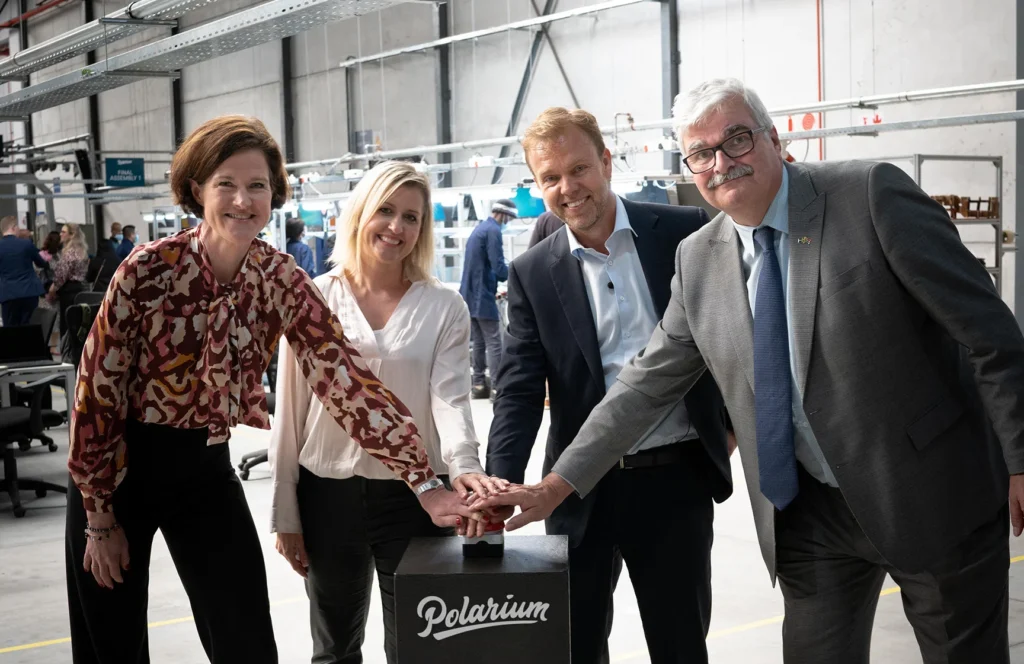
The company has just opened a new production facility in Cape Town, South Africa, which will have an annual production capacity of 4GWh when fully ramped up and will employ 200 people. That came off the back of a multi-year supply deal Polarium signed with telecoms infrastructure company ATC Africa. Polarium also has factories in operation in Mexico and Vietnam.
It has been a “rapid growth journey from day one,” Polarium’s CEO and founder Stefan Jansson said, from its core competencies in reducing the carbon footprint and increasing profitability of telecoms companies through replacing lead-acid and diesel to its diversified position targeting broader market opportunities.
“With AMF as our partner, we are well positioned to accelerate our growth within reserve power, and springboard that expertise to capture more of the ever-growing market for energy optimisation,” Jansson said.