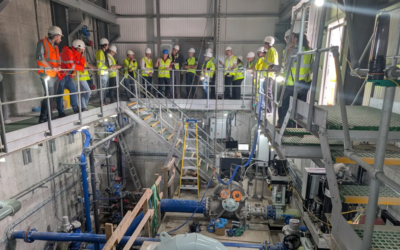
“Extensive works” to house two 125MW turbines have begun at Australia’s first new pumped hydro energy storage (PHES) plant in nearly 40 years, developer Genex Power has said.
Underground works began over December at the 250MW Kidston Stage 2 Pumped Hydro Project, renewable energy development company Genex said in a construction update provided to the Australian Securities Exchange (ASX) yesterday.
The works relate to the project’s 1.5km long, 6 metre x 6 metre Main Access Tunnel (MAT), which will provide access to the powerhouse cavern which will house the turbines, about 250 metres underground.
It will take about six months to drill and blast the first heading to the cavern, with multiple headings then planned, which will expedite excavation of the powerhouse cavern itself. About 8 metres per day of tunnelling works are expected over the next six months.
Try Premium for just $1
- Full premium access for the first month at only $1
- Converts to an annual rate after 30 days unless cancelled
- Cancel anytime during the trial period
Premium Benefits
- Expert industry analysis and interviews
- Digital access to PV Tech Power journal
- Exclusive event discounts
Or get the full Premium subscription right away
Or continue reading this article for free
The project achieved financial close in May 2021. Its planned capacity will be 2,000MWh and Genex has said it expects construction to be completed by 2024, with engineering, procurement and construction (EPC) duties carried out by a consortium of two companies, John Holland and McDonnell Dowell.
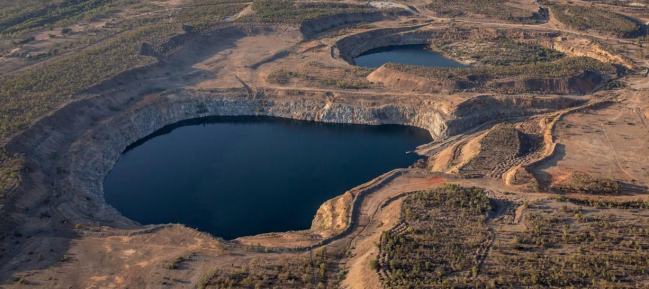
Located at a former goldmine site in Kidston, Queensland, the project is expected to cost about AU$777 million (US$600 million) in total, including the cost of building transmission infrastructure to carry power to the northeast coast of Australia around 190km away. The plant will also be connected to the National Electricity Market (NEM).
Financing close was achieved with AU$620 million debt equity pledged by the Commonwealth Government’s Northern Australia Infrastructure Facility, as well as AU$147 million from the state government of Queensland. The latter sum will go towards the transmission upgrade, while the Australian Renewable Energy Agency (ARENA) also approved AU$47 million funding support for the project.
It will be Australia’s first new PHES facility built since 1984. In July last year, the state government of Queensland committed AU$14 million to refurbishing and modernising the 570MW Wivenhoe Pumped Storage Hydroelectric Power Station, which was the plant opened in 1984.
In October, Genex signed a supply agreement with Tesla for the developer’s 50MW / 100MWh Bouldercombe Battery Project (BBP) in Queensland. BBP will comprise 40 Tesla Megapack battery energy storage system (BESS) units. It will be Genex’s first standalone battery storage project.
Australia second to China for pumped hydro plans in Asia-Pacific
Two other new significant PHES capacity additions in development in Australia are the Snowy Hydro 2.0 project which will retrofit project which could increase capacity of an existing plant to 2GW and as much as 350GWh and Oven Mountain, a 600MW/7,200MWh new-build PHES. Both are in New South Wales.
In December, the State Grid Corporation of China brought online two generating units at the 3.6GW Fengning Pumped Storage Power Plant in China’s Hebei province. Twelve 300MW reversible pump turbines were commissioned and integrated into the North China Power Grid and the State Grid Corporation said they are expected to be put into operation during this year.
The Fengning PHES system will support greater integration of renewable energy into the grid, as well as supporting the running of the Beijing Winter Olympics this year.
According to figures issued by research and analysis group IHS Market last year, China leads the Asia-Pacific region for pumped hydro in construction or planning. The country’s energy companies had about 52.3GW of a total 71GW across the whole region in their development pipelines as of January 2021. Since then, China’s government has announced a 30GW by 2025 deployment target for non-PHES energy storage technologies.
Australia came second, with 7,880MW of planned or in-construction pumped hydro, followed by Indonesia (4,063MW), India (2,780MW) and Japan (2,480MW). The Philippines and Vietnam had smaller 500MW and 1,200MW pipelines respectively.