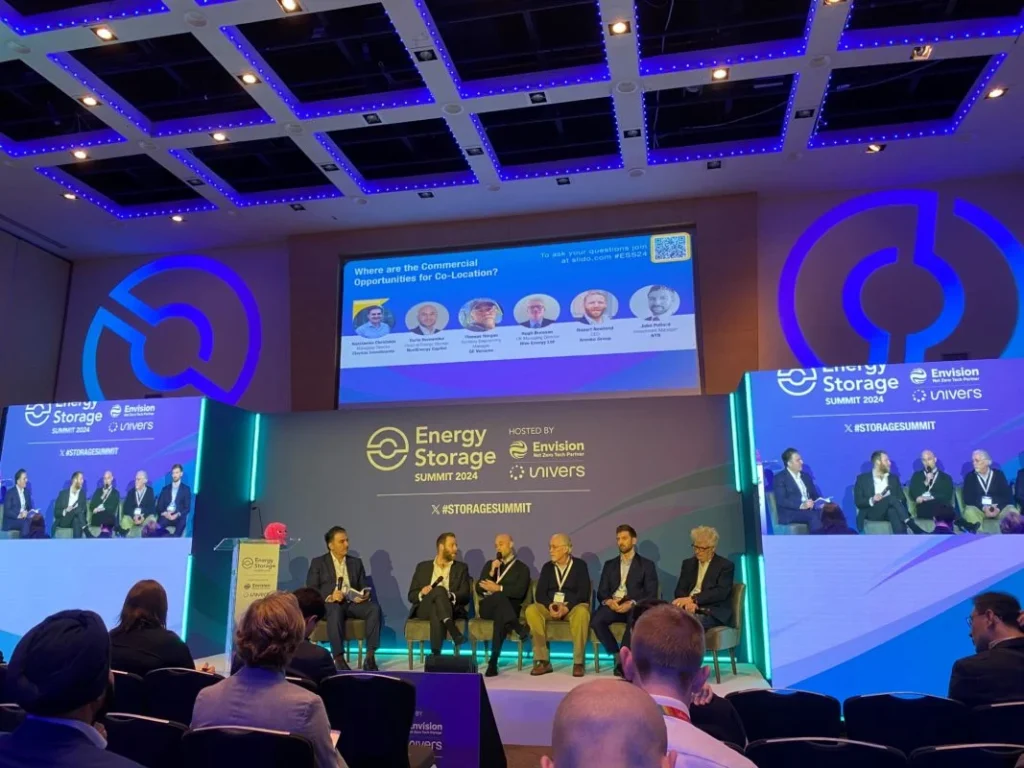
“There is a roadblock in getting interconnections [for renewables] passed, and people are looking for alternatives…we need more storage on the grid more quickly,” said Thomas Horgan, systems engineering manager at GE Vernova, at the Energy Storage Summit 2024 yesterday (20th February) in London, speaking about the potential of co-location for energy storage and solar projects.
The panel – Where are the Commercial Opportunities for Co-Location? – was almost full to capacity on the afternoon of the first day of the Summit. In their opening remarks, panellists including Horgan said that co-location offers a possible solution to grid bottlenecks and capacity shortages. Horgan also pointed to the instability that greater renewables penetration can inflict on grid networks; in this regard, “storage solves a lot of problems”, he said.
However, the business case for co-located projects is less simple than that. Rupert Newland, CEO of UK renewables technology provider Arenko Group, said that co-located projects are something of an unknown quantity at the moment. “There isn’t a proven commercial model across this sector,” he said.
This, he continued, is because of the inherent differences between solar or wind and battery energy storage systems (BESS). Not only different technologies, but different supply chains, financing models, use cases and technical parameters present themselves.
Try Premium for just $1
- Full premium access for the first month at only $1
- Converts to an annual rate after 30 days unless cancelled
- Cancel anytime during the trial period
Premium Benefits
- Expert industry analysis and interviews
- Digital access to PV Tech Power journal
- Exclusive event discounts
Or get the full Premium subscription right away
Or continue reading this article for free
“People recognise the benefits [of co-located projects]”, he said, whether it’s shared infrastructure and grid connections or the gradual increase of revenues and capacity that can be generated from a co-located project, “but I think the actual commercial model is still not very well-understood”.
Arenko announced work on its first co-located solar-plus-storage project in the UK last year, a 50MW BESS co-located with a 55MW solar PV plant. The company is offering optimisation services through a partnership with French renewables developer Engie. Newland spoke with Energy-storage.news in October about its existing co-located wind and storage projects (Premium access), and how the projects could provide a blueprint for co-location.
The falling price of BESS over 2023 is likely to continue, panellists said, which would improve the business case for co-located projects. The drop in solar module prices over the last two years has been good news for developers, and if batteries follow suit then co-located projects will become easier and easier to develop, they said.
The panel’s moderator – Anastasios Christakis, managing director at Claritas Investments – ended up asking if co-located projects would be more valuable than standalone assets in the future.
“If done correctly…yes,” said Hernandez. But this is reliant on a list of details and factors aligning to let the project reach its full potential, he said, harking back to Pollard’s call for developers to comprehensively examine the specifics of co-location. “The times when you’re going to find that absolutely everything aligns for a co-location project are quite limited. From the development side, sometimes it’s the weakest link that defines the project,” said Hernandez.
Newland said that co-located sites have the potential to offer more value. He said that the “quality of output from the site is inherently better when it’s a co-located site…you can sculpt the output to fit market conditions, you can move power around to make sure you’re maximising the value of it.” The value will boil down to market signals, the panellists concluded, and whether the specifics and legislation of co-location materialise.
To read the full version of this story, visit PV Tech.