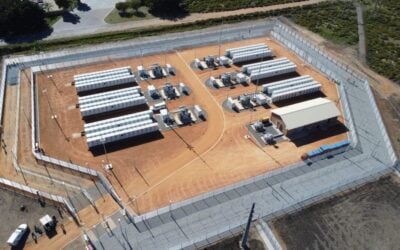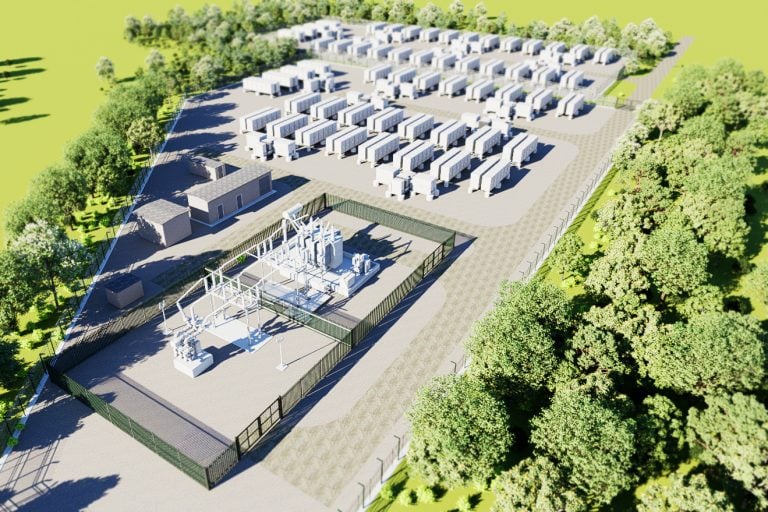
The commercial manager for Balance Power, one of two UK battery storage developers to have announced project approvals this week, has questioned whether the market standard 2-hour duration is enough to meet net zero goals in time.
Balance Power last week unveiled the first 30MW project in a 500MW pipeline partnership with TagEnergy, having secured planning approval for the project in Worcester earlier this year. And yesterday (17 July), developer Cambridge Power said it secured planning approval for a 100MW BESS in Bedfordshire.
The projects contribute to a staggering pipeline of BESS in the UK, totalling 71.4GW/100.9GWh, according to Solar Media Market Research’s UK Battery Storage Project Database Report, or as high as 118GW according to National Grid ESO figures cited by Balance Power’s commercial manager Nick Provost.
But Provost has questioned whether the 2-hour duration of most new BESS projects is adequate to decarbonise the grid in a report published on the company’s website.
Try Premium for just $1
- Full premium access for the first month at only $1
- Converts to an annual rate after 30 days unless cancelled
- Cancel anytime during the trial period
Premium Benefits
- Expert industry analysis and interviews
- Digital access to PV Tech Power journal
- Exclusive event discounts
Or get the full Premium subscription right away
Or continue reading this article for free
“The key takeaway is that the commercial business models that developers are following today don’t align with or are unlikely to provide the technical needs that are needed to deliver a net zero grid,” Provost told Energy-Storage.news.
“In most cases the best internal rate of return (IRR) if you have a piece of land for BESS is to develop a 2-hour system. A classic project developed today is a 50MW/100MWh system. But if we actually reduced the power to 25MW to make it 4-hours or 12.5MW to make it 8-hours, that actually better aligns with net zero, because you still get all the megawatt-hours but you don’t need as many grid upgrades so projects connect quicker.”
“Our entire industry works in MW at the moment, which has been fine up until this point, but we need to transition to MWh as that will provide security of supply.”
Provost’s report estimates that 8-hour durations would be the optimal solution for providing a balance between sufficient power (MW) to deliver flexibility, while minimising the cost and time of connecting the required energy storage capacity (MWh) to the grid.
Energy-Storage.news then asked Provost what he thought needs to change to incentivise this, considering that most projects today still make the majority of revenues from ancillary services which reward MW power, not MWh capacity (even if those services are starting to saturate).
A relatively simple change would be to change the ‘de-rating factors’ for energy storage assets in the UK Capacity Market to better incentivise longer duration projects, he said. The de-rating factor is the percentage of the clearing tariff that assets will actually receive based on their technology. The figure is 95% for gas peaker plants, 46% for 4-hour energy storage systems, 24% for 2-hour ones, and around just 5% for solar PV, figures which aim to reflect the reliability of each technology in providing standby power.
But the overall key missing component is is a revenue forecast to determine how much an 8-hour project could make, Provost’s report added.
Building projects at 2-hours duration now and increasing the duration later is an option, by either reducing the power output or adding energy storage capacity, but both have big downsides. Halving the power means an over-spec’d transformer while adding capacity requires extra land.
“UK developers will often have secured planning based on the minimum amount of land they need because the size impacts planning costs and project risk,” he said. “Even if the land was available you’d need another planning process.”
Replacing the technology entirely to a longer duration one – if lithium-ion BESS is no longer the most cost-effective in, say, 10 years time – would also dent the commercials of a project if it was part-way through its expected lifetime.
See the full report from Balance Power here.