Donald Trump has announced his sweeping ‘Liberation Day’ global tariffs, with another new China tariff resulting in an effective doubling of the price of batteries and BESS imported from there to the US.
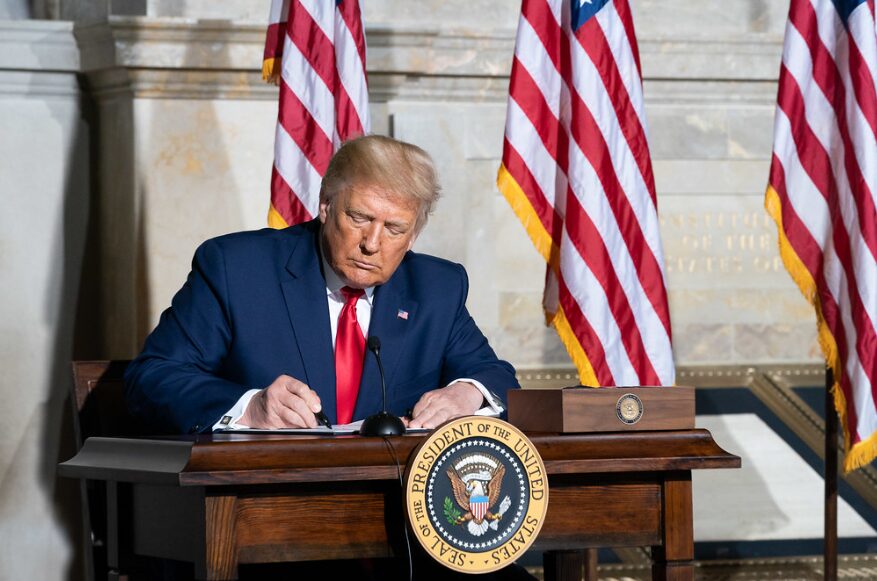
President Trump announced the new tariffs, which the White House described ‘reciprocal’ to existing tariffs levied in the other direction, yesterday (2 April).
Virtually every country in the world has been targeted, including the UK with 10% and the European Union with 20%, but China and Southeast Asia are amongst those subjected to the highest.
Bloomberg said the average US tariff is now 23%, the highest since the 1930s, and the move has been widely criticised with some promising retaliatory measures.
Try Premium for just $1
- Full premium access for the first month at only $1
- Converts to an annual rate after 30 days unless cancelled
- Cancel anytime during the trial period
Premium Benefits
- Expert industry analysis and interviews
- Digital access to PV Tech Power journal
- Exclusive event discounts
Or get the full Premium subscription right away
Or continue reading this article for free
China has been hit with a new 34% tariff, on top of the 20% Trump announced, in two separate incremental 10% announcements, since taking office.
These are effective immediately and, combined with existing and incoming tariffs, mean that from 1 January 2026, batteries and battery energy storage systems (BESS) from China will be subject to a total tariff of 82%, Energy-Storage.news calculates.
The 54% tariff, which covers all goods with a few exceptions, combines with the following battery-specific duties:
- a pre-existing 3.4% tariff on all lithium-ion batteries globally
- a Section 301 tariff on batteries from China, which is currently 7.5% and set to increase to 25% in January 2026, and is already the case for electric vehicles
The National Electrical Contractors Association (NECA) said that items such as copper, semiconductors, steel and aluminium are exempt.
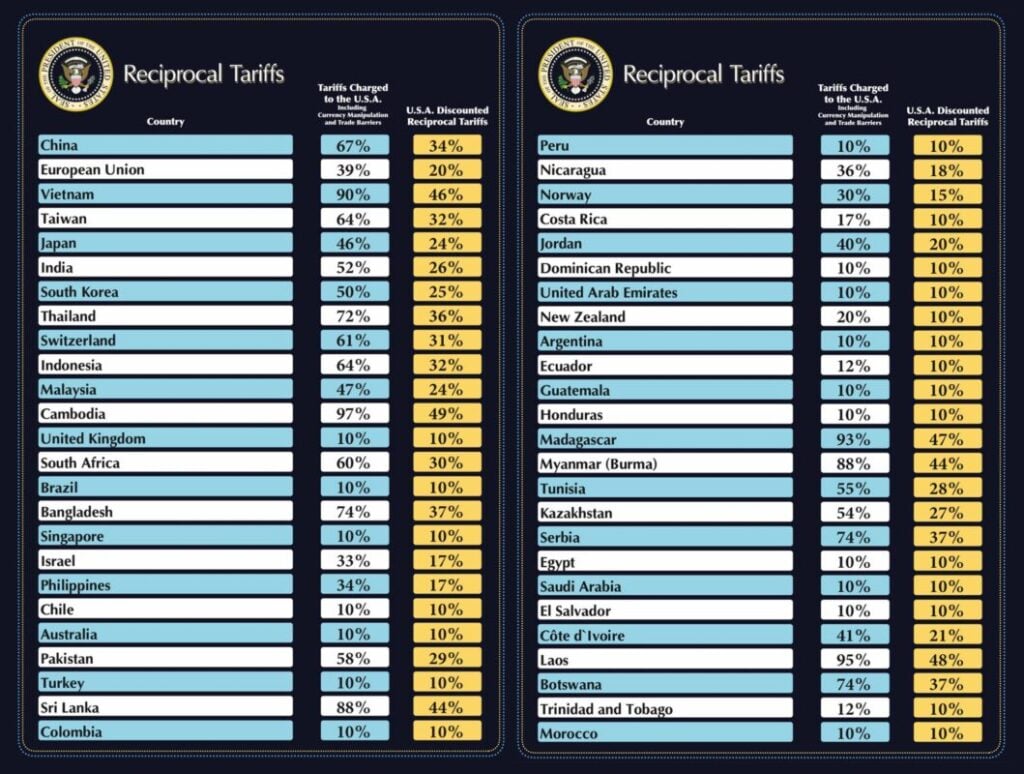
Vietnam is subject to 46% tariffs, Thailand 36%, Taiwan 32%, Cambodia 49%, Malaysia 24% and Indonesia 32%. These are significant as many lithium-ion battery and BESS manufacturing has moved from China to these countries in order to circumvent the US’ tariffs on China.
You can see the first of several tables the White House posted on social media platform X below, detailing those for China, the EU, the UK and Southeast Asia.
At the end of 2024, the American Active Anode Material Producers (AAAMP) filed a new AD/CVD petition against imports of active anode material from China on 18 December, 2024, seeking a tariff of up to 910%.
Energy-Storage.news will bring you more reaction and analysis in the coming days and weeks.