Tesla is ambitious to grow its energy storage business in 2022, after it reported a 32% year-on-year increase in battery storage deployments, executives including CEO Elon Musk have said.
The company’s quarterly financial results came out earlier this week, collecting its yearly performance across its automotive and energy sector businesses.
Tesla produced and delivered just under a million cars in 2021, and as our sister site PV Tech reported yesterday, enjoyed its best yearly performance for solar installs since 2017.
In battery storage, Tesla deployed 978MWh during Q4 2021, a slight dip from Q3’s 1,295MWh and a bigger drop from Q4 2020, when it deployed 1,584MWh of Powerwalls and Megapacks across the residential, industrial and utility-scale sectors.
Try Premium for just $1
- Full premium access for the first month at only $1
- Converts to an annual rate after 30 days unless cancelled
- Cancel anytime during the trial period
Premium Benefits
- Expert industry analysis and interviews
- Digital access to PV Tech Power journal
- Exclusive event discounts
Or get the full Premium subscription right away
Or continue reading this article for free
However, yearly figures show that it made 3,992MWh of energy storage deployments in 2021, compared to 3,022MWh in 2020. Along with that 32% year-on-year growth, the 2021 figure is more than double 2019’s 1,651MWh and a massive jump from 2017’s 358MWh total.
| Year | 2017 | 2018 | 2019 | 2020 | 2021 |
| Storage deployed (MWh) | 358 | 1041 | 1651 | 3022 | 3992 |
Company executives said demand for energy storage has been “substantially above capacity”.
There have been constraints in various lines of its business caused by supply chain issues which have affected all manner of global industries. Musk, CFO Zach Kirkhorn and senior VP Drew Baglino said the chip shortage and COVID-19 related delays were at the top of the list.
On the stationary storage front, the CEO said that it’s likely Tesla’s Powerwall and Megapack will transition to iron-based chemistry battery cells and away from nickel, with iron being abundant. Musk said a question mark hangs over manganese and its availability in future. The CEO also noted that the electric vehicle (EV) business was prioritised during 2021 for materials supply.
Long-term, Elon Musk said, the company sees a “probably terawatt-hour per year energy business,” or in other words, “very vast”.
“Our plans are pretty ambitious for Megapack this year and storage in general,” Kirkhorn said, adding that the business segment needs to grow rapidly, even faster than the vehicle business.
Musk reiterated that Tesla’s primary mission is to accelerate sustainable energy.
“That’s always been our primary mission, and we’re trying to stay true to that,” he said.
The company has already broken ground last year on a 40GWh Megapack production factory in California to add to its battery storage production lines at the Nevada Gigafactory 1.
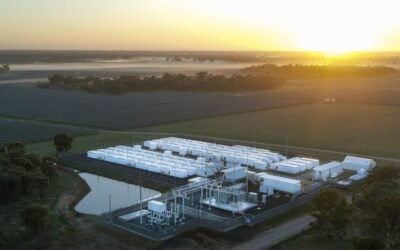
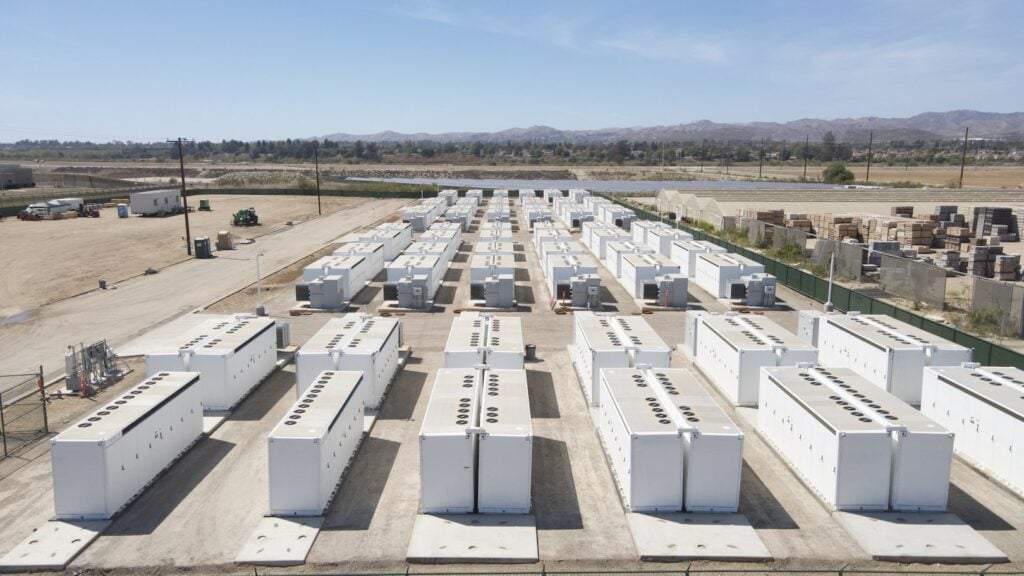
Notable Megapack projects reported by Energy-Storage.news last year include the 300MW/450MWh Victorian Big Battery in Australia which came online in December, Arevon Asset Management’s 100MW/400MWh Saticoy project in California (pictured above), a 99MW/198MWh project in the UK in construction by Harmony Energy and Fotowatio Renewable Ventures and a 25MW/100MWh BESS which Arizona utility company Salt River Project brought online in September. On a much smaller scale, the company got its first Megapack order in Japan for a 6MWh system in August.