The World Bank plans to make energy storage an integral part of its ‘Scaling Solar’ program, that until now has been focused purely on facilitating large-scale solar tendering, predominantly in Africa.
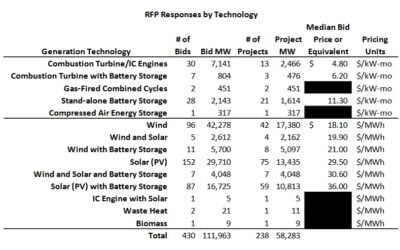
Median bids received by US utility Xcel Energy in a solicitation for energy resources for energy storage paired with solar came in at US$9 per megawatt lower than the previously observed record.
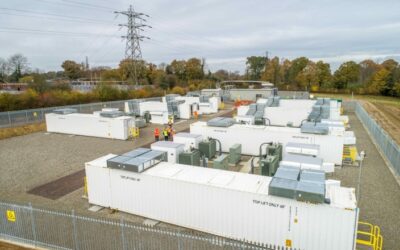
VLC Energy has become the latest firm to finish its Enhanced Frequency Response (EFR) battery projects following the completion of two projects totalling 50MW.
National Grid has revealed a simplified, more standardised approach to Firm Frequency Response (FFR) procurement whilst teasing the first details of its fast-response follow-up to EFR.
Australian large-scale renewables investor Lyon Group has confirmed it is selling three projects under development, totalling 800MWh of energy storage and 545MW of PV generation capacity, in Queensland, Victoria and South Australia.
A representative of National Grid, the UK’s transmission system operator (TSO), has said that energy storage will be “integral” to the network’s flexibility strategy – while urging developers not to rely solely on early frequency regulation contracts.
No one moment took energy storage into the mainstream of the UK power system more than the outcome of National Grid’s August 2016 tender for Enhanced Frequency Response (EFR). Reporter David Pratt examines the business case behind Vattenfall’s first EFR project and asks what grid operators and regulators’ next moves are likely to be.
Submissions for Thailand’s first 300MW hybrid PPA scheme, which encourages use of energy storage to supplement renewable energy generation, are due by 20 October.
Queensland’s tender for 400MW of large-scale renewables and 100MW of energy storage has received 115 proposals from 79 different entities spanning a wide range of technologies, according to the state’s energy minister Mark Bailey.