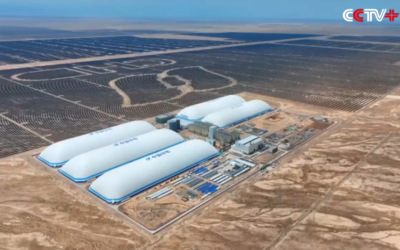
A large battery energy storage system (BESS) project in Hubei, China, using sodium-ion technology is set to be completed this year.
Construction has already started on the 50MW/100MWh project in Qianjiang, Hubei province, according to Shanghai Metals Market (SMM).
The BESS project was highlighted in a three-year plan released by the Qianjiang Municipal People’s Government in November 2023, which said it should be ‘completed’ before the end of 2024.
Its three-year plan said the project would be 100MW/200MWh while SMM and other outlets’ articles this past week reported it to be 50MW/100MWh.
Try Premium for just $1
- Full premium access for the first month at only $1
- Converts to an annual rate after 30 days unless cancelled
- Cancel anytime during the trial period
Premium Benefits
- Expert industry analysis and interviews
- Digital access to PV Tech Power journal
- Exclusive event discounts
Or get the full Premium subscription right away
Or continue reading this article for free
Either way, it would be by far the largest BESS online using sodium-ion technology, which many in the industry agree is the most commercially mature alternative technology for BESS to lithium-ion.
The sodium-ion BESS is being developed by Datang Hubei Energy Development, which is owned by the state-owned Assets Supervision and Administration Commission of the State Council (SASAC), SMM told Energy-Storage.news. It said the project would total investment of RMB200 million (US$27.8 million).
It is part of a wider, national-level effort to build large-scale energy storage demonstration projects, including those using flow battery technology. Two years ago, Energy-Storage.news reported on the first phase of a 200MW/800MWh vanadium redox flow battery (VRFB) coming online.
Recently published statistics from China’s National Energy Administration said that the country’s capacity of so-called “new-type energy storage” hit 31.39GW by the end of 2023. The administration said that 22.6GW was deployed in the past year alone, with lithium-ion BESS technology making up 97.4% of new capacity additions.
Read all our coverage of developments in the sodium-ion battery sector here.
Energy-Storage.news’ publisher Solar Media will host the 2nd Energy Storage Summit Asia, 9-10 July 2024 in Singapore. The event will help give clarity on this nascent, yet quickly growing market, bringing together a community of credible independent generators, policymakers, banks, funds, off-takers and technology providers. For more information, go to the website.