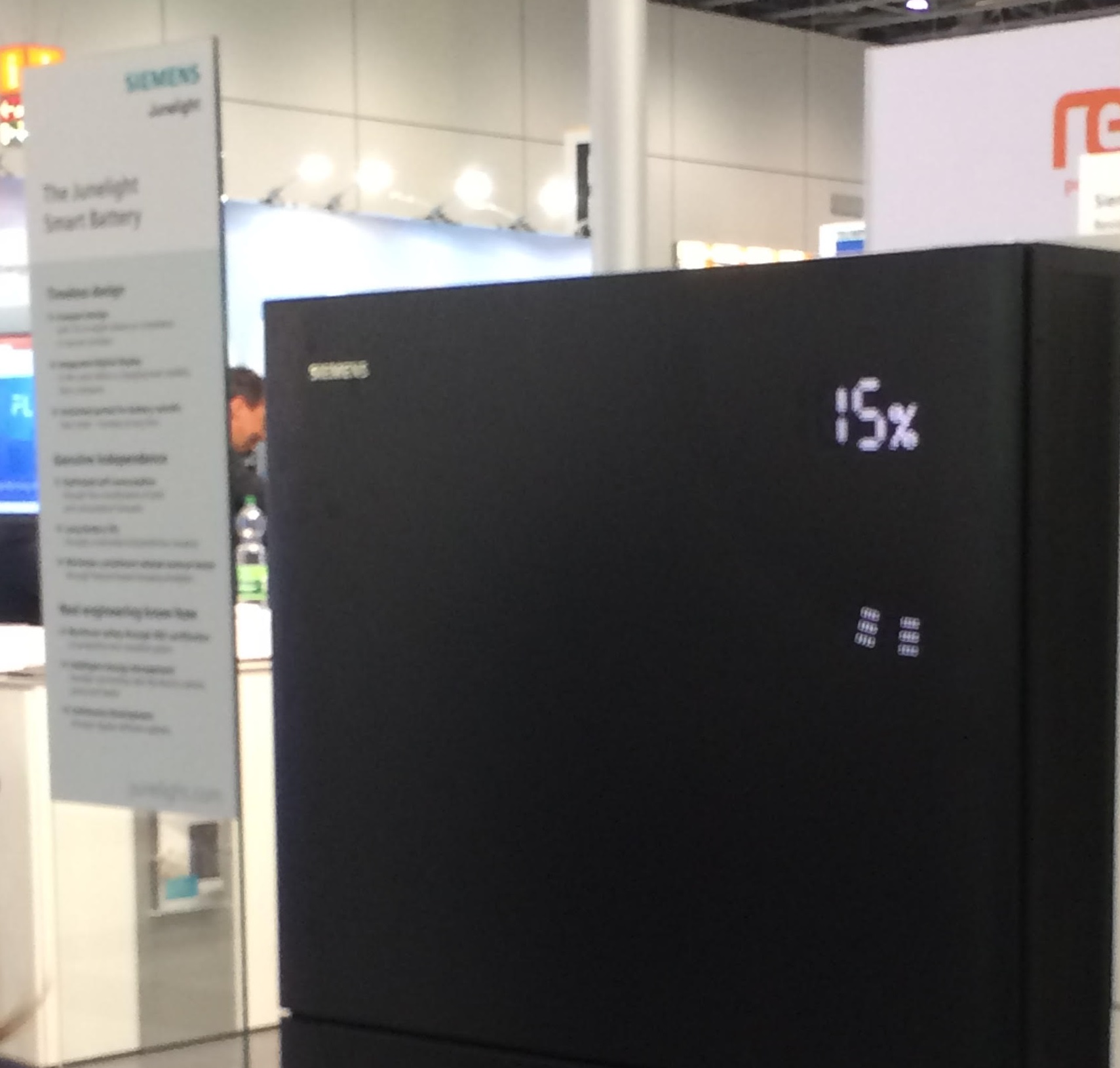
Sales of battery storage units to residential households in Germany are booming, but it’s the value of services the batteries can provide, rather than the hardware itself that offers a long-term economic opportunity, a Siemens representative has said.
The engineering giant became the latest entrant to Germany’s home battery storage market in late February. At last week’s Energy Storage Europe show, Marlon Hassel, global sales and marketing manager for the product said that rather than targeting big profit margins from selling the product itself, it’s the services and opportunities the company’s Junelight lithium-ion systems are capable of targeting in future that are most interesting to Siemens.
Junelight will be marketed to German and Austrian homeowners with PV systems. As heard from other commentators at Energy Storage Europe, as subsidised feed-in tariff (FiTs) come to the end of their 10-year lifespan, the price difference between having to buy power from the grid and simply using what’s stored in the “intelligent home storage system” makes it economical to ‘self-consume’ solar energy.
“The goal is that you can maximise the self-consumption of solar energy, to cover the maximum part of your consumption with your own energy from your solar plant. We use weather forecasts and artificial intelligence to learn about consumption behaviour. Matching both together, you can much better optimise the way the batteries are charged and discharged to reach the goal of high self-consumption,” Hassel said, adding that while the lithium-ion batteries are sourced from suppliers, Siemens designed the system.
Try Premium for just $1
- Full premium access for the first month at only $1
- Converts to an annual rate after 30 days unless cancelled
- Cancel anytime during the trial period
Premium Benefits
- Expert industry analysis and interviews
- Digital access to PV Tech Power journal
- Exclusive event discounts
Or get the full Premium subscription right away
Or continue reading this article for free
“The value add is in the software and the intelligence of the system,” Hassel said.
‘We don’t want to earn money with the storage system itself’
As highlighted by Christoph Ostermann, CEO of rival battery storage provider Sonnen in an interview with Energy-Storage.news recently, the value of behind-the-meter (BTM) or customer-sited energy storage systems begins to rise when the capabilities of grid-connected residential batteries in multiple locations are combined together.
“We don’t want to earn money with the storage system itself. For us the hardware is the basis to [scale it] to services,” Hassel said at the Dusseldorf event.
“We will put all the storage together into a virtual power plant (VPP), we want to trade energy on the spot market and also on the regular energy markets – and we want to aggregate the data and offer digital services for energy management in the future, for smart homes.”
In the interview with Christoph Ostermann, which took place as oil major Shell agreed to acquire Sonnen, the energy storage company CEO said that aggregating systems together to provide grid services had not been an easy business model to set up in Germany. Once established however, it could be a “nice and profitable business”, Ostermann said.
Marlon Hassel of Siemens said that at present, the goal is for Junelight to be sold into as many private homes as possible, typically one or two-family dwellings. The company wants to learn about the “possibilities within this market”, Hassel said, agreeing that to offer digital services efficiently, the company needs to achieve a certain volume of sales. After that, a global rollout can be expected “in the coming years”.
IOT platform allows for cloud-compatibility
Energy-Storage.news asked if Siemens would be developing those aggregation and trading capabilities in-house or from third parties, to which Hassel replied that the company will rely on “experienced partners”, with one such partnership already underway.
“In Germany, we’ve started a cooperation with an energy supplier which is very experienced in the spot markets. There we will develop our own product, a community product, where our goal is that it’s very easy to understand and that customers really save a lot of money or earn money by trading energy on the spot market,” Hassel said.
Siemens has developed its own internet of things (IOT) operating system that can be adapted to incorporate devices and distributed energy resources from competing providers, meaning that in theory, as well as its own Junelight systems, Siemens could “create a VPP with all the different competing batteries”.