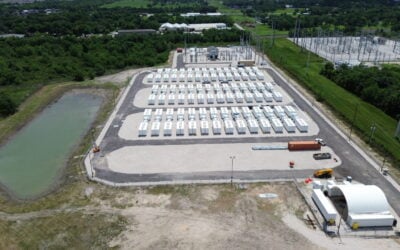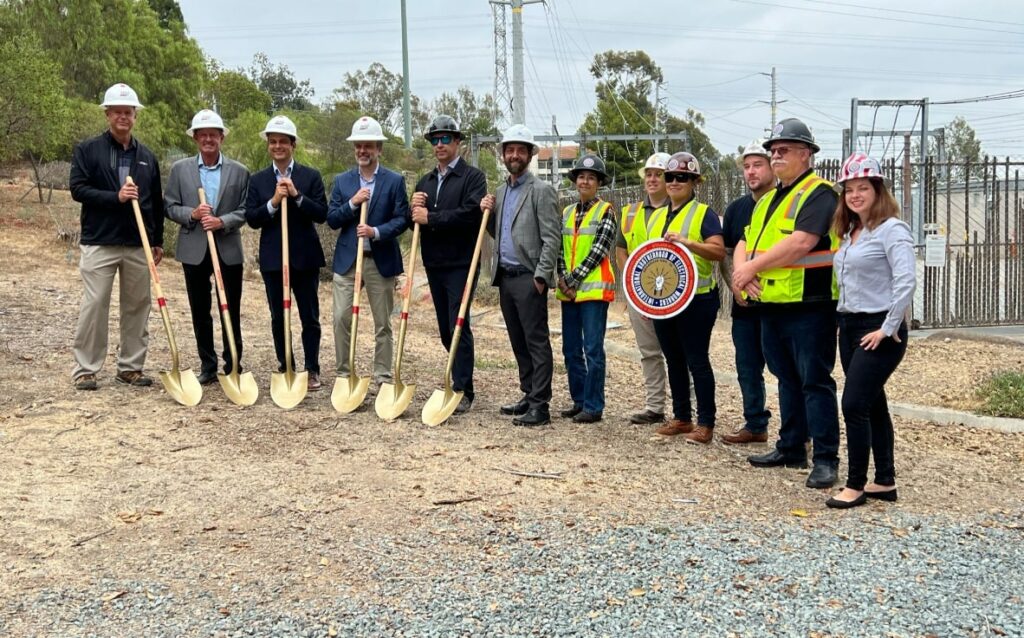
California investor-owned utility SDG&E has completed construction of a 40MW battery energy storage system (BESS) and started work on four storage-enabled microgrids totalling 39MW.
The utility announced yesterday (12 October) it had started testing on the 40MW project in Fallbrook, a small region between San Diego and Los Angeles, and begun building one of the four microgrid projects. It now has 95MW of utility-owned energy storage and another 200MW in development.
The Fallbrook project is a 40MW/160MWh system, with four-hour duration being a condition for providing capacity to utilities like SDG&E under Resource Adequacy, the California Independent System Operator’s (CAISO) means of ensuring there is enough supply to meet demand, plus a reserve margin. The project will be connected to the state’s energy market once testing has been completed.
The Elliott Microgrid in San Diego, the first of the four being built, will be able to provide power to essential services. Those are the Fire Station 39, the Tierrasanta Public Library (which acts as a Cool Zone during extreme heatwaves), Tierrasanta Medical Center, Jean Farb Middle School, Canyon Hills High School, and Tierrasanta and Kumeyaay Elementary Schools.
Try Premium for just $1
- Full premium access for the first month at only $1
- Converts to an annual rate after 30 days unless cancelled
- Cancel anytime during the trial period
Premium Benefits
- Expert industry analysis and interviews
- Digital access to PV Tech Power journal
- Exclusive event discounts
Or get the full Premium subscription right away
Or continue reading this article for free
“Innovations like storage and microgrids are vital to building a more resilient electric grid that can extend the availability of renewable energy into peak demand hours and better prepare communities to manage through emergencies,” said SDG&E vice president of energy innovation Miguel Romero.
As Energy-Storage.news recently reported, BESS capacity had a major role to play in the CAISO grid’s mitigation of extreme heatwaves sweeping the Golden State. CAISO’s latest figures show it had 4,367MW of BESS connected to the grid as of 1 October 2022.
Recent large-scale projects to have been completed and connected to the grid include AES’ 908MWh system, a 387MW co-located BESS from NextEra and a 200MW one from EDF.