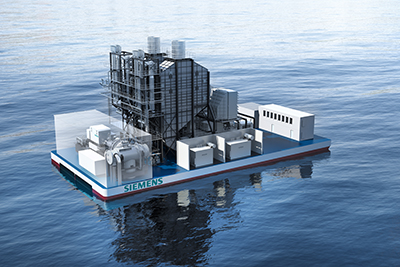
A natural gas power plant that floats on water will be built in the Dominican Republic and equipped with a battery energy storage system supplied by Fluence.
Transcontinental Capital Corporation, an independent power producer (IPP) headquartered in Bermuda and a subsidiary of multinational conglomerate Seaboard, has ordered a barge-mounted power plant from German engineering firm Siemens and Singapore’s ST Engineering.
The floating solution has been selected as a consequence of available land being in short supply, while Siemens said that the project will come in at a lower cost than comparable facilities built on dry land, with the floating platform concept, Seafloat, having been proven in a demonstration and modelling project in a shipyard already according to the company.
Transcontinental already operates diesel-power stations on barges, but the newest, Estrella del Mar III, will run off a combined cycle natural gas power plant with 145MW capacity. Siemens will provide the machinery, while ST Engineering will perform EPC duties, integrate balance of plant equipment and execute the installation.
Try Premium for just $1
- Full premium access for the first month at only $1
- Converts to an annual rate after 30 days unless cancelled
- Cancel anytime during the trial period
Premium Benefits
- Expert industry analysis and interviews
- Digital access to PV Tech Power journal
- Exclusive event discounts
Or get the full Premium subscription right away
Or continue reading this article for free
Within the gas plant, Siemens will integrate SIESTART, the company’s hybrid solutions suite that combines fossil fuel generators with battery energy storage systems (BESS). Technology provider Fluence, which is in fact a joint venture (JV) company created by Siemens with AES Corporation’s energy storage division, will deliver the battery system portion of the project.
Along with two Siemens gas turbines and one steam turbine, a 5MW / 10MWh battery system will be in operation, enabling it to perform frequency regulation applications and to operate the hybrid power plant system “at full capacity with highest fuel efficiency”, Siemens said.
“We’ve already seen both the flexibility and the resilience energy storage provided to the D.R. and its grid during last year’s hurricanes, when AES Dominicana’s storage assets helped prevent widespread outages,” Fluence’s managing director for Latin America, Ismario Gonzalez said.
“The SeaFloat installation adds a fresh innovation – the ability to site a hybrid thermal-storage project where land is scarce, and do so for less cost.”
The project, off the coast of the Dominican capital city of Santa Domingo, is expected to be completed and begin operation in spring 2021. Siemens said that the project and others like it could deliver a diverse range of applications. It could be used as a base load energy generator, provide backup power for disasters and emergencies, could power desalination plants to provide clean water.
The floating platform solution is mobile and designed to be as small as possible, can be built and assembled in shipyards and using equipment and processes that Siemens said have been standardised to reduce lead times for construction. Fluence’s Ismario Gonzalez also added that the batteries could enable both future applications and opportunities in the Dominican Republic.
“[Customer] Seaboard is also taking a long-range view on the project, procuring a two-hour duration energy storage system, which will not only provide frequency regulation services in the short term, but also open the door to delivering additional services as the regulatory environment changes.”
Meanwhile, within renewable energy, floating solar arrays have become something of a hot trend, with one of our publications, the quarterly journal PV Tech Power, making it the focus of its cover story in Vol.14 a few issues back. The hybridisation of fossil fuel plants with battery energy storage has also been reported by Energy-Storage.news and is being attempted in various configurations and to serve applications including increasing the efficiency of existing or new gas power plants.