Image: Sunverge.
Sunverge launches AC-coupled system
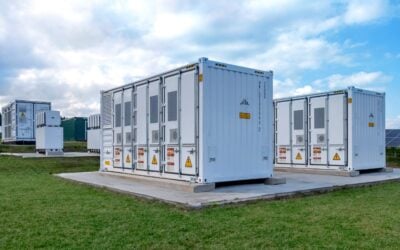
California-based energy storage system maker Sunverge has launched an AC-coupled version of its Solar Integration System (SIS) energy storage devices.
Available to utilities and renewable energy installers, the new model of SIS can be installed as a retrofit to existing PV systems or added to new ones at the point of installation. DC-coupled systems are more closely tied to the PV system, charging only from the PV rather than also being able to charge from the grid and retrofitting can often require additional hardware.
Sunverge has made a name for itself through its behind the meter systems being used for several ‘virtual power plant’ (VPP) projects in territories including Australia, the US and Canada, where the capabilities of several systems are aggregated to form a larger grid asset. The AC-coupled SIS includes that proprietary VPP software.
Try Premium for just $1
- Full premium access for the first month at only $1
- Converts to an annual rate after 30 days unless cancelled
- Cancel anytime during the trial period
Premium Benefits
- Expert industry analysis and interviews
- Digital access to PV Tech Power journal
- Exclusive event discounts
Or get the full Premium subscription right away
Or continue reading this article for free
The product is available in four sizes from 7.7kWh to 19.4kWh. It provides 7kW of peak power, or 6kW continuous, can be installed indoors or outdoors and comes with a 10-year warranty.
RES plays up possible role of battery storage following Australia blackouts
Following South Australia’s widespread blackouts in September, which caused 22 high voltage pylons to fail, Renewable Energy Systems (RES) has claimed that distributed energy supported by energy storage could have played a role in keeping power supplies up and running.
The blackout on 28 September affected 1.7 million residents of South Australia and was initially at least partly attributed to unexpected power reduction from wind farms, an explanation which remains disputed. While some wind farms lost power, the damage to the high voltage lines is considered the real reason why the transmission network failed. The event, dubbed a ‘black swan event’ which could not have been predicted, meant that the network had to undergo a ‘black start’ i.e. power up back to normal from nothing, for the first time in its history.
RES and engineering, technical and business services company Lloyd’s Register Group jointly said that battery storage, combined with low carbon power generation, could help contribute to security of supply. Lloyds Group modelled a simulation of the events described in the Australian Energy Market Operator’s (AEMO) own report and found that so-called ‘inverter based power systems’ could have restored power smoothly.
South Australia, which has adopted increasing amounts of renewable energy recently, is now seeking to overhaul energy policy, partly to ensure such events do not happen again or can be minimised in impact. Lloyd’s Register and RES said they are now looking to develop a 100MW storage battery in South Australia which would cost around £40 million (US$50.31 million).
Younicos to offer expertise to German government ‘blueprint’ region for clean energy
A German government-backed demonstration area for new and low carbon energy technologies has been approved and will benefit from the expertise of system integrator/storage system maker Younicos.
Enera, a 266,500 hectare ‘model region’ will host a four-year trial where various renewable technologies will be brought online in a real-world scenario. The German ministry for the economy and energy this week approved the project, including a €50 million (US$52.82 million) grant of federal funding and handed over an official grant certificate to a consortium led by utility EWE, consisting of 70 different companies and organisations. The project as a whole is expected to cost around €200 million.
As well as the technological aspects of deploying renewables, the region will be used to examine the effect on grids and grid management, market design in the more flexible power systems enabled by renewables and storage and the role of data in optimising energy systems. The region already generates a surplus of renewable energy, which is exported, and the project will look closely at smart grids and their role in implementing clean energy. The project could be considered a ‘blueprint’ for other areas in Germany if successful.
Younicos’ role will include offering expertise on integrating storage and markets to the enera project.
“Enera shows the value of intelligent battery systems for a safe and competitive power supply from renewable energy. But only when storage is efficiently linked with wind and solar production on the one hand, and with the markets on the other, can it deploy its full potential. The key to this is smart software, which ensures that all parts of the system work together smoothly,” Younicos CEO Stephen L. Prince said.
The enera model region. Image: EWE / Younicos.