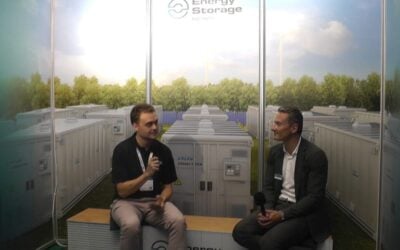
Sonnen chief Christoph Ostermann at the launch in Berlin yesterday. Image: Andy Colthorpe.
Sonnenbatterie, Germany’s market leader for residential energy storage, has launched an energy trading platform that the company believes in time could make it even bigger than today’s existing utility companies, rebranding as Sonnen in the process.
Sonnen held the launch in Berlin on Wednesday at Ewerk, a disused fossil fuel plant that has since been converted into an event space. The new platform, sonnenCommunity, is aimed at enabling trading of surplus power from solar PV coupled with its battery systems.
The concept is that distributed generation, battery technology and digital networking can combine to create a new way of buying and selling electricity without the need for a traditional power company. Customers can make an additional profit to their feed-in tariff (FiT) income and pay what Sonnen described as “significantly below the average of traditional suppliers” for electricity not generated by their own PV-plus-storage systems.
P2P energy trading community
Try Premium for just $1
- Full premium access for the first month at only $1
- Converts to an annual rate after 30 days unless cancelled
- Cancel anytime during the trial period
Premium Benefits
- Expert industry analysis and interviews
- Digital access to PV Tech Power journal
- Exclusive event discounts
Or get the full Premium subscription right away
Or continue reading this article for free
The sonnenCommunity links together Sonnen customers in Germany and can select trading opportunities in real-time, which is vital to the business model, because electricity prices can change quickly and normal billing cycles under most existing utility-based models can take months. The process is automated by Sonnen’s software, so while consumers will have visibility into the trading via smart metering and mobile apps, they will not be required to do anything besides sign up to the scheme.
One of the drawbacks of so-called peer-to-peer (P2P) energy trading has been that the monetary value of the electricity is not considered high enough for the system to work, unless a large amount of scale is built up, or higher-value grid services such as frequency regulation are also provided by the systems.
However, in Sonnen’s case, CEO Christoph Ostermann told PV Tech Storage that the company is not interested in making money from the retail of electricity, while grid regulations prevent aggregated energy storage systems in Germany from participating in providing grid services – although Sonnen has participated in some trials of this latter model on a limited basis.
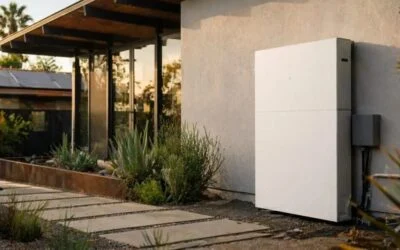
For a subscription fee, households without their own PV or batteries can also participate in the scheme, which trades surplus energy from Sonnen’s PV-plus-storage systems via the grid. Image: Andy Colthorpe.
Platform could undercut Powerwall on price in rapidly commoditising market
Instead, Ostermann said, with the new “virtual pools” of connected energy storage systems, it wants to become a service provider for its customers. Ostermann also explained this was also part of the thinking behind removing “batterie” from the brand name. This appears to be a trend in both solar and storage, where commoditisation of solar panels and increasingly batteries, is making it difficult for companies that provide hardware to differentiate on anything but price.
Having said that, from the figures given yesterday, Sonnen appears prepared to be competitive on hardware prices too. The systems could even undercut Tesla’s much-anticipated Powerwall. At Tesla’s stationary storage launch in April, the EV-maker’s CEO Elon Musk gave a price of US$3,000 for a single residential unit – with the price excluding essential non-battery hardware, including power electronics.
Tesla’s German rival said it will launch SonnenCommunity at a cost of EUR3,599 (US$3,818) including VAT – including everything to make it ready to connect, excepting the installation cost. Existing Sonnenbatterie customers are expecting to be offered a significant discount.
Sonnen’s managing director for sales, and former Tesla employee, Philip Schroeder told PV Tech Storage that another important facet of the community model is that people without solar panels – or a battery system – could also join the scheme, paying a subscription of less than EUR10 a month to benefit.
Overtaking utilities in 10 years
If the company could gain significant levels of participation both from these non-PV-plus-storage hosting households as well as purchasers of systems, Sonnen could become as big as a conventional utility in 10 years, Schroeder claimed.
“Most of all there are two trends behind [SonnenCommunity]. The decentralisation of energy, so that you are decentralising energy production via solar and other distributed generation sources, is the first. The second underlying trend is the internet and digitalisation. We have smart meters available that enable us. This would have been impossible 10 years ago and even five years ago it would also have been an issue,” Schroeder said.
“It’s decentralised clean, affordable energy and on the other hand you have an amazing learning curve software-wise. This will push this business concept quite rapidly.
“So in Q1 2016, we are starting this scheme. You can apply today and in 10 years we want to be bigger than E.On! We want to be aggressive and fast-growing.”