
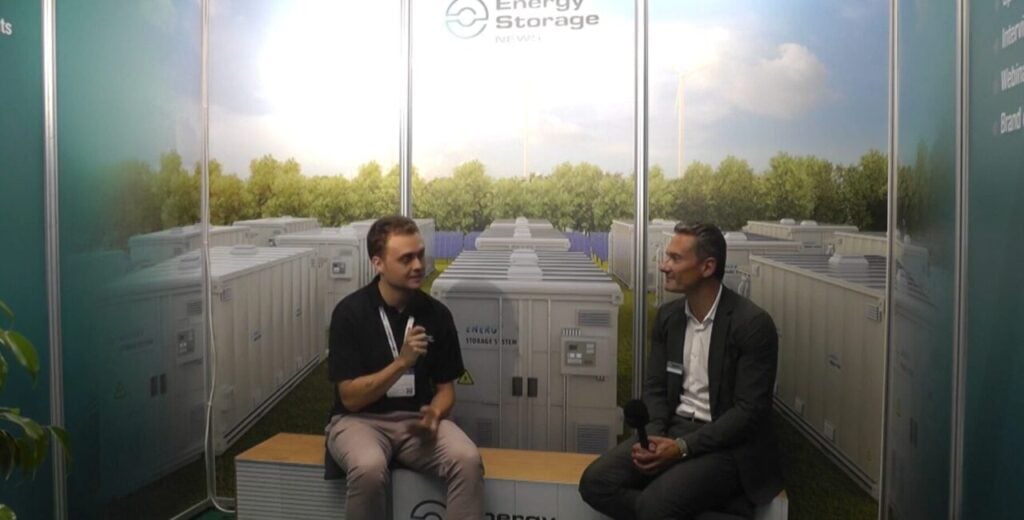
BESS deployments in Europe are growing exponentially year-on-year, but is asset management, operations & maintenance (O&M) and data given enough priority? A data executive from BayWa r.e. discussed the topic.
Simon Slapka, MD for Data Services at the Germany-based renewables developer and services provider sat down with us at the Smarter E Europe trade show and conference in Munich last month for a chat on the state of play for operating large-scale battery energy storage systems (BESS). See the full video and write-up below.
The prompt for our discussion was BayWa r.e. successfully landing an eight-year asset operations service contract for the 137MW/282MWh BESS in Lower Saxony, owned by investor Scale Fund, in May. It could be the largest in Germany when it comes online in Q3 this year.
‘Not enough priority given’ to operations
We started by asking Slapka how he sees the status of O&M within the battery storage industry in terms of the priority given to it, the performance in the industry and risk sharing between parties.
Try Premium for just $1
- Full premium access for the first month at only $1
- Converts to an annual rate after 30 days unless cancelled
- Cancel anytime during the trial period
Premium Benefits
- Expert industry analysis and interviews
- Digital access to PV Tech Power journal
- Exclusive event discounts
Or get the full Premium subscription right away
Or continue reading this article for free
“On the one hand, from a purely technical perspective, of course there is maturity in the market, as the technology in principle is not that new and you can copy a lot of on-site services that we know from PV technology into BESS. Many components are similar, and the technology is not so complex that we aren’t able to manage multiple sites,” Slapka explained.
“However, the whole value chain is relatively immature. So we see that the manufacturers, system integrators, they do not put a lot of priority on the operations. They’re focusing a lot on building bigger plants and on selling assets. So we see that the whole asset sale and build is growing three times faster than the actual operations of the assets.”
“So the real challenge at the moment in the market is that there are not enough technicians out there, that there are not enough asset managers who are capable and experienced enough with batteries to actually assess the risks and act appropriately.”
After all, it’s still a relatively young industry, relatively young technology, with a lot of immaturities which we see in the market. So this is really at the moment an area which needs some improvement over the next years.”
He said that this is reflected in the fact that his asset managers spend 40% of their time dealing with system integrators and OEMs. Batteries arrive delayed and uncharged, systems are imbalanced or have irreversible chemical damage.
Slapka said: “At the end of the day, these are effectively chemical plants that are a relatively risky technology, and it’s a lot of time that you need to invest to make sure an asset is brought to a mature and good stage so that the customer gets the performance they paid for.”
Portfolio asset management, technical asset management, O&M and LTSAs
Slapka was also keen to emphasise that you need to define your terms in this area. There is asset management and then there is O&M done by blue collar workers.
Within asset management, there is technical asset management, which looks at a BESS project’s operating parameters, and there is portfolio or financial asset management, which would most likely be done by an executive of the investor that owns the project. But technical asset management would typically be outsourced.
“The investor’s asset manager would look at 20-30 assets, maybe, and purely look at financial performance. Then we as a technical manager look in detail at each rack in the container, is it out of balance, is there a temperature problem. These are entirely different jobs,” he says. “But it depends what kind of customer you are talking about.”
We would suspect this is true for financial investors owning projects, like the Scale Fund. Big integrated power firms and utilities like RWE and Engie, or even BESS platforms like BW ESS, may well look to have those technical capabilities in-house.
Within technical asset management, Slapka explains that typically a BESS project owner will sign a long-term service agreement (LTSA) with the BESS supplier which covers the servicing of the container itself. Everything outside of the container is out of that scope, and for the O&M and asset management of that typically a third party (like BayWa r.e.) would be brought in.
Cybersecurity is another key area for BESS and managing that risk is also typically provided by a third party. System integrator Fluence’s Lars Stephan discussed this at the event in a video interview too, see that here.
Don’t lock yourself into an LTSA?
On LTSAs, however, Slapka says that BayWa r.e. typically advises its customers to have contract stipulations enabling them to terminate the LTSA after certain thresholds in their lifetime after 2-5 or eight years.
“That way they can potentially make smarter decisions when we have enough data about the asset and really can predict ourselves the availability, performance and degradation of it,” he says.
Data capabilities helped it win Alfeld contract
The company’s asset operations contract for the Alfeld project reflects this, with the LTSA sitting with the BESS manufacturer and only covering everything with the container. BayWa r.e. meanwhile is responsible for:
- Technical asset management including 24/7/365 remote monitoring
- Advanced data analytics for client reporting regarding BESS system health, performance and safety
- Data management
- Operational technology (OT) & cybersecurity services including attack detection management
- Commercial asset management
- On-site preventive maintenance of the balance of plant (BOP) components
Slapka says BayWa r.e.’s data capabilities helped it win the contract. BESS assets generate easily 100 times more data than comparable PV plants, he says, with every cell transmitting second-level granular information. BayWa r.e. Data Services has a competitive advantage because it approaches battery operations from a data-first perspective rather than traditional O&M services, enabling it to process vast data volumes and meet stringent cybersecurity requirements, Slapka claims.
“We come from the data side and are now growing into battery technology whereas others are coming from pure O&M. They of course can service the asset but have a hard time to make sense of the vast data they are getting, and also fulfil the cybersecurity requirements.”
Slapka sees big potential in better use of data in the industry. Batteries are active, not passive assets requiring real-time management. Manufacturing defects and cell imbalances are nearly inevitable, but comprehensive data access enables optimisation from day one—balancing revenue generation across multiple markets while maximising asset health and longevity. That data represents untapped value, with BESS complexity offering significantly higher optimisation potential than other renewable technologies.
BayWa r.e. is part of the industrial conglomerate BayWa Group.
BESS asset management is now the focus of four of our publisher Solar Media’s Battery Asset Management (BAM) Summit series. They are:
- BAM Australia | 25-26 August 2026 | Sydney
- BAM USA | 15-16 September 2026 | Anaheim
- BAM UK & Ireland | 13-145 October 2026 | London
- BAM Europe | 2-3 December 2026 | Rome
Use our discount code ESN30 for a 30% discount on tickets.
