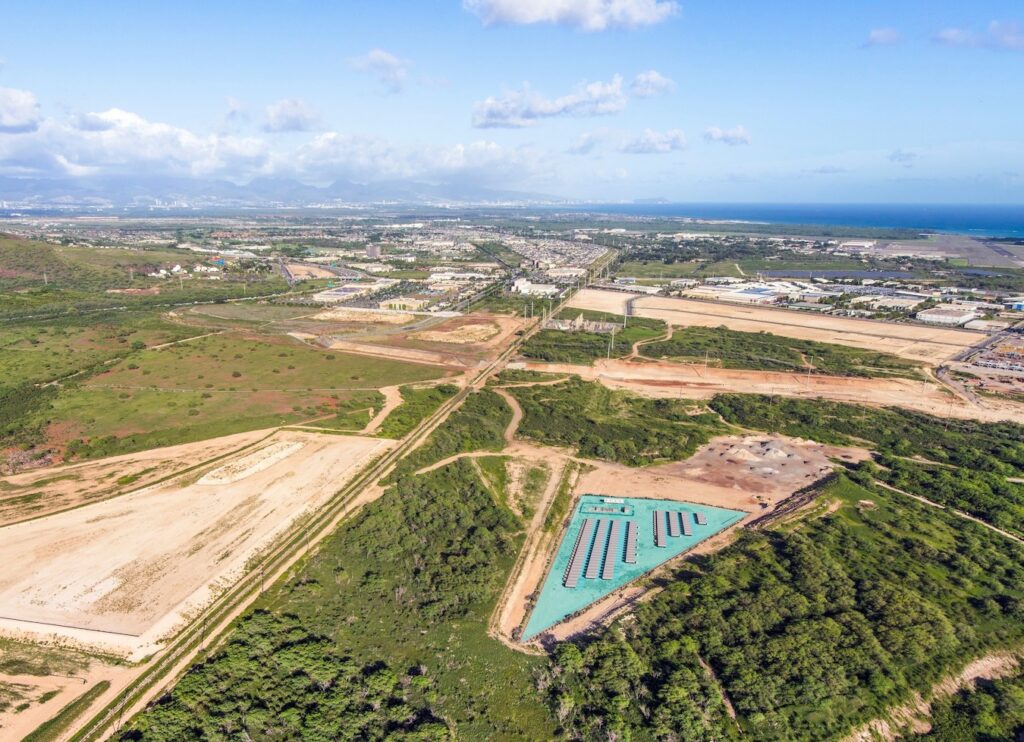
US$219 million of financing has been secured by developer Plus Power for the 185MW / 565MWh Kapolei Energy Storage (KES) project in O’ahu, Hawaii.
Plus Power said earlier this week that it had closed the credit facility comprising US$188 million in non-recourse construction debt and US$31 million in letters of credit, through financing led by Mizuho Securities USA and KeyBank.
Silicon Valley Bank and CoBank also joined in the facility for the standalone battery energy storage system (BESS) project, on which construction began in August. It is scheduled to go into operation during 2022.
A power purchase agreement (PPA) was signed for KES with utility Hawaiian Electric in late 2020. The facility will enable the retirement of Hawaii’s last remaining coal power plant, the 180MW AES Hawaii Power Plant.
Try Premium for just $1
- Full premium access for the first month at only $1
- Converts to an annual rate after 30 days unless cancelled
- Cancel anytime during the trial period
Premium Benefits
- Expert industry analysis and interviews
- Digital access to PV Tech Power journal
- Exclusive event discounts
Or get the full Premium subscription right away
Or continue reading this article for free
Plus Power’s contract award was made following a competitive solicitation round in which Hawaiian Electric also handed contracts to 15 other projects, including solar-plus-storage and standalone energy storage.
Kapolei Energy Storage is the largest energy storage project selected by the utility in a procurement round to date. It will provide capacity and allow the utility to store energy generated at off-peak times and times of abundant renewable energy generation, shifting it to be used when demand peaks.
The BESS will also be used to deliver 50MW of fast frequency response services to the local grid and support Hawaiian Electric by providing virtual inertia and blackstart capabilities to maintain grid stability and enable offline power plants and other infrastructure to be brought back online quickly.
There had been some challenges in the project’s development, as although the regulatory Hawaiian Public Utilities Commission (PUC) had approved the September 2020 PPA, it retained some concerns that the batteries could be charged using fossil fuel energy with the project set to come online before sufficient renewable capacity buildout.
However after negotiations, an agreement was reached and PUC gave its approval.
“This landmark financing highlights Plus Power’s ability to execute on projects that deliver energy, capacity and grid services for our customers and attract capital from top tier financiers like Mizuho and KeyBank,” Plus Power’s general manager Brandon Keefe said.
Plus Power focuses on standalone battery storage project development and has other large-scale projects in development around the US including proposed facilities in Maine (175MW / 350MWh), Massachusetts (150MW / 300MWh) and Georgia (150MW / 600MWh) that it hopes it can bring online by the end of 2024.
“Very rapid growth in standalone battery storage projects will be needed to transition the grid to 100% renewable energy,” Keefe said.
“Should standalone energy storage become eligible for the federal production tax credit, matching access by hybrid energy storage, we will be able to expedite gigawatts of Plus Power projects to support wholesale markets.”
The success Plus Power is having so far is in contrast to the recent abandonment by ENGIE North America of a solar-plus-storage project on Hawaii Island that it was awarded a contract for by Hawaiian Electric in the same procurement round.
ENGIE North America cited elevated interconnection costs, as well as issues with supply chain, production and tariffs and trade disputes that are affecting the global solar PV industry as reasons for ditching the project and 25-year PPA.
Meanwhile, Hawaiian Electric said in a draft Request for Proposals (RfP) for a renewable energy procurement for Hawaii Island that it wants all solar PV project bids in the forthcoming round to include energy storage.