
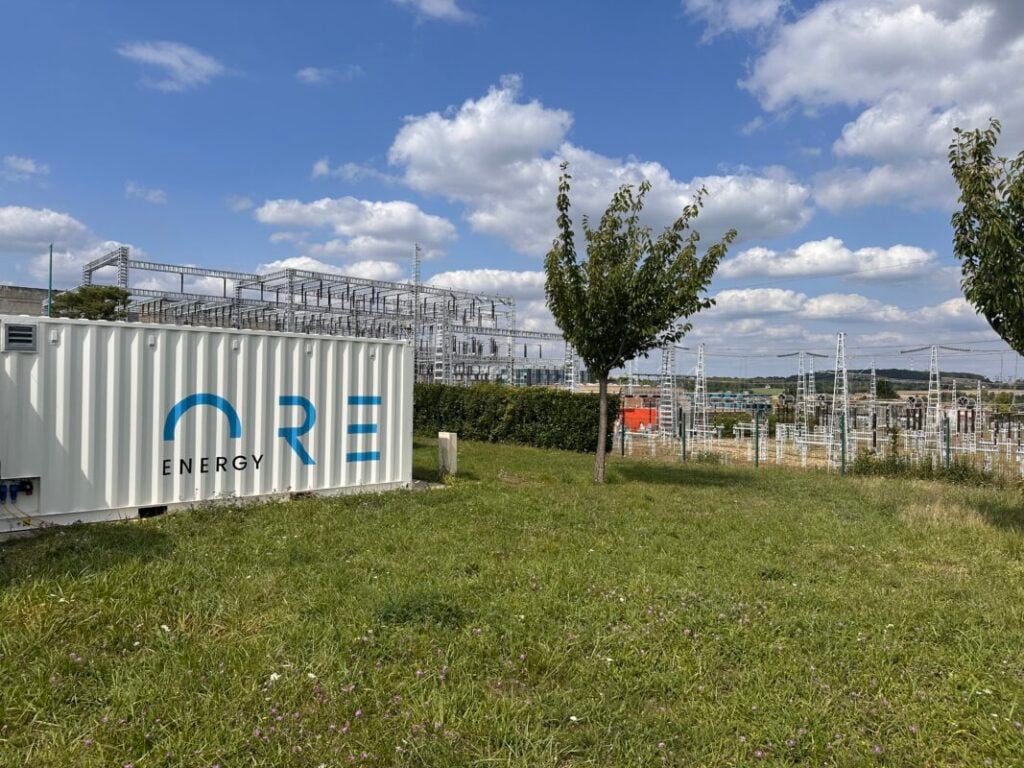
We look at the iron-air battery technology of startup Ore Energy, including how it works and technology developments it is pursuing after a recent US$43 million fundraise.
Ore Energy latest funding round
Netherlands-based Ore Energy has been developing its technology over the last few years and raising money along the way. In a recent funding round, Ore Energy secured US$43 million of Series A funding to take its iron-air BESS technology to the next level of commercialisation. This latest funding round brings the total raised by Ore Energy to US$61 million. The funding will help Ore Energy establish its first manufacturing facility, with plans to reach GWh-scale manufacturing by 2028.
Ore Energy has also just completed its second grid-connected pilot project with EDF in France and has recently signed an agreement with Dutch utility company Budget Thuis for a large-scale commercial deployment. So, both the technology and financial rounds are helping Ore Energy move towards becoming a commercial success.
Technology built for long duration
Ore Energy has developed grid-scale iron-air batteries that have been designed for long-duration energy storage at a claimed lower cost per kWh than Li-ion.
Try Premium for just $1
- Full premium access for the first month at only $1
- Converts to an annual rate after 30 days unless cancelled
- Cancel anytime during the trial period
Premium Benefits
- Expert industry analysis and interviews
- Digital access to PV Tech Power journal
- Exclusive event discounts
Or get the full Premium subscription right away
Or continue reading this article for free
Beyond 8-12 hours discharge time, the low-cost materials used means that the iron-air BESS has a lower marginal cost per additional hour of storage beyond 8-12 hours when compared to lithium-ion, the company says.
The iron-air system has been designed for 24 to 100 hours discharge times, and while a specific levelised cost of storage (LCOS) has not been given (due to use case and geography differences), Ore Energy has stated that the systems will have a lower LCOS than lithium for LDES applications.
Iron-air batteries have been designed to deliver a slower energy release over multiple days. By providing small amounts of energy for longer, iron-air batteries could help to fill energy shortages when there is a low renewable energy output.
The iron-air system developed by Ore Energy uses only iron, water and air and is therefore not reliant on critical and often geopolitically strained metals such as lithium or cobalt and can be built completely within the European supply chain. This also means that the technology is decoupled from conventional battery supply chains.
In terms of the specifications that are available for the iron-air BESS, iron-air batteries have a theoretical energy density of 1,200Wh/kg with a deep discharge capability. Iron-air batteries have a much lower round-trip efficiency (RTE) than lithium-ion, of around 40-50%, and the BESS have been designed for at least 20 years use.
The iron-air technology behind the BESS
Iron-air batteries work very differently to lithium-ion batteries. In lithium-ion batteries, lithium ions travel between the electrodes and intercalate within the electrode pores, facilitating the transfer of electrons between the battery and an external circuit. This process enables the battery to charge (receive electrons from the circuit) or discharge (remove electrons from the battery to the circuit).
This is how most batteries today work. Iron-air batteries, however, work on the principle of reverse rusting. It is a type of metal-air battery that uses iron as one electrode, and oxygen from the surroundings of the battery as the other electrode (which is really a reactant), with an aqueous-based electrolyte. In the iron-air cells, there is an iron electrode that oxidises into rust when the cell discharges and de-oxidises back into iron metal again during charging. This means that the iron electrode rust (oxidises) and de-rusts (de-oxidises) while cycling.
When the battery is discharged, oxygen from the surrounding atmosphere outside of the cell is drawn inside the cell. Once inside the cell, the iron reacts with oxygen causing it to undergo oxidation, forming rust (iron oxide). Rust forms in the presence of water and oxygen, hence the need for an aqueous electrolyte. The water-based electrolyte also allows the circulation of electrons between the electrodes using hydroxyl ions as a transfer medium. The formation of rust changes the valence state of the iron from Fe2+ to Fe3+, releasing an electron in the process. The formation of rust is also governed by the following equation:
4Fe(II) + 3O2 + xH2O à 2Fe(III)2O3 . xH2O
The release of an electron during rusting is released into the external circuit, much like when an electron is released from a lithium ion once it intercalates within the anode. This can then be sent to the grid or other assets that need to be powered.
During charging, the reverse reaction occurs and the iron de-rusts and de-oxidises. This process is simple. Once electrons from an external circuit introduces electrons back to the rust, the iron reduces, changing from a Fe3+ state back to a metallic Fe2+ and releases oxygen back to the surrounding atmosphere in the process. In essence, the charging and de-rusting resets the system ready to be rusted again.
The reaction itself is a straightforward and simple reaction in chemical terms. However, despite its simplicity, once introduced into the battery for storing and releasing energy, the cells do require efficient airflow management governed by system control, moisture balance, and electrolyte stability to maintain long-term performance.
Upsides and downsides
The BESS can discharge at full power for up to four days and the cells are housed inside 40-foot containers, that enables up to GWh-sized storage systems to be installed. However, as with any technology, there are upsides and downsides.
First, the positives of the iron-air technology. Because the cells use non-flammable aqueous electrolyte chemistry, there is no chance of thermal runaway occurring, unlike in lithium-ion batteries. This makes large installations much safer, particularly in areas where there is a dense population.
Second, the materials used to create the iron-air BESS are much cheaper than lithium-ion batteries and a lot more readily available. Where critical rare earth metals are getting more expensive, iron is one of the most abundant elements on earth (about 5% of the Earth’s crust) and is already produced in many countries around the world. So, the supply chain risks are a lot lower, which may become more important in the future as resources dwindle, and political differences continue to cause global fracture. Finally, they can be designed for very long discharge times and are more economical at these durations than other batteries, with the modularity making them easy to scale.
However, there are some downsides to iron-air technology, and this is not just related to Ore Energy, but also Form Energy and any other iron-air BESS manufacturers that come after them.
Iron-air BESS are a lot heavier and bulkier than lithium-ion BESS. Iron-air batteries are also a lot less efficient with a much lower volumetric energy density, so the combination of bulkiness and lower efficiency means that iron-air batteries require a lot larger footprint than lithium-ion BESS for the same capacity. For many grid applications, this will not be an issue as many installations are not space constrained, but urban installations and other installations where there is limited land available may have to grapple with this footprint trade-off.
Where the BESS is already being deployed
As noted above, Ore Energy has already completed some grid connected pilot projects and is now looking towards larger scale commercialisation.
The EDF grid-connected pilot project at EDF Lab les Renardières in France was recently completed and was designed to show how the 100-hour LDES could feasibly be used over extended time periods, with an emphasis on system behaviour, control, and integration. A pilot project that was previously trialled in Netherlands focused on whether the iron-air BESS could reliably and safely connect to the grid and work as intended. So, the second pilot project has taken the commercial feasibility of the system through the next stages.
The pilot project didn’t focus on performance metrics such as RTE or degradation rates, but instead, the BESS was cycled over several months to see its operational characteristics in a real-world utility setting. During the project, the BESS was cycled under different load profiles and seasonal conditions to evaluate the charge/discharge behaviour of the BESS, as well as the system responsiveness and how well it integrated with standard grid management approaches.
Ore Energy is now taking the next step towards full utility commercialisation after the announcement of an agreement to supply up to 1GWh of iron-air BESS to Budget Thuis. This could take the commercialisation to the next phase because it is a large volume of BESS that will be tied to a real utility project involving an energy supplier. The aim of the project is to store excess wind energy when there is a high generation and release it back to the grid during low generation periods and electricity prices are higher. The agreement will start with 400MWh being delivered in 2028, with the rest delivered at a later date.
Ore Energy developing second generation iron-air cells
Ore Energy has also been involved in a European Innovation Council (EIC) accelerator project called F-AIR BAT to improve its technology and market access. Outside of the go-to-market strategies devised the project, which identified that key markets for their BESS include wind co-location deployment, integrated energy suppliers, and data centres, there has also been some key technical developments.
One aspect of the project centred around improving the core iron-air cell design and the creation of a second generation (Gen2) of iron-air cells with better optimised electrode materials and structures, refined electrolyte compositions, and improved air flow conditions.
The project also focused on improving the battery stack and pack assembly. This part of the project integrated the Gen2 cells into larger systems and tested stack configurations, tested the stacks with a new battery management system (BMS), and combined multiple Gen2 stacks into battery packs with the required auxiliary equipment for pilot-scale operations. The final technical element of the project involved a third-party validating the Gen 2 cells, the battery stacks, and the new battery packs under relevant operating conditions.
Some results of the project, and in turn the Gen2 cells, has already been released, while some tests are still ongoing. The Gen2 cell technology has already moved from lab test to pilot operations, and test results to date show that the Gen2 cells have a better electrochemical stability and performance than the first-generation cells. At the stack and pack level, the BMS has been fully integrated and the Gen2 cells can now be controlled at a system level.
Real-life pilot validation is currently ongoing, but the pilot operation is already showing that the Gen2 technology can run outside of the lab without issue. The next stages to ensure that the Gen2 becomes a commercial success involves continuing to evaluate the BESS at a commercial scale, including analysing multi-container interactions for modular setups, completing certification and compliance testing to meet regulatory requirements, and scaling up of manufacturing and supply chains to reach cost targets.
If the Gen2 system can reach these commercial scales it’s expected that they will be co-located with wind and solar assets and used as a multi-day storage medium—helping to reduce renewable curtailment and replace fossil fuel back-ups during low harvesting periods.
