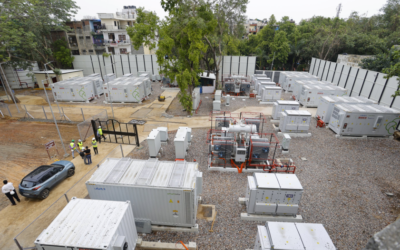
The announcement follows SunEdison’s agreement with the state government of Karnataka in India to build 5GW of subsidy-free wind and solar. Image: SunEdison.
US renewable energy developer SunEdison is planning to power rural electrification and micro-grid projects in India with vanadium flow batteries, announcing that it plans to purchase 100 megawatt hours-plus from Imergy Power Systems.
According to SunEdison’s website, the company plans to effect a change for over 1.5 billion people around the world who lack basic access to electricity, starting by bringing solar electricity to 54 villages in India with a combined population of around 7,800 people. Micro-grids with battery storage will be paired with 241kW PV arrays, with the company apparently pledging to transfer operation of the micro-grids to the local population within five years of their going online.
India seems like an appropriate place for SunEdison to undertake this mission. Dr Rahul Walawalkar of the India Energy Storage Alliance, blogging for PV Tech Storage in November last year, wrote about the 100 million or so households – representing around 400 million people in a total population of 1.2 billion – that lack even basic access to electricity.
Coupled with policy initiatives and support from the current administration of prime minister Narendra Modi, Walawalkar said he was enthusiastic about the scope for “energy infrastructure transformation”. At present, however, as Walawalkar’s colleague Harsh Thacker wrote in another guest blog at the beginning of this year, also for PV Tech Storage, the local energy storage industry is dominated by lead acid, although Panasonic plans to begin production of lithium-ion batteries in the country later this year.
Try Premium for just $1
- Full premium access for the first month at only $1
- Converts to an annual rate after 30 days unless cancelled
- Cancel anytime during the trial period
Premium Benefits
- Expert industry analysis and interviews
- Digital access to PV Tech Power journal
- Exclusive event discounts
Or get the full Premium subscription right away
Or continue reading this article for free
The world’s biggest renewable energy developer will use vanadium flow batteries as part of its rural electrification and micro-grid project in India. Image: SunEdison.
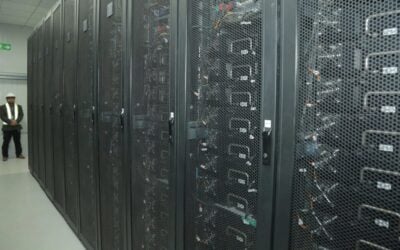
In the instance of SunEdison’s latest announcement, flow batteries are the technology of choice, using liquid electrolyte to store energy and providing scope for scaling up of battery size. They are more commonly used in larger scale energy storage applications than lithium-ion or lead acid batteries.
Imergy’s vanadium flow batteries have been used in a number of recent micro-grid projects and test installations, including a trial with the US Navy. The company claims its use of recycled environmental waste in battery production helps it to lower costs.
The forthcoming deal also marks the second of two big moves into storage for SunEdison, which recently also purchased US grid-scale storage start-up Solar Grid Storage. SunEdison also became the biggest renewable energy developer in the world in the past few months, after diversifying its portfolio with the US$2.4 billion acquisition of First Wind.