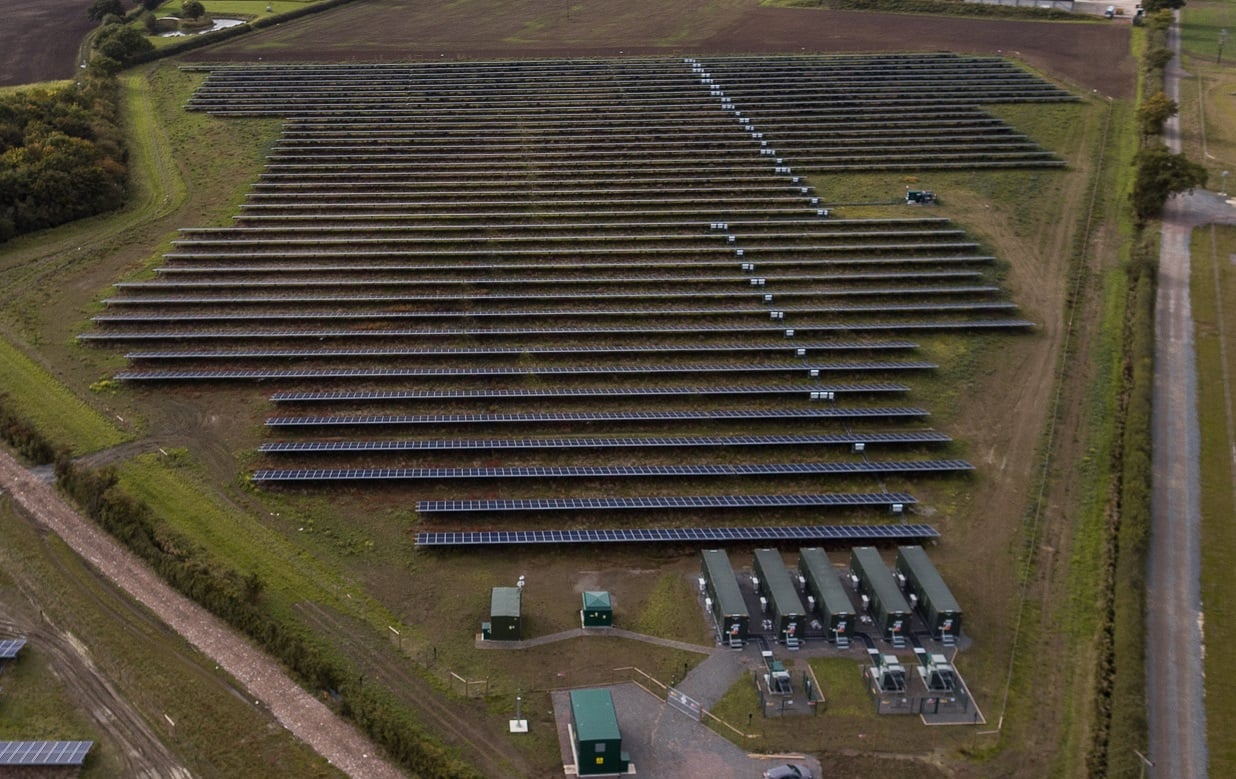
Co-located battery storage’s ability to help mitigate risk and counter renewable yield compression has been hailed as a “fantastic opportunity” by renewables investor Bluefield Partners’ investment director Jan Libicek.
Speaking on a panel at this week’s Energy Storage Summit 2021, Libicek said that when it comes to financing, energy storage remained “firstly a question of confidence”, but deemed that the finance community can no longer ignore the potential of energy storage assets and in particular, co-located sites.
The technology offers a “fairly elegant way to counter the yield compression trend that we’ve seen across virtually all renewable energy markets”, he said, explaining how even in markets where most renewables development is subsidy-free, huge influxes of capital is causing project yields to fall.
“The fact that you can now add storage as an additional co-located element to your project could counter that trend,” he said, suggesting that co-located energy storage may be a way for investors such as Bluefield to continue to operate in emerging markets. He went on to give the example of Spain, where subsidies are beginning to run out, which creates “a completely new risk for investors to deal with”.
Try Premium for just $1
- Full premium access for the first month at only $1
- Converts to an annual rate after 30 days unless cancelled
- Cancel anytime during the trial period
Premium Benefits
- Expert industry analysis and interviews
- Digital access to PV Tech Power journal
- Exclusive event discounts
Or get the full Premium subscription right away
Or continue reading this article for free
“You can now to some degree mitigate that risk with storage” he said, describing this as a “fantastic opportunity” and stating that he believes the financing community is “ready to invest”.
Indeed, Libicek described Bluefield as being “bullish” about storage, a phrase also used by Equinor’s project director, energy storage development, Tim Woodcock, who described his company’s view on the UK for battery storage as such.
The UK was also voted the most attractive country for co-located battery storage in an audience poll conducted during the panel, securing 36% of the vote, with this followed by Spain at 23%, then the Middle East at 14% and 9% each for Ireland, Portugal and Italy.
The market for battery storage in the UK in general is largely attractive, especially as the country moves away from having a grid that doesn’t require much flexibility to one with a higher need for these services in light of increasing volumes of renewables. Services such as Dynamic Containment – a flexibility market offered by system operator National Grid ESO which is often described as a lucrative source of revenue due to its relatively high prices – are also providing strong revenue streams, with Chris Morrison, managing director of the Green Investment Group, describing the UK as having been “at the forefront” of the growth in flexibility markets.
Aazzum Yassir, sales director, EMEA at Honeywell Process Solutions, said that the “fundamental question we need to ask is will the future grid operate without energy storage, and it’s very apparent right now that that is likely not going to happen” especially in light of renewables targets such as the 40GW of offshore wind by 2030 goal of the current UK government.
“You can’t just rely on variable energy sources, you need some form of storage to really provide that inertia, constraint management piece”, Yassir said, adding that in the next few years it’s likely that Black Start contracts will start to be awarded to renewable energy sources, with the “only way to provide that through wind and solar being to have some form of energy storage”.
Already, National Grid ESO is running the three-year Distributed ReStart project exploring how distibuted energy resources can be used to restore power in the event of a total or partial shutdown of the electricity transmission system, with results expected in March 2022. Additionally, the electricity system operator is running competitive tenders for Black Start contracts, which it has said will lead to increased competition and encourage non-traditional providers to offer Black Start services, enabling it to operate a carbon free network securely.
When it comes to large co-located projects, there are some “distinct benefits and some barriers to opening up the flood gates”, according to Woodcock, who pointed to how Equinor’s Batwind project – a 1MW/1.3MWh battery storage solution paired with the offshore wind farm Hywind Scotland – was an opportunity for the company to learn about those benefits and barriers.
He detailed how Equinor had been unable to participate in the frequency regulation markets or capacity markets or “even directly in energy arbitrage” because of the nature of its coupling with Hywind, however “those markets could be made available to coupled renewables with storage” he said, pointing to how this is the case in the US and other markets.