Moving from today’s gas stations to their electrified equivalent can present a challenge so “dramatic” that in some cases, microgrids may be the only viable solution, a representative of Schneider Electric has said.
Schneider Electric already provides standardised solutions for refuelling stations based on internal combustion engines and is near ubiquitous in that market in the US in particular. Andy Haun, senior vice-president and chief technology officer (CTO) at Schneider’s microgrid division told Energy-Storage.news that in the transition from centralised fossil fuel generation to distributed, lower carbon energy, in order to provide financial benefit, environmental benefit as well as the increasingly important aspect of resiliency – “to do all three of those things together you actually have to have a microgrid”.
The company is offering bundled packages of microgrid solutions that can integrate solar PV, batteries and other technologies such as generators for backup to provide electric car charging “as a service”. Haun said that the company’s microgrid technologies including charge controllers and integrated with its Ecostruxure internet of things (IOT) solution hits a real “sweet spot” for installations between 1MW and 5MW where the impact of charging several electric vehicles from the grid can be “dramatic”. Such microgrids would be grid-connected, but capable of being islanded from it in the event of power outages or natural disasters.
“Our ability to put islanding – integrated, automated with load shedding with the asset controls – and the grid interactivity allows a microgrid to be completely serving a site for its critical loads, essential loads for its carbon footprint and its low-cost energy,” Haun said.
Try Premium for just $1
- Full premium access for the first month at only $1
- Converts to an annual rate after 30 days unless cancelled
- Cancel anytime during the trial period
Premium Benefits
- Expert industry analysis and interviews
- Digital access to PV Tech Power journal
- Exclusive event discounts
Or get the full Premium subscription right away
Or continue reading this article for free
‘Opportunity to put in charging as a service infrastructure’
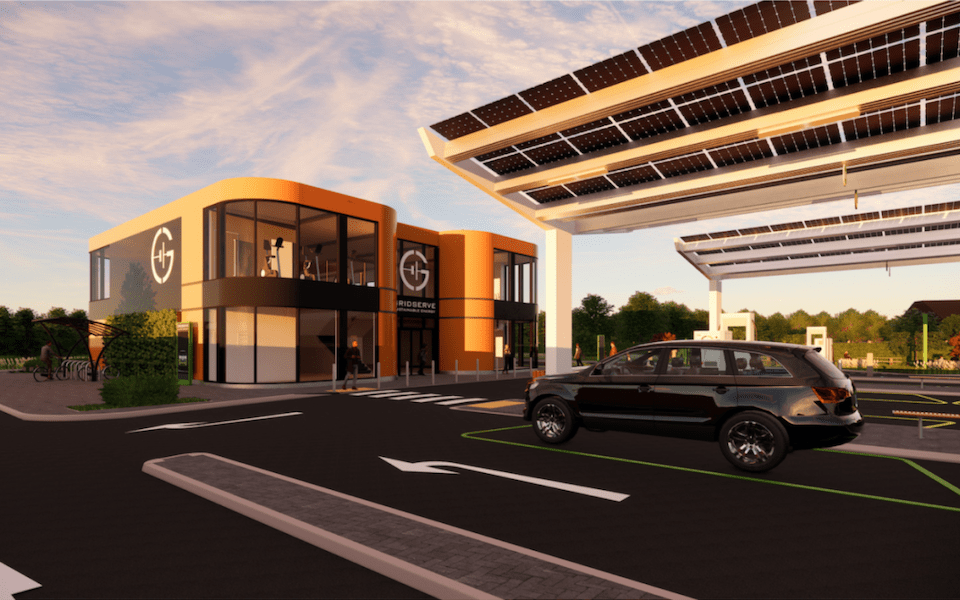
The UK recently got its first-ever ‘electric forecourt’, where EVs can be charged with solar power, and more are on their way from developer GridServe after it struck a partnership with tech giant Hitachi. Energy-Storage.news also just reported on the deployment of 2MWh of battery energy storage at what is described as Europe’s biggest electric car charging park with more than 100 chargers onsite – and an organic bakery. Meanwhile the link between the batteries in EVs and stationary storage batteries grows stronger with a variety of other business models and projects. While Schneider Electric microgrid CTO Andy Haun said there will be different solutions for different scales of charging, his unit at Schneider is focused on customers that might be procuring EV fleets, or replacing traditional gas station operations, or even retailing EVs – anywhere that edge of grid capacity can be constrained enough to present a challenge in providing a seamless ‘refuelling’ experience.
The demand for power from EVs on the electric grid can have a “dramatic impact” at the distribution level, Haun said, creating a burden that did not exist when transportation was centred around large fuel trucks hauling diesel and gasoline around. A recent webinar on the history of microgrids by Homer Energy founder Peter Lilienthal included the factual snippet that the power demand of light vehicles alone could be 10x the amount of power generated by electric utility generation in the US today.
When an EV comes into charge, Schneider Electric’s Andy Haun said, “the load difference between what the vehicle is doing versus what the facility’s demand was, can be several times higher depending on the kind of facility. It can be so dramatic that the substation, the feeder or even the substation may not have the capacity to serve that load. So everything from the service entrance to the facility, from the substation feeding the service entrance and even the feeder feeding the substation may be stressed”.
“So where microgrids can come in is we can bring in some local generation that maybe the substation was limited or at its max and we can bring in some PV, some batteries, some local generation assets and we can manage the power flow through the charging infrastructure to tell the chargers to charge when the power’s available from local generation assets. It can put those local generation assets behind-the-meter or even from a utility standpoint they could put it in front of the meter if the utility wanted to be a partner in this system.”
“There’s an opportunity in place to put in charging as a service infrastructure, or a forecourt that they could then go and monetise the charging value, they want to do it quickly they would put in their own infrastructure to do this”.