Sonnenbatterie has opened an R&D centre in Atlanta, Georgia, USA. Other recent moves by the company include opening 10 Sonnenbatterie centres in Italy. Image: Sonnenbatterie.
Elon Musk’s Tesla has done the rest of the storage industry a big favour by putting a price point on lithium-ion batteries, according to the CEO of Sonnenbatterie’s North American operations.
The German energy storage system maker has just opened a research and development (R&D) facility in Atlanta, Georgia. Currently thought to be among the leaders of Germany’s residential energy storage market in terms of sales, Sonnenbatterie is also racing the EV maker to enter the US residential energy storage market. While some Tesla-supplied batteries are already in a small number of US homes through pilot programmes, such as that with residential solar installation giant SolarCity, the German company expects to launch on a commercial basis there before Elon Musk’s own Powerwall product, Sonnenbatterie North America’s Boris von Bormann told PV Tech at Intersolar Europe on Wednesday.
“The US is going to be a brand new market, especially residential. No one’s really doing anything in residential there yet, Tesla announced it, but we’re going to be the first to market with a product in that space. We have great hope,” von Bormann said.
“We were able to create a really good team in Atlanta, some really experienced power electronics engineers, grid engineers, certification engineers which I think is necessary for any product going to this [US] market.”
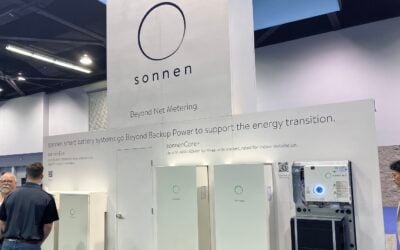
Sonnenbatterie was showcasing residential products starting from 4kWh and commercial offerings that go up to 200kWh at the trade show in Munich. The company has sold around 8,000 units in Germany, from a household market that according to some estimates, numbers around 20,000 units sold in total to date.
Try Premium for just $1
- Full premium access for the first month at only $1
- Converts to an annual rate after 30 days unless cancelled
- Cancel anytime during the trial period
Premium Benefits
- Expert industry analysis and interviews
- Digital access to PV Tech Power journal
- Exclusive event discounts
Or get the full Premium subscription right away
Or continue reading this article for free
The market dynamics for storage are rapidly changing, von Bormann said, with as many as nine in 10 commercial storage units in the US expected to be installed without being paired to solar. Sonnenbatterie and others will target specific time of use tariff markets there, allowing customers to peak shave and to do arbitrage to make savings on their electricity costs.
Another suprising development in the recent past has been Italy’s announcement of grid interconnection rules for energy storage. Von Bormann said Sonnenbatterie could see the market opening up in Italy and has opened 10 of its customer centres there. He also agreed that making storage simpler could reinvigorate the country’s solar market, which has dropped off significantly.
“Yes, and this is something we see even in Germany where solar has dropped,” von Bormann said.
“Some people have said to us they would have closed their solar shop but now a high percentage of solar systems are sold with storage. It’s a huge validation for us, but also great for the industry because it still drives the solar market. Storage is growing while the rest of the market is declining and that’s how we can kind of revitalise the market hopefully.”
Van Boorman said the energy storage industry is developing quickly, both in conjunction with solar and without. One catalyst for change has been Tesla’s entry into the market and while the two companies are likely to be pitted in competition with one another, Elon Musk’s big announcements had also helped companies like Sonnenbatterie, which do not produce their own battery cells.
“Let’s face it, batteries are going to be a commodity soon. Maybe they already are – especially when Tesla’s announcement put a price point on it, which is nice for us, we can call our battery suppliers and say ‘hey, sorry…but can you get us a better price?'”
“
Let’s face it, batteries are going to be a commodity soon. Maybe they already are – especially when Tesla’s announcement put a price point on it, which is nice for us, we can call our battery suppliers and say ‘hey, sorry…but can you get us a better price?’