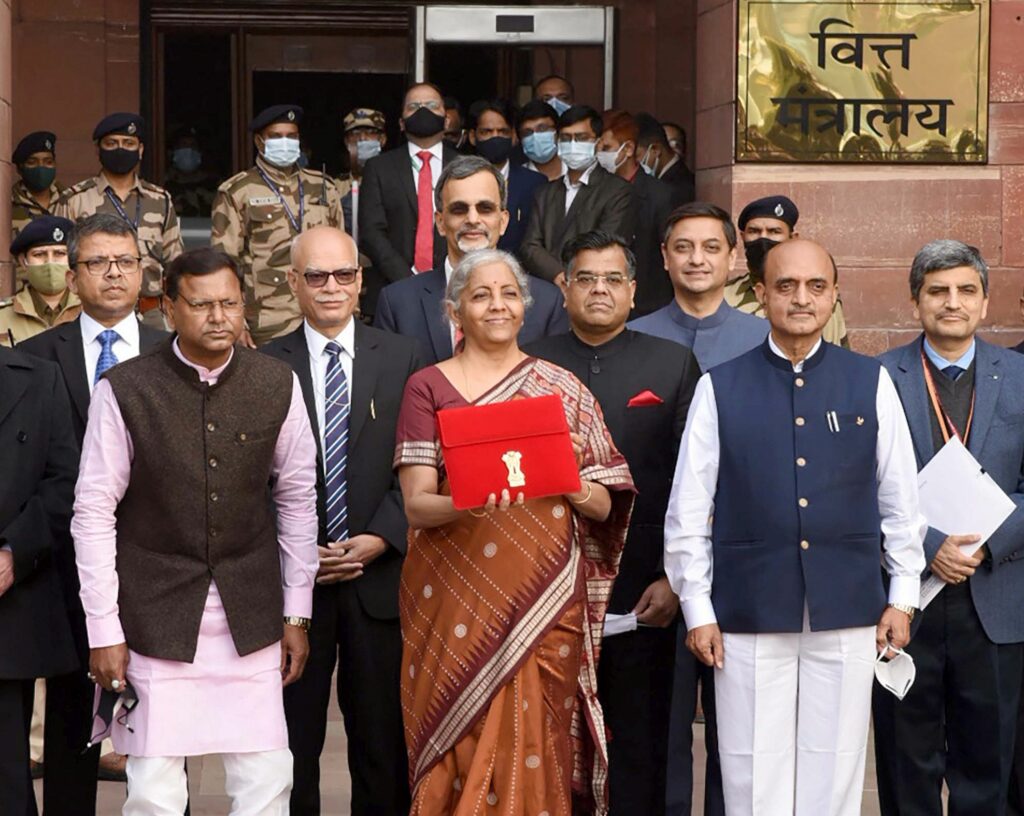
The government of India has committed to helping get 4,000MWh of battery storage projects built in its national budget and said it will come up with support mechanisms for pumped hydro.
Finance Minister Nirmala Sitharaman presented the Union Budget 2023-2024 today, with ‘Green Growth’ one of its seven main priorities, along with things like reform and support of the finance sector, inclusive development and ramping up “investments in infrastructure and productive capacity”.
Through that Green Growth priority agenda, IR350 billion (US$4.28 billion) will be provided for the Ministry of Petroleum and Natural Gas’ capital investments into energy transition and net zero agenda projects.
Sitharaman also reaffirmed India’s commitment to its National Green Hydrogen Mission, which follows on from a similar successful scheme for solar PV. IR197 billion (US$2.4 billion) will be invested in the hydrogen mission, with India targeting annual production of 5 million tonnes of green hydrogen by 2030.
Try Premium for just $1
- Full premium access for the first month at only $1
- Converts to an annual rate after 30 days unless cancelled
- Cancel anytime during the trial period
Premium Benefits
- Expert industry analysis and interviews
- Digital access to PV Tech Power journal
- Exclusive event discounts
Or get the full Premium subscription right away
Or continue reading this article for free
There will also be significant financial support for interstate transmission projects to transmit 13GW of renewable energy from the northeastern region of Ladakh and a so-called Green Credit Programme to incentivise “environmentally sustainable and responsive actions”.
The support measures for energy storage were mentioned within the Green Growth section of minister Sitharaman’s speech.
“To steer the economy on the sustainable development path, battery energy storage system (BESS) with capacity of 4,000MWh will be supported with Viability Gap Funding (VGF),” Sitharaman said.
The minister added the government will also formulate a “detailed framework” for pumped hydro energy storage (PHES), a technology making something of a comeback in India.
It marked the second successive year in which minister Sitharaman directly referenced the role energy storage would play in achieving India’s key energy policy aims in the national budget, which include reaching net zero by 2070, strengthening the grid and extending electrification to rural communities.
India Energy Storage Alliance (IESA) executive director Debi Prasad Dash welcomed the VGF, which would “help advance battery projects in India”.
However, as regular readers of this site might notice, IESA had made some recommendations that the Ministry of Finance could take up to help boost the stationary energy storage sector, as well as the green hydrogen and electric vehicle (EV) sectors.
Chief among these was the recommendation tax breaks could be applied to incentivise investment in energy storage. That appears not to have been adopted in the budget announced today, but there was a customs duty exemption for goods used to make lithium-ion batteries, which IESA executive director Debi Prasad Dash said would “further boost the sector and Production Linked Incentive (PLI) schemes”.
Energy-Storage.news’ publisher Solar Media will host the 1st Energy Storage Summit Asia, 11-12 July 2023 in Singapore. The event will help give clarity on this nascent, yet quickly growing market, bringing together a community of credible independent generators, policymakers, banks, funds, off-takers and technology providers. For more information, go to the website.