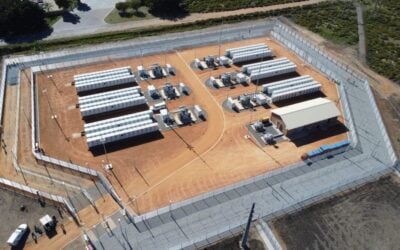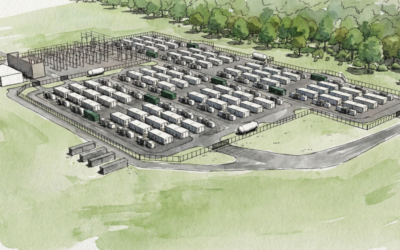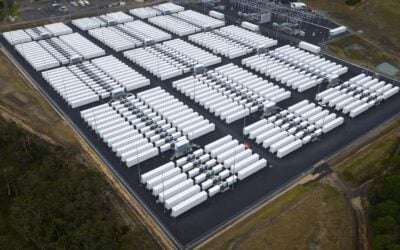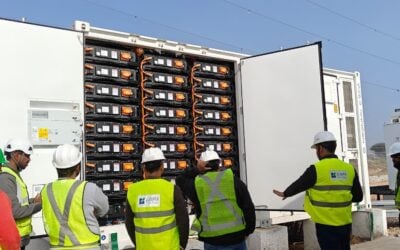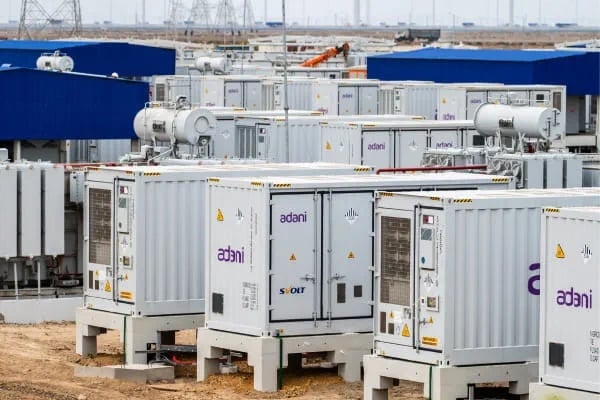
Adani Green Energy has now commissioned more than 3GWh of battery storage capacity at the world’s largest single-location renewable energy project, Khavda Renewable Energy Park in India.
The renewable energy development subsidiary of multinational conglomerate Adani Group announced yesterday (26 May) that its cumulative lithium-ion (Li-ion) battery energy storage system (BESS) installations at the 30GW mixed technology clean energy complex in Gujarat have reached 3.37GWh.
This includes 1.7GWh of BESS capacity brought into operation in March. The battery storage supports the Adani Green Energy-led development at Khavda. Although the company did not mention the megawatt output of the batteries, current market trends in India suggest it is likely to be 4-hour-duration storage.
The clean energy park already features 9.9GW of operational wind and solar PV generation capacity, with the company having begun operation of the site’s first 551MW of solar PV in early 2024. As reported by our colleagues at PV Tech in September of that year, Adani Green Energy signed a 5GW, 25-year power purchase agreement (PPA) for the park’s output with Maharashtra State Electricity Distribution Company (MSEDCL).
Try Premium for just $1
- Full premium access for the first month at only $1
- Converts to an annual rate after 30 days unless cancelled
- Cancel anytime during the trial period
Premium Benefits
- Expert industry analysis and interviews
- Digital access to PV Tech Power journal
- Exclusive event discounts
Or get the full Premium subscription right away
Or continue reading this article for free
Other developers are also contributing to Khavda’s generation capacity, including Indian state-owned power provider NTPC and its renewable energy arm NTPC Green.
The park is strategically located in an area of Gujarat, in western India, which is rich in both solar and wind potential, and all generation facilities are developed on contiguous land.
It connects to the central grid and an existing ‘green corridor’ for renewable energy transmission through high-capacity transmission lines, according to a 2024 Adani Green Energy presentation.
In reporting its fourth quarter and full-year results for the 2025-2026 financial year, the company said the addition of nearly 3GW at Khavda was among the main drivers of a 23% year-on-year increase in core EBITDA. As of that time, Adani Green Energy’s total operational portfolio was 19,294MW.
The company is targeting the deployment of more than 10GWh of battery storage in the 2027 financial year, and 50GWh over the following five years.
“As renewable energy capacity scales rapidly, storage infrastructure becomes critical for delivering reliable, round-the-clock clean power. With the commissioning of the 3.37GWh BESS at Khavda, AGEL is strengthening the foundation for resilient, dispatchable and flexible energy systems,” Adani Green Energy executive director Sagar Adani said.
“Our investments in battery storage reflect a long-term commitment to building future-ready clean energy infrastructure at global scale.”
The project makes a major contribution to India’s installed base of energy storage. The country is estimated by its Central Electricity Authority to require some 411.4GWh of energy storage by 2031-2032, including 236.2GWh of BESS and 175.2GWh of pumped hydro energy storage (PHES); as of the end of last year, only around 800MWh had been deployed.
However, as highlighted in a Guest Blog for Energy-Storage.news by India Energy Storage Alliance (IESA) president Debmalya Sen, at the beginning of 2026, a total of 60GWh of projects were in the execution phase, 80GWh under various stages of tendering and 35GWh awarded through tenders.
Energy Storage Summit India 2026 will take place 22-24 October at India Expo Mart, Greater Noida, India. Hosted by Energy-Storage.news publisher Solar Media, the event aims to unlock grid capacity and drive energy storage development in India. See the official event website for more details.