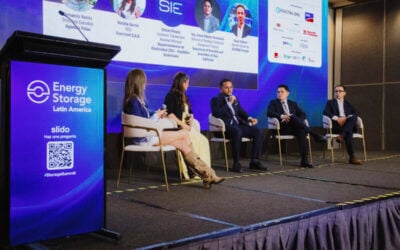
At a round table discussion around utilities in the Iberian BESS market at last week’s Battery & Energy Tech Expo in Barcelona, Spain, panellists highlighted some of the challenges in accelerating the deployment of battery energy storage systems (BESS) in the region.
Asked what the single largest obstacle to faster deployment of BESS in Iberia was, Roger Casals, CEO of high-power stationary energy storage manufacturer Wattium, said it was economic.
“In Europe, we have a problem. Every single operator, every single country, has its own ways of monetising grid services. In many cases, many grid services, especially those related to power, are not even monetised.
“People don’t provide those services that are essential to the grid stability. So unless we help monetise those services, we won’t get those.”
Try Premium for just $1
- Full premium access for the first month at only $1
- Converts to an annual rate after 30 days unless cancelled
- Cancel anytime during the trial period
Premium Benefits
- Expert industry analysis and interviews
- Digital access to PV Tech Power journal
- Exclusive event discounts
Or get the full Premium subscription right away
Or continue reading this article for free
Silvia Sanjoaquin Vives, director of transformation, technology and environment – renewable generation division at the Spanish utility Naturgy, added that there is a lack of market mechanisms to provide the necessary flexibility and ancillary services.
For Sanjoaquin Vives, having a “clear and concrete market framework that remunerates flexibility with different mechanisms” is the most important thing that the Iberian market needs to solve in the next five years in order to allow energy storage to be a key technology in the region’s grid.
Leonor Alves, head of energy storage at Portuguese utility Galp, also shared the same opinion, saying that the Iberian market needs to have “appropriate revenues to the flexibility that the batteries provide to the system, and not forgetting the capacity market that will give a long-term visibility in a revenue that will be quite important to deploy all the market.”
Accelerate permitting process for BESS
Alves added that another concern is the permitting process, which he said needs to be shortened to accelerate BESS deployment in the region and meet the country’s targets.
“These are taking more than three years to license the BESS that is co-located inside the same fence of a PV plant. This is to start the construction, then once the BESS is installed here in Spain, we still have more or less at least six months, so that we can get all the documentation and all the authorisations to inject into the grid,” explained Alves, adding that these longer timelines make it more difficult for investment decisions on projects, as it brings uncertainty.
“There was already a positive sign when the requirement of environmental assessment impact was removed for some co-located projects.
“We have gigawatts of projects that are under development here in Spain, but we need to unblock this investment, and we can only unblock this investment if we accelerate the permitting process,” added Alves.
BESS needed to meet data centre requirements
The panellists also covered the importance of BESS for data centres, and in particular, the recent proposal from the Spanish government to require data centres to meet at least 80% of their hourly generation from renewable energy.
It remains to be seen whether the royal decree will be modified from the initial proposal that was open to public consultation until earlier this month, but for Silvia Sanjoaquin Vives, without BESS, it would be impossible to meet the conditions proposed by the Spanish government.
Finally, when looking at the technologies that will be used for the deployment of energy storage, Alves said that Galp is agnostic when it comes to the choice of technology, but emphasised the importance of using proven, reliable and safe technologies.
“We are not going to select a technology that is not proven in terms of safety. And we know that even LFP batteries have safety issues, and we need to control those very well. So it’s not that we may select another technology, but we need to analyse several aspects between technical and safety.”
Jean Louis Cols, Vice-President of trade association Flow Batteries Europe, added that “the market is very dynamic, and the regulatory framework is stuck in the paradigm of the past.”
Due to the massive changes in how the energy system is operated, it is difficult for the regulator to follow its footsteps.
“I think the technologies are there, but what is lacking is sort of system thinking to harmonise those technologies and make sure that you know the grids are prepared to face the reality of the future, which is more electrification and more demand for data centres, as well as increasing renewables,” added Cols.
Connected to that aspect, Cols also mentioned the importance of the optimisation software. “We always talk about technology from a chemical point of view. All the chemistries are available, but there are other aspects that are mainly software in terms of control of those assets, and electronics in terms of having very powerful and effective electronics. When you’re talking about frequency response, for example, or fast response to grid load, it’s not the battery; it’s the power conversions, etc., that tie the bottleneck. So again, looking at the end-to-end solution is the way to solve the problem.”