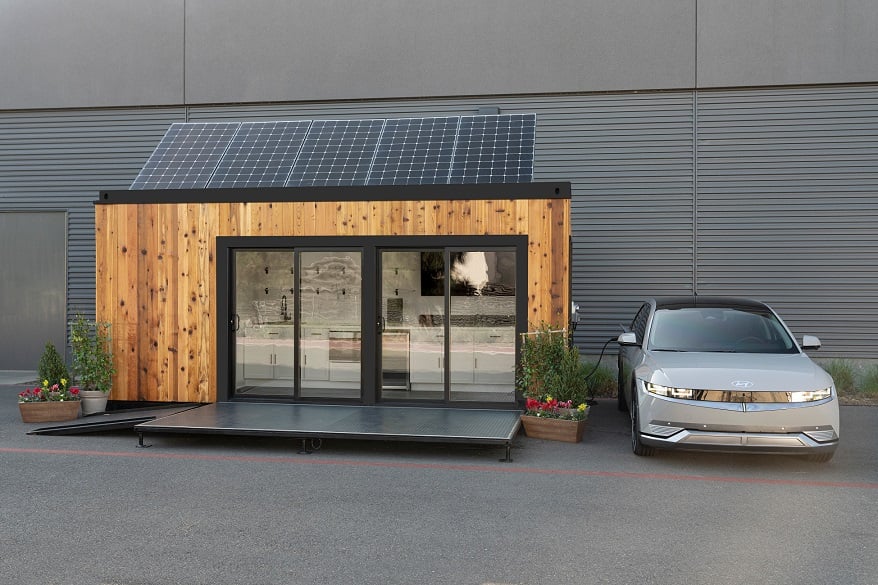
Automaker Hyundai has begun offering home electrification equipment to customers in the US, including EV charging solutions, battery energy storage and solar PV.
After showcasing the Hyundai Home product range as a ‘proof of concept’ at the Los Angeles Auto Show in 2021, ahead of this year’s edition which opened last week, the South Korean company announced availability of the range in 16 states across the country.
In partnership with home electrification company Electrum, Hyundai North America aims to offer a home electrification one-stop-shop, with customers able to buy solar, battery storage and mobility solutions together.
The pair’s new online marketplace will connect customers with local installers of the distributed energy resources (DERs) in their area.
Try Premium for just $1
- Full premium access for the first month at only $1
- Converts to an annual rate after 30 days unless cancelled
- Cancel anytime during the trial period
Premium Benefits
- Expert industry analysis and interviews
- Digital access to PV Tech Power journal
- Exclusive event discounts
Or get the full Premium subscription right away
Or continue reading this article for free
Called the Hyundai Home Marketplace, customers will get a dedicated energy advisor to talk through available options and purchases, including helping them determine the right system for their household’s needs.
As standard, three different installation bids will be offered for every order from a network of Electrum-affiliated electricians. Customers can then choose their preference from the three proposals they get.
The marketplace is equipped with an automated bidding platform that can assess what sort of incentives might be available to them from utilities or their local government, for example if net metering programmes are in place for solar PV, virtual power plant (VPP) programmes for batteries and so on.
Hyundai’s sideways move into the solar and storage market follows a more vertically integrated recent play by another major automaker.
General Motors (GM) last month launched a dedicated energy storage division, making residential and commercial and industrial (C&I) energy storage systems and energy management solutions which it is offering alongside its existing EV charger range.
GM is working with its preferred installer, SunPower, to also develop a home energy system comprising integrated EV and battery storage solutions as well as solar PV. That includes developing an auto range with vehicle-to-home (V2H) capabilities. GM has in recent months collaborated with two of California’s main investor-owned utilities (IOUs), Pacific Gas & Electric and San Diego Gas & Electric, to explore the potential of vehicle-to-home and vehicle-to-grid (V2G) technologies.
Similarly, Ford’s new all-electric version of its most popular truck, the F150, comes ready with V2H capability, in that instance developed in partnership with another of the US’ leading residential solar (and storage) companies, Sunrun.
In a recent interview with this site, Sunrun policy and market development senior director Chris Rauscher discussed a broad range of topics, including the tie-up with Ford and the roles V2H and vehicle-to-grid (V2G) technology could play in the US energy transition.