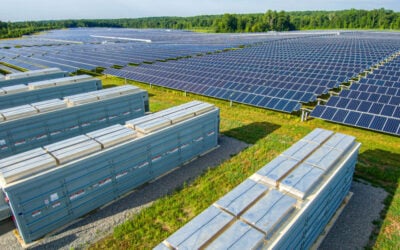
Utility-scale storage is still the bigger market, but behind-the-meter now takes an 80% share of total megawatt-hours deployed. Image: Southern California Edison / Scott Dreger.
Another period of growth in US energy storage was enjoyed in the first quarter of 2016, up by 127% year-over-year compared to the equivalent period in 2015, GTM Research has found.
In the first three months of the year, 18.3MW was deployed, compared to less than 8MW in Q1 2015. Behind-the-meter storage enjoyed the most growth, 142% compared to the first quarter of 2015.
The US could reach 2,081MW of annual deployments by the year 2021, the team led by GTM director of energy storage, Ravi Manghani, wrote. This >2GW annual market which GTM is predicting, following an expected period of growth across all segments, would also lean on a higher proportion of behind-the-meter installations than before. It would also by then be worth US$2.9 billion, six times more than last year’s market total. GTM had previously described 2015 as the year “energy storage took off” in the US.
Utility-scale still bigger overall but behind-the-meter is 80% of MWh
Try Premium for just $1
- Full premium access for the first month at only $1
- Converts to an annual rate after 30 days unless cancelled
- Cancel anytime during the trial period
Premium Benefits
- Expert industry analysis and interviews
- Digital access to PV Tech Power journal
- Exclusive event discounts
Or get the full Premium subscription right away
Or continue reading this article for free
In 2015, the majority of action in the US was seen in the form of large-scale storage playing into front-of-meter grid-balancing markets, some of which – as in the case of PJM Interconnection’s frequency regulation market – are competitively run. By 2021, however, the share of behind-the-meter storage could be almost half, 49%, of the total market. It was just 15% in 2015.
However, the utility-scale segment will still have the highest economic value, leaping from US$356 million last year to US$1.2 billion in 2021, compared to an expected value for the behind-the-meter segment of about US$1.6 billion.
Nonetheless, as front-of-meter projects tend to be built for short duration, high power applications such as frequency regulation where short bursts of electricity are used to balance the grid and behind-the-meter tends to be used for storing energy for longer periods of time for arbitrage or solar self-consumption, behind-the-meter storage nonetheless took an 80% share of storage deployed in Q1 2016 in megawatt-hours. A total of 21.2MWh of energy storage was deployed in total behind and in front of the meter, again a huge leap (142%) compared to Q1 last year.
Policy and market drivers and the slow first quarter
GTM’s report also focussed on moves to integrate storage more comprehensively into wholesale markets where applicable, led by national regulator FERC, which is conducting its own enquiry (AD 16-20) on the role of storage alongside generation. Energy Storage Association policy expert Jason Burwen recently told Energy-Storage.News that his group saw the launch of this “systematic review” as a positive step. GTM also looked at activities in independent system operator (ISO) run markets such as Texas’ ERCOT, which do not fall under FERC jurisdiction. Additionally, news of Total’s planned US$1.1 billion acquisition of European battery and storage system maker Saft is analysed.
The Monitor also looks at policy and market dynamics and drivers for activity across the US, both in front-of-meter and behind it, looking at recent actions in various states, from advanced markets such as Hawaii and California to those at the earlier stages, such as Iowa, which saw utility MidAmerican Energy file a Preliminary Implementation Plan and an investigation by Nevada’s Public Utilities’ Commission into the role of storage.
There is still a geographical concentration of activity in advanced markets – California and PJM alone, have since 2013 accounted for a 92% share of the total US market. GTM also observed that the first quarter of each calendar year tends to be very quiet compared to other quarters, and has been the case since the firm’s analysts began tracking the market in 2013. Another analyst, Mercom Capital CEO Raj Prabhu, also pointed out this seeming trend in a recent interview with Energy-Storage.News.
“The slow start to 2016 is not unusual, but also points to the shifting nature of US energy storage market. After the rush to build and commission systems in PJM to meet the interim cap in second half of 2015, this year is likely to see a move toward California as the leading market even for utility-scale segment,” Ravi Manghani of GTM said.
“This transition will undoubtedly be hastened by the gas shortage in Southern California caused by the Aliso Canyon gas leakage, and [the] resulting energy storage procurement.”
As with previous editions of the Energy Storage Monitor, the report has been prepared in collaboration with the US Energy Storage Association.