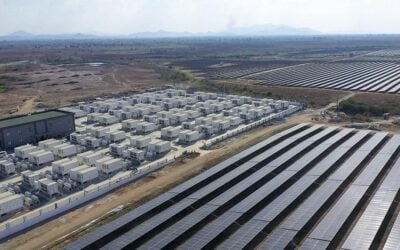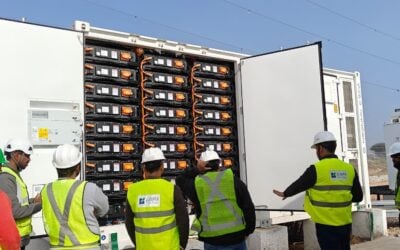
A step toward removing dual grid fees for energy storage units (ESUs) has been hailed as “great news for the Irish storage industry.”
In a Minded-To decision published by Ireland’s Commission for Regulation of Utilities (CRU) last week (15 April), grid fees will be levied on energy storage units as generators, paying only Generation Transmission Use of System (G-TUoS) charges.
This would, the CRU says, avoid distortions that arise from volumetric charging on ESUs, provide a level playing field between ESUs on the single electricity market (SEM) across Ireland and Northern Irelend, and between ESUs and other generation technologies providing the same services. It will also provide locational signals for ESUs.
Since 2020, battery energy storage systems (BESS) have operated under an arrangement introduced by the CRU as an interim decision that stated ESUs would pay just Demand Transmission Use of System (D-TUoS), not both generator and demand fees as had been previously required.
Try Premium for just $1
- Full premium access for the first month at only $1
- Converts to an annual rate after 30 days unless cancelled
- Cancel anytime during the trial period
Premium Benefits
- Expert industry analysis and interviews
- Digital access to PV Tech Power journal
- Exclusive event discounts
Or get the full Premium subscription right away
Or continue reading this article for free
However, the CRU now acknowledges that the decision “may not accurately reflect the costs imposed on the network by BESS and posed a potential barrier to entry”.
Indeed, in 2020 the CRU planned a full review of network tariffs as part of a wider Electricity Network Tariff Structure Review 2 (the ENTSR) but that was postponed in 2022 to divert CRU resources to managing the impact of the Russian invasion of Ukraine.
However, the CRU now acknowledges that the decision “may not accurately reflect the costs imposed on the network by BESS and posed a potential barrier to entry”.
Indeed, in 2020 the CRU planned a full review of network tariffs as part of a wider Electricity Network Tariff Structure Review 2 (the ENTSR) but that was postponed in 2022 to divert CRU resources to managing the impact of the Russian invasion of Ukraine.
Further, the CRU notes that since 2020 there has been greater investment in energy storage in Ireland and BESS’ role has changed “substantially” from providing system support to being able to participate in the wholesale market.
As such, the regulator is minded to implement a revised interim decision to specify that ESUs should pay G-TUoS, not D-TUoS.
While this will increase charges for remaining D-TUoS customers, it said, the importance of ESUs in delivering the “future energy system”, one based on renewables, means it is minded to implement the change all the same. The CRU estimated an increase in charges of 2%, with a knock-on increase in standard domestic energy bills of 0.2%.
The trade body representing the energy storage sector in Ireland, Energy Storage Ireland, called the CRU’s position “great news for the Irish storage industry”. It also notes that figures from Economic Consulting Associates (ECA), cited in the CRU’s decision notice, suggest the benefit of removing D-TUoS charges are a 30% increase in storage utilisation resulting in a net saving to customers of €37 million (US$43.48 million) per annum.
The Irish government is working toward an 80% Renewable Energy Source (RES) target for 2030, which the CRU said it continued investment in ESU capacity will be necessary to meet.
Last week, figures from the grid operator EirGrid showed that renewables met just under 49% of electricity demand in Ireland in March.
Elsewhere in Europe, Energy-Storage.news has heard that the proposed removal of an exemption on grid fees in Germany is making investors pull back from the market. Currently, energy storage systems commissioned up until 4 August 2029 are exempting from paying the fees, but Germany’s Bundesnetzagentur (BNetzA), the federal regulator, has suggested this could be lifted and even applied retrospectively to some assets.
The change was floated as part of a broader overhaul of grid fees in the country, and could still go in either direction. However, speaking with the site at the Energy Storage Summit 2026 in London, UK, Julian Jansen, managing director for Germany at Fluence said the uncertainty the BNetzA announcement created took the “wind out of the sails of the industry” at a time when the German market was otherwise “going through a very positive development” trend.
Additional reporting for Energy-Storage.news by Andy Colthorpe.