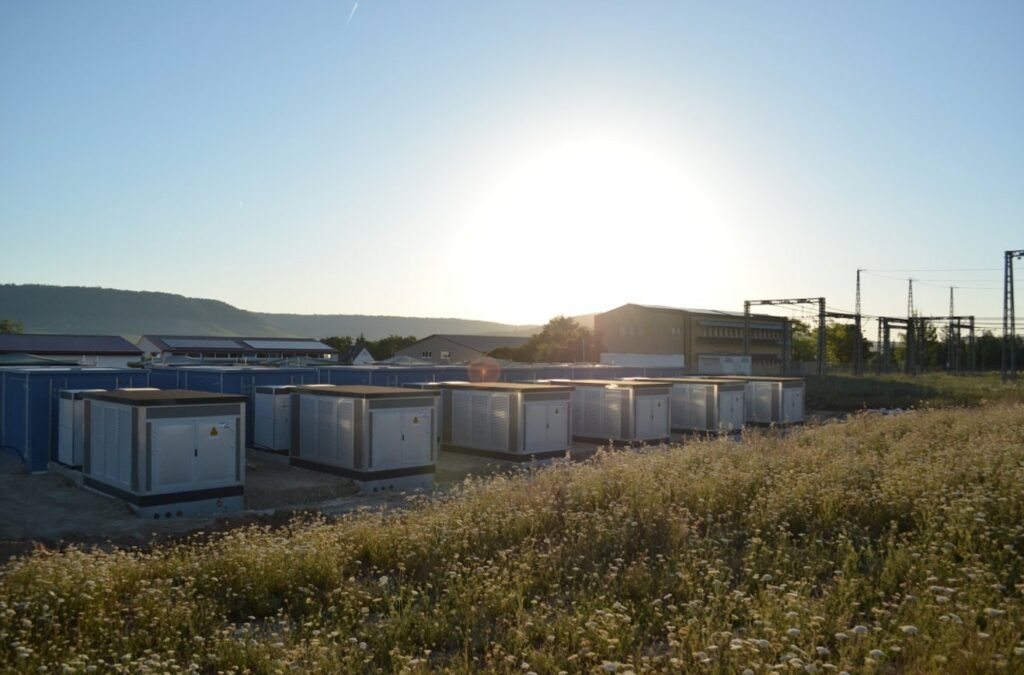
System integrator Eco Stor is planning to build a 300MW/600MWh battery energy storage system (BESS) in Saxony-Anhalt, Germany, one of the largest projects in Europe.
The project will be completed in 2025, managing director Georg Gallmetzer told German press last week, and will require an investment of around €250 million (US$280 million). Construction is set to begin next year at the site in Förderstedt.
The location was chosen thanks to the presence of an existing substation, which would allow the large grid connection required. It is within the service territory of transmission system operator (TSO) 50 Hertz, one of Germany’s four big TSOs along with TransnetBW, TenneT and Amprion.
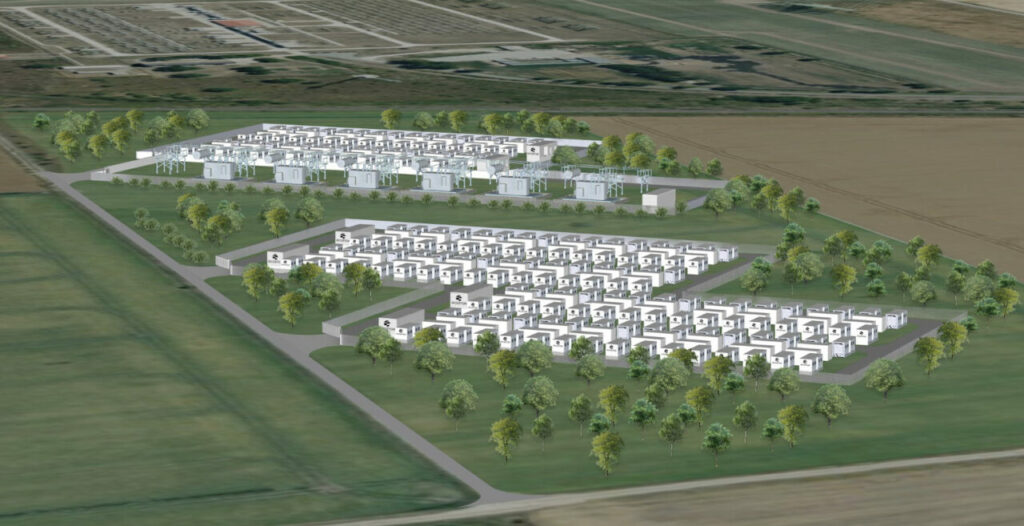
The project would comprise six of the company’ ECO STOR ES-50C block configurations, each with a 50MW/100MWh capacity. Each block has a 110kV substation, 16 containers for the inverters and transformers, and 32 containers for the lithium-ion batteries.
Try Premium for just $1
- Full premium access for the first month at only $1
- Converts to an annual rate after 30 days unless cancelled
- Cancel anytime during the trial period
Premium Benefits
- Expert industry analysis and interviews
- Digital access to PV Tech Power journal
- Exclusive event discounts
Or get the full Premium subscription right away
Or continue reading this article for free
A preliminary building permit application is in progress and a decision is expected in the coming weeks, Gallmetzer added. See a render of the project below.
Eco Stor operates out of Norway and Germany and counts Agder Energi Venture and Klaveness Marine Holdings as its main shareholders.
The company has recently deployed and commissioned projects in Germany for investment firm Obton as well as utility Verbund, with both projects developed at the early-stage by Kyon Energy.
This latest project will be larger than the current largest operational system, a 72MW one in Werne deployed and owned by energy firm RWE. RWE is building two which will both surpass it, totalling 80MW/84MWh and 140MW/151MWh, both in North Rhine-Westphalia, for 2024 commissioning.
The largest operational project in Europe by energy capacity is a 196MWh BESS commissioned by investor Harmony Energy in the UK, in late 2022.
Germany now has over 1GW of grid-scale BESS online according to Eco Stor’s figures. While its residential and commercial & industrial (C&I) segments have been very strong, grid-scale projects have only just started to pick up in the last year or two.