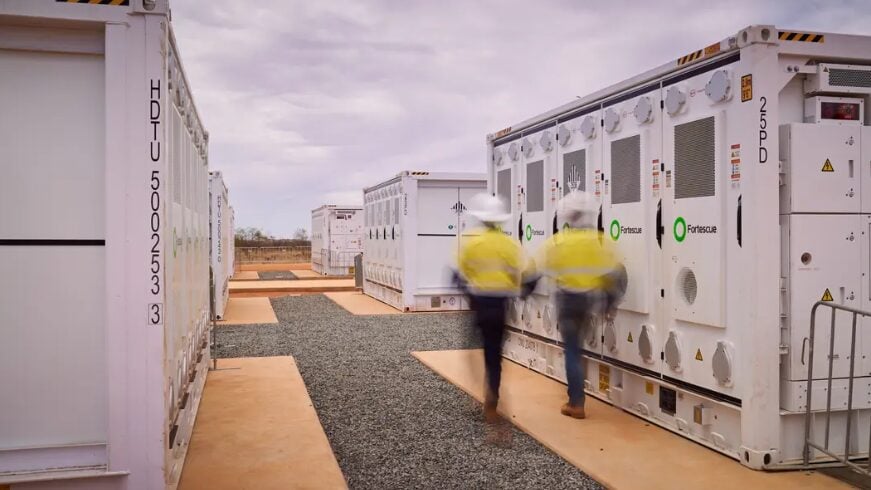
Australian mining giant Fortescue has accelerated its timeline for deploying 4-5GWh of battery energy storage systems (BESS) paired with 1.8GW of renewable energy generation, which it now expects to begin commercial operation by 2028.
The portfolio will consist of 1.2GW of solar PV capacity, alongside 600MW of wind, which Fortescue dubbed “the world’s largest off-grid system” for heavy industry.
The miner expects the first 290MW of solar capacity to be operational by early 2027 and a Fortescue spokesperson told our sister site PV Tech that it plans to use LONGi solar panels, BYD batteries and Envision Energy wind turbines across the portfolio.
Fortescue has already announced plans to deploy 4-5GWh of battery energy storage systems (BESS) in Western Australia, and these batteries will help deliver “24-hour periods”, where fossil fuels are not used to power mining equipment, across the operations by late 2027.
Try Premium for just $1
- Full premium access for the first month at only $1
- Converts to an annual rate after 30 days unless cancelled
- Cancel anytime during the trial period
Premium Benefits
- Expert industry analysis and interviews
- Digital access to PV Tech Power journal
- Exclusive event discounts
Or get the full Premium subscription right away
Or continue reading this article for free
The project accelerates the company’s ‘Real Zero’ decarbonisation plan, which initially aimed to reach zero emissions across its scope one and two emissions by 2030. In comments made on LinkedIn, Fortescue’s health and safety and R&D superintendent Daniel Hewitt said that the project would require US$6.2 billion in capex, but that it would “pay itself back in a few years” by slashing diesel-related opex costs by US$818 million per year from 2030.
The portfolio will be built in and designed to provide power for the company’s extensive mining operations in the Pilbara region of Western Australia. Earlier this year, the company started construction at a 440MW solar PV project in the region, which it claimed would be the largest such project in the state upon completion in 2028 and forms part of the renewables-plus-storage hub.
In December 2025 CEO Dino Otranto claimed the company had secured low “pricing that hasn’t really been seen” for its battery projects in the region.
Western Australia is home to some of the world’s deepest iron ore reserves, and these deposits have formed the bedrock of Fortescue’s work since its inception. The miner shipped a record 198.4 million tonnes of iron ore in the 12 months to June 2025, up from 191.6 million tonnes in the previous 12 months, and Fortescue said last July that it expects to grow iron ore export volumes by up to 3% in the next year.
On the same day as it announced its record mining exports, Fortescue cancelled two green hydrogen projects under development in the US state of Arizona, citing the Trump administration’s hostile attitude towards the energy transition. Following these cancellations, and the announcement of record iron ore sales, the value of the company’s shares increased by 4%.
This article first appeared on PV Tech.