
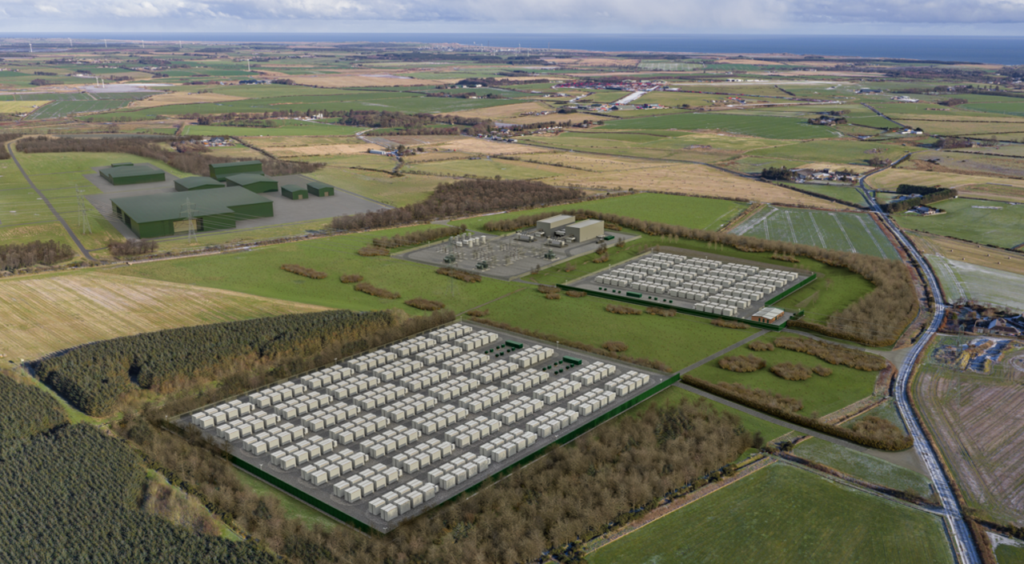
What led Field to submitting, and winning, 16- to 18-hour BESS projects in the UK’s long-duration energy storage (LDES) cap-and-floor scheme, and what are the next steps? We hear from the firm’s technical director.
The BESS owner-operator’s five winning projects total a combined 1.6GW/27.06GWh, ranging between 16- and 18-hours in duration. The full list of the LDES results was published in a ‘Minded To’ decision by regulator Ofgem at the end of June. A consultation on the decision ran until last week (7 August).
In this interview, Field’s Chris Wickins discusses how the company approached the scheme, why its projects were selected, their potential activity once online and how it is approaching procurement and construction.
Energy-Storage.news: Congratulations on the projects. When we last spoke, LDES was still in its early days, probably before lithium-ion was even included in the scheme. Can you talk me through the last few years and how Field has approached the scheme at its different stages?
Try Premium for just $1
- Full premium access for the first month at only $1
- Converts to an annual rate after 30 days unless cancelled
- Cancel anytime during the trial period
Premium Benefits
- Expert industry analysis and interviews
- Digital access to PV Tech Power journal
- Exclusive event discounts
Or get the full Premium subscription right away
Or continue reading this article for free
Chris Wickins: It’s a fantastic result for Field. Ofgem has run a landmark global scheme here, and reading the Minded To decision, you really get a sense of the amount of work they’ve done to identify the best long-duration projects the market had to offer. They attracted significant interest—177 projects reducing down to 77.
The process for Field started in 2022 or certainly 2023. We procured consultancy work asking: if you’re developing a project that will go operational toward 2030, what’s the right duration to build? At the time, final investment decisions were going through for one-hour or two-hour duration projects, but if your COD is 2028, 2029, or 2030, what duration should you be developing now?
The answer didn’t come out as 16-hour or 18-hour duration, but it did indicate that if you’re in certain locations—the north of Scotland, East Anglia, behind constraints—longer duration might be as good as shorter duration. Field responded by securing much larger land plots than we might have done otherwise, keeping our options open for either shorter or longer duration projects.
At the beginning of 2024, the scheme was really just designed for pumped hydro projects. We were vocal advocates, along with the Electricity Storage Network (ESN), for the long-duration scheme being genuinely technology agnostic. We responded to the consultation saying this should be a technology agnostic scheme with as much competition as possible.
At the end of 2024, the final decision was made to run a process where lithium-ion batteries would be included just as much as pumped hydro and any other technology. In January 2025, Field’s board signed off on committing to a portfolio of long-duration projects.
We spent most of 2025 working on it. If there was one thing I’m really pleased we did, it was seeking to understand what Ofgem were trying to procure—where was the value to them? We procured consultancy to understand how our projects could have the most benefits to society, and the answer was: go as long duration as you can. The longer the duration, the more benefits to society.
That guided us through 2025. We did a procurement exercise and challenged our supply chain: can you go longer, can you make the round-trip efficiency higher when you go longer, can you make degradation lower when you go longer? We ended up with five projects—three at 16-hour duration, two where the sites were large enough to go up to 18-hour duration.
Ofgem has really backed that. They’ve largely selected the longest duration projects in the scheme. They also made a decision about the amount of long-duration capacity they wanted and went to the top end of their range. If there are benefits to society that cost consumers nothing, why wouldn’t you do that?
The location point is also worth calling out. It’s very noticeable that many of these long-duration projects are being selected in the north of Scotland, where there are very large and growing constraint problems. We believe, and Ofgem seems to agree, that you have the biggest impact with these projects where you can store wind energy that would otherwise be curtailed. Our decision to develop sites there was made in 2023 and turned out to be a good one.
The majority of awarded capacity is in north Scotland. When did it become clear that Ofgem was prioritising the north of Scotland for capacity?
At the beginning of 2025, we asked a consultant to do a cost-benefit analysis like Ofgem would do, for different durations and different locations. We also analysed a pumped hydro project to understand our competitors. The answer came back: there are more benefits to consumers if you’re longer duration and if you’re behind constraints, storing wind energy that would otherwise be curtailed.
Our analysis said it would be good to be behind constraints, but we didn’t know at that point that Ofgem would agree. Our analysis indicated the right thing for consumers would be to put long-duration storage in the north of Scotland behind constraints, and that’s what they’ve selected.
What’s been the industry feedback to this list of projects?
Publicly there’s been a lot of positive engagement. Lots of people have been in touch—not least people wanting to sell equipment, legal advice, technical advice, owners, engineers, whatever. Many people have been pleased for us.
Inevitably, I’m sure there are people who think the results aren’t right, that Ofgem has made a mistake. The consultation process going on now is their opportunity to express their views and challenge the assumptions. There’s a long consultation document with lots of detail that people will be going through, and we’ll be responding.
These projects are so much bigger than anything else in the UK or any comparable market environment. What are the next steps, assuming everything goes ahead as planned?
We feel very confident these would be the longest duration batteries in the world. They’re very large developments.
Field is already in delivery mode. It’s an exciting time because we’ve been through a big period of growth. Alongside this LDES news, we just announced two final investment decisions (FID) on one gigawatt-hour of storage. That’s still a big FID in comparison to the market, but it now feels small compared to the 27 gigawatt-hours subject to these Minded To decisions.
It’s exciting to enter another period of growth. Field will need to recruit more developers, grid connection engineers, project engineers, and project managers.
We’re already in delivery mode following a programme to reach final investment decisions. There’s lots of work polishing projects up for FID: discharging planning conditions, procurement, agreeing contracts, and financing—these projects are project financed.
The most important thing I’m spending time on is grid connections. To properly design these projects, we need information from the transmission owners. We need that information to do our studies and tell contractors what we want to buy. We’re encouraging TOs to provide this as fast as possible.
There’s also reform of national pricing that rumbles on. Transmission network use of system charges—what that will look like in the future is uncertain. It’s fairly universally recognised that TNUoS doesn’t work as currently structured for storage. SSE has been making this point for years. We want to see rapid progress on reform of national pricing, especially TNUoS, before these projects reach FID, because it’s such an important part of operating costs, especially for longer duration projects in the north of Scotland.
Obviously they prioritised the north of Scotland because there’s a lot of wind power and curtailment will grow. But what exactly will these BESS be doing? What would a typical cycle pattern look like? What markets will they be playing in?
The reason they’re in the north of Scotland is because it’s forecast that there will be some level of constraints moving wind power north to south for all time. It wouldn’t be efficient to build so much network that there are never any constraints.
Our analysis says that by 2030, the average duration of a constraint—when there’s so much wind being generated that not all the power can be moved down the transmission network—will be about 16 hours. Our projects are 16 to 18 hours, which means they’re quite a good duration to absorb that excess wind energy, let the wind die down or demand increase, and then export that power so renewable electricity ends up in the grid rather than being thrown away.
The projects are also a security of supply asset. On cold winter days when the wind isn’t blowing, we expect these assets will run through the evening peak, just like a gas plant might at the moment, because of their duration.
From a trading perspective, to do both of those things you need to look at much longer time frames and be good at predicting the weather, specifically the wind. You want to make sure you’ve got plenty of capacity to charge before a constraint bites, and if you’re going through a winter peak, you want to be well charged up to discharge and help meet security of supply.
What’s the mechanism by which the BESS can charge from specific wind assets? Is it the balancing mechanism?
Right now, it’s largely the balancing mechanism. But we’re in an interesting position. We have quite a lot of wind and solar generation, and constraints are growing, but we haven’t yet got to the point where there’s so much wind and solar that when constraints are enforced, wholesale prices reduce to very low values.
If you fast forward to the future with much more wind and solar, there will be more correlation between when the wind is blowing, a constraint is enforced, and when the price is low. Once that happens, storage will choose to charge up in wholesale markets, not the balancing mechanism. Day-ahead, you’re increasing demand and resolving the constraint before it’s even happened because the price is zero or maybe even negative.
You don’t need to wait for the balancing mechanism to resolve a constraint. If not the day-ahead market, then maybe the intraday market, where you can see close to zero or negative prices.
Over time, we’ll see the value for assets in the north of Scotland move from the balancing mechanism to wholesale markets at day-ahead or intraday stage, and there will be fewer constraints to resolve using the balancing mechanism.
Let’s talk about how the cap and floor is going to work. Part of the cap and floor is determined by project cost – it must be hard to determine project costs for something this big that hasn’t been built in the UK before.
Field has run a really thorough procurement exercise. We shortlisted suppliers, and any one of them would be able to deliver our projects for the cost we submitted to Ofgem. Of course, things can change between when we submitted in November and when we go through FID, which might be two years later in late 2027. But we couldn’t have done a more robust tender exercise.
There’s a consultation just launched on licence conditions, and much of that will be around costs. There’s a post-construction review, the mechanism used in the cap and floor scheme for interconnectors. Developers have an obligation to scrutinize costs, minimize them, and act in the best interests of consumers. But Ofgem accepts that things happen during construction.
It’s quite sophisticated. Ofgem asked us to submit three prices: P10 (the lowest you could ever reasonably imagine), P50 (your best guess), and P90. We also have the number our suppliers told us when we went out to tender. Ofgem is saying costs must be within the P10 to P90 range. They expect them to be about P50, but they’ll listen if you can justify why costs aren’t P50—for lots of reasons like foreign exchange rates, lithium carbonate prices, or labour shortages.
The scheme is reasonably sophisticated compared with some government schemes that expect you to hold one price unrealistically for a long time. The benefit is you don’t have to put so much risk into the project—less risk on the developer, and therefore less risk passed on to consumers.
Is there much difference between a one gigawatt-hour project and a 17 gigawatt-hour project in terms of how you approach design and talking to suppliers?
In large part it’s similar. What I would say is through 2025, while taking part in this process, we worked really collaboratively with our supply chain to think of ideas that could make projects more competitive. From their perspective, we were asking some quite unusual questions, like: can you reduce the amount of cooling on this system because it’s much longer duration? The answer is yes, because the batteries are charging up slower, they generate less heat, and therefore need less cooling. That means your energy efficiency is higher (because less power is needed for cooling).
There’s some really quite sophisticated engineering that has already happened through taking part in the scheme by the suppliers. We need to continue working with them to make sure projects are optimised as much as they can be. There’s quite a lot the battery OEM can do to make it easier for the balance of plant contractor to connect equipment up. Efficiencies on even unloading a battery container from a crane onto a foundation and plugging it up—when you’re doing it as many times as we need to for these long-duration projects—are important. There’s still quite a lot that can be done, but at a high level, it’s quite a similar process.
Does a larger project see less degradation simply because each cycle is less hard?
Exactly. Lower cycling rates means less degradation. You’re also not running at such extreme temperatures. Both of those are sort of unexpected benefits. If you go to long duration, you expect to get a bit more revenue, but actually you get more than expected like-for-like because round-trip efficiency has gone up and degradation has gone down—your state of health is higher in year 25.
We were quite conscious of both when optimizing our projects. Without factoring those in, we probably wouldn’t have submitted projects that were 16 or 18-hour duration.
Grid is obviously a massive challenge, and Scotland has a different grid owner and operator than England and Wales. Is the challenge of build-out of grid a bit less difficult in Scotland?
You’re inviting a controversial answer. Field has worked with Scottish Hydro Electric Transmission (SHET), SSE’s transmission arm, for many years. A lot of renewable generation has been built in the north of Scotland. If you go up there, it’s very noticeable physically—the substations look new, there are wind farms recently built all over the place, operating offshore.
One advantage is they’ve already done a big grid upgrade. They’ve got another big one to do—there’s a lot of work for them—but they’ve already done a lot of infrastructure investment and have gotten increasingly good at delivering big substation projects.
They delivered, for example, the 400kV upgrade from Blackhillock to Peterhead. That was a very big project, probably four or five years of work, and it was essentially delivered on time. That gives us greater confidence when working with Scottish TOs.
National Grid Electricity Transmission (NGET, in England), by comparison, has a much more complicated, more meshed network to start with. A lot of it’s much older, so it’s harder to integrate. That might explain any perception that it’s harder to get connections in England—you’re dealing with an older grid that hasn’t gone through such a major upgrade already.
