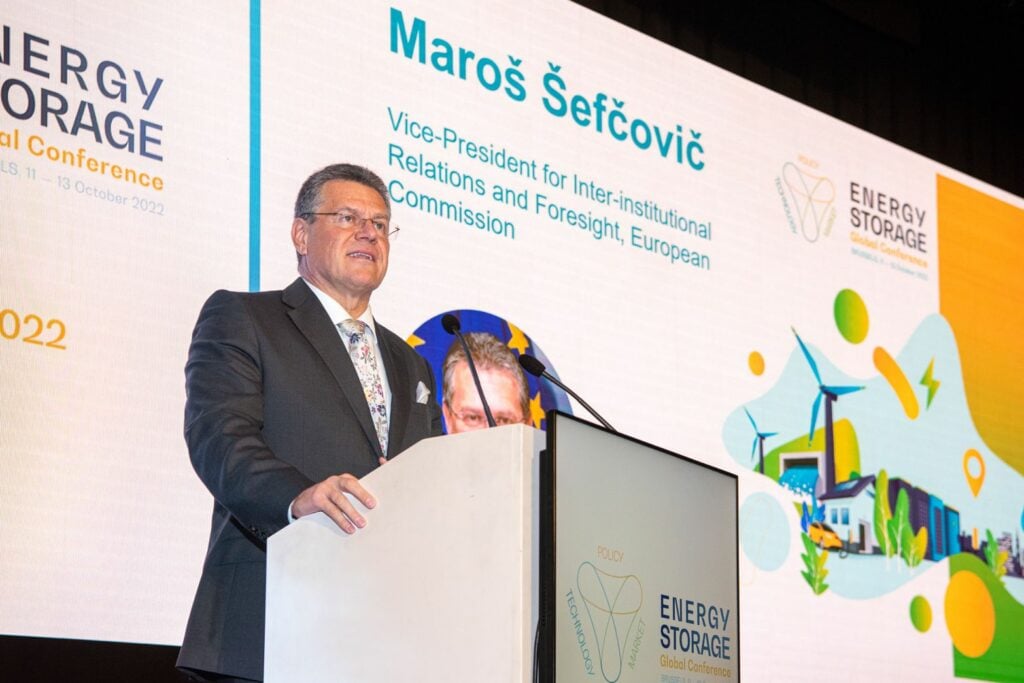
Energy storage must play a central role in enhancing Europe’s energy security, enabling integration of renewable energy and lowering power prices, according to European Commission (EC) Vice President Maroš Šefčovič.
Šefčovič gave a speech yesterday at the Energy Storage Global Conference in Brussels, an industry event hosted by European energy storage trade association EASE.
“Europe is facing challenging times. Russia’s unjustified war against Ukraine is driving up the price of energy, food and other basic commodities, and is triggering supply chain disruptions,” the Slovak diplomat’s speech began.
“It is causing instability, and risks spilling over into our economies as a whole and provoking social unrest.”
Try Premium for just $1
- Full premium access for the first month at only $1
- Converts to an annual rate after 30 days unless cancelled
- Cancel anytime during the trial period
Premium Benefits
- Expert industry analysis and interviews
- Digital access to PV Tech Power journal
- Exclusive event discounts
Or get the full Premium subscription right away
Or continue reading this article for free
Gas prices across Asia are half of those in Europe, and in the US the cost is around 10 times less, threatening the competitiveness of European business and endangering investment into the European Union (EU) Member States.
Where the European Commission will act to take strong action to counter these impacts, the VP called for a unified stance across the EU nations. The crisis presented an opportunity to modernise and decarbonise the economy, reinforce resilience and achieve “strategic autonomy” from outside actors like Russia, Šefčovič argued.
“Energy storage will play a key role in this effort. It will help facilitate the integration of renewables and the electrification of the economy, while increasing the flexibility and security of the energy system.
“Storages will be critical to reducing energy prices by pushing expensive gas power plants out of the market during peak price hours.”
Vice president Šefčovič highlighted that in the short-term the potential of batteries, and in the longer-term power-to-X technologies must be “exploited to make the most of the current global storage revolution”.
Growing recognition of downstream and upstream opportunities
REPowerEU, the union’s energy strategy put together in response to Russia’s invasion of Ukraine and the resulting systemic shocks to energy markets, is in many ways an exit strategy for dependence on Russian fossil fuel imports.
Regular readers of Energy-Storage.news will note that while energy storage was absent from a leaked early draft of the plan, later versions did include some mention of the importance of the technologies, albeit fairly briefly.
This had led to calls from the energy storage and adjacent industries as well as from clean energy advocates for more firm consideration of storage, including suggestions REPowerEU could include energy storage deployment targets.
Analysts at EASE had modelled a need for around 14GW a year of new storage deployments in Europe, to meet a forecasted 190GW requirement by 2030, and in stark contrast to just 1GW installed on the continent during 2021.
Most recently, an open letter from a group of CEOs of energy storage companies and European national trade associations reinforced the call for energy storage to be prioritised, a letter to which there are now more than 24 signatories.
In September, the secretary general of EASE, Patrick Clerens welcomed the focus of European Commission president Ursula von der Leyen on energy security in her annual State of the Union Address, in which von der Leyen likened the situation of today to the OPEC-driven fossil fuels crisis of the 1970s.
“We should have used that crisis as a catalyst to fully commit to green solutions, achieving energy security, low prices, and decarbonisation. We must learn from our past mistakes: stay the course on climate targets and deploy energy storage to replace fossil fuels imports,” Clerens said at the time.
“This crisis should be a wake-up call: the technology is there, but we need better market design and a comprehensive energy storage strategy.”
One industry expert, Corentin Baschet of consultancy Clean Horizon, had told Energy-Storage.news in September that it was likely EU policymakers were becoming attuned to understanding the strengths and weaknesses of the continent’s energy markets and were starting to respond to the role storage could play.
In yesterday’s speech, Maroš Šefčovič indicated that those voices had indeed been heard, referring to the EU’s Clean Energy Package and how it sets out rules for the regulatory treatment of energy storage, and how REPowerEU continues to evolve to create a level playing field for different technologies and ensuring “adequate economic signals” are sent.
Šefčovič is also a driving force behind the European Battery Alliance, which has put billions of Euros into supporting the European battery value chain, from raw materials supply to manufacturing and implementing sustainability rules and other safeguards.
The European Commission VP said at the EASE conference that as well as deployment, progress in the whole value chain is a key priority, not least because the EU’s dependence on imports from China continues to grow.
Innovation should also be a focus, Šefčovič said, with funding from the Horizon Europe innovation programme going towards developing and improving “not only of existing technologies, like lithium-ion based batteries, but also new kinds like sodium-ion, and organic flow batteries”.
Read Maroš Šefčovič’s full speech here.