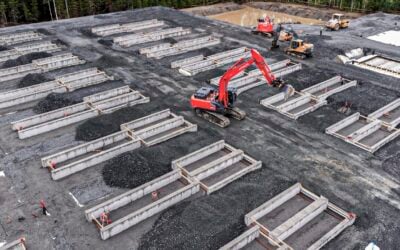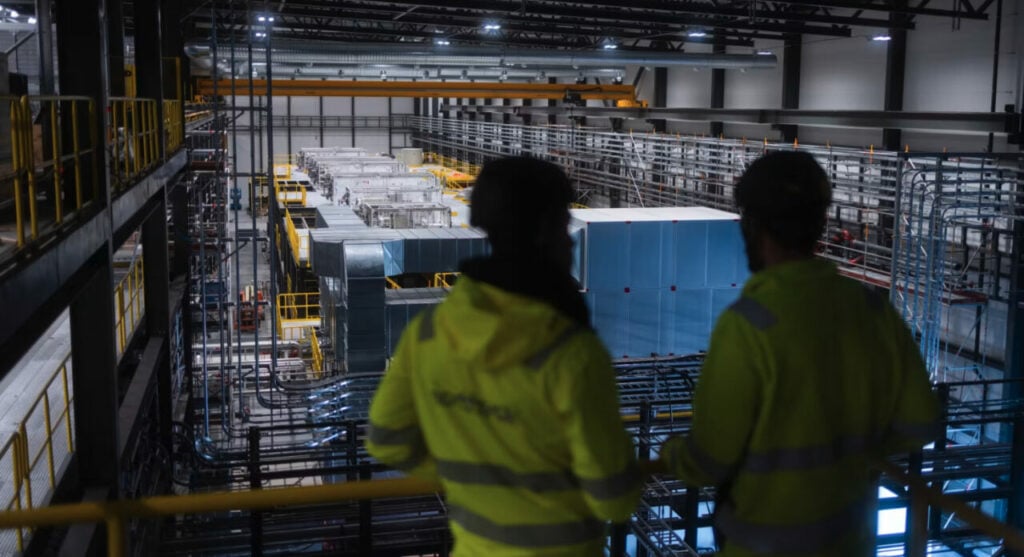
European lithium-ion battery developer and manufacturer Northvolt has secured a US$5 billion (€4.6 billion) non-recourse project financing package from various EU and Nordic institutions for its manufacturing and recycling plants.
The package includes a refinancing of a previous US$1.6 billion package secured last year, and will go towards expanding its cathode and cell production (Northvolt Ett) and recycling facilities (Revolt Ett) in northern Sweden.
The package has been provided by 23 commercial banks as well as the European Union’s European Investment Bank (EIB) and the Nordic Investment Bank (NIB), an international finance institution founded by the five Nordic countries.
Northvolt said a “significant portion” of the package is covered by a number guarantees combined with direct funding, provided by the Swedish National Debt Office, Euler Hermes, the Export-Import Bank of Korea (KEXIM), Nippon Export and Investment Insurance (NEXI) and the Korea Trade Insurance Corporation (K-Sure).
Try Premium for just $1
- Full premium access for the first month at only $1
- Converts to an annual rate after 30 days unless cancelled
- Cancel anytime during the trial period
Premium Benefits
- Expert industry analysis and interviews
- Digital access to PV Tech Power journal
- Exclusive event discounts
Or get the full Premium subscription right away
Or continue reading this article for free
The financing comes at a time when Europe’s nascent lithium-ion cell and material manufacturing sector looks increasingly under threat from the US market, after the introduction of generous tax credit incentives for clean energy manufacturing in the US. Under the 45X tax credit, US-based battery manufacturers are directly paid US$35/kWh of batteries produced, reducing the cost of producing batteries by about a third.
For example, Northvolt’s Norwegian peer Freyr has paused all further investment and development of its battery production facilities in Norway and Europe to focus entirely on the US, citing the tax credit incentives there. Tesla shelved plans to build battery cells at its gigafactory in Germany while other gigafactory companies elsewhere on the continent, like the UK’s Britishvolt, have collapsed.
In an interview with Energy-Storage.news to discuss its decision (Premium access), Freyr CEO Birger Steen said the company was seeking a package from the Norwegian government comprising export guarantees, loans and buybacks worth US$870 million (NOK9.5 billion) to resume European investments.
Commenting on Northvolt’s package, Northvolt CEO Peter Carlsson said: “This financing is a milestone for the European energy transition. It will enable us to realise the full potential of Northvolt Ett and demonstrates that circular, sustainable business practices are fundamental to success in today’s industry.”
Northvolt has secured offtake agreements with companies primarily from the electric vehicle (EV) market, which it says amount to US$55 billion of orders, and has also produced battery energy storage system (BESS) products from a factory in Poland (Northvolt Dwa) since last year.
In an interview at the Energy Storage Summit Central & Eastern Europe in September last year (Premium access), executives from the company told Energy-Storage.news that a ‘level playing field’ was needed in order for Europe to successfully compete with other markets on lithium-ion production.
Northvolt is also developing sodium-ion batteries in partnership with technology firm Altris, with the pair claiming a breakthrough in the chemistry’s energy density at the end of 2023.
The new package brings the company’s total equity and debt raised to-date to US$13 billion. Alongside its facilities in Sweden and Poland, the firm is also aiming to build production facilities in Germany (Northvolt Drei), the US (Northvolt Cuberg) and Canada (Northvolt Six).
Energy-Storage.news’ publisher Solar Media will host the 9th annual Energy Storage Summit EU in London, 20-21 February 2024. This year it is moving to a larger venue, bringing together Europe’s leading investors, policymakers, developers, utilities, energy buyers and service providers all in one place. Visit the official site for more info.